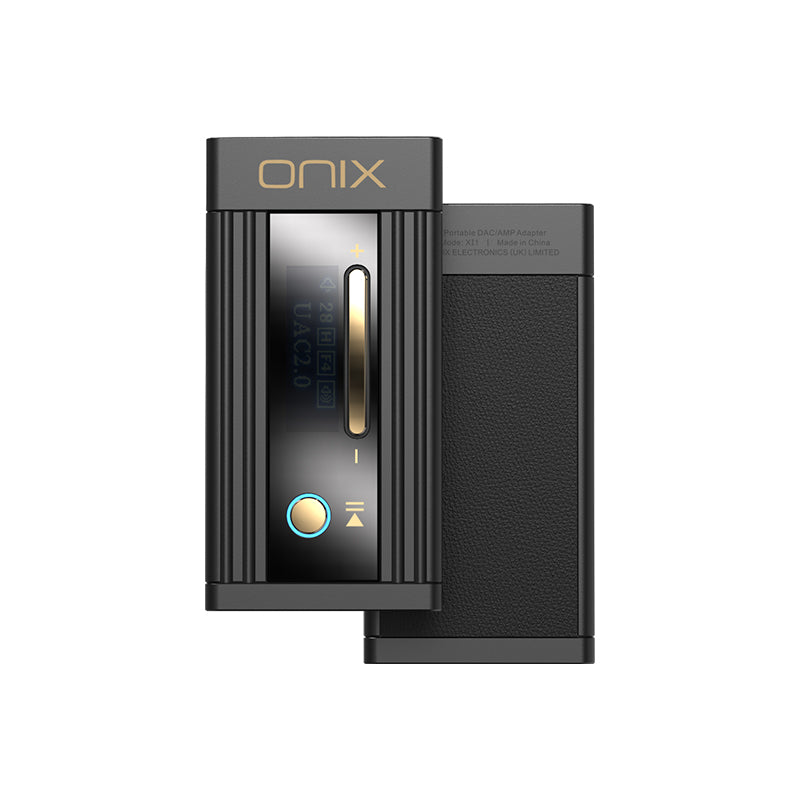
Onix is Shanling’s newer sub-brand for DAC/amp and player hardware, and the Alpha XI1 is one of its first portable dongle-style amplifiers, sold as the Onix XI1 in most listings. It sits in a slightly different niche than Shanling’s own UA-series dongles: bigger, with more amplification power, and priced accordingly. I tested it as a desk companion for a laptop and as a phone dongle over a couple of weeks.
| Spec | Detail |
|---|---|
| Brand | Shanling (Onix sub-brand) |
| Model | Onix Alpha XI1 (Onix XI1) |
| DAC Chips | Dual Cirrus Logic CS43198 |
| Amp Chips | Dual SGM8262 |
| Max Resolution | 32-bit/768kHz PCM, native DSD256 |
| Balanced Output (4.4mm) | ≈500mW at 32Ω |
| Single-Ended Output (3.5mm) | ≈180mW |
| Connector | USB-C |
What Is Inside the Onix XI1
The XI1 uses dual Cirrus Logic CS43198 DAC chips paired with dual SGM8262 amplifier chips, supporting up to 32-bit/768kHz PCM and native DSD256. Output tops out around 500mW at 32 ohms on the balanced 4.4mm jack, with 180mW available from the 3.5mm single-ended output. That balanced figure is genuinely strong for a portable dongle-format device, enough to properly drive a number of planar IEMs and lighter full-size headphones that would leave a typical phone-powered dongle sounding thin.
Setting It Up
- Connect the XI1 to your phone, laptop, or tablet using the included USB-C cable, matching the connector to your source device.
- Give it a few seconds to initialize; the small onboard screen will show the sample rate and format of whatever is playing.
- On Windows, install any driver Shanling provides on its support page if the device is not recognized automatically, though most modern systems detect it as a standard USB audio class device.
- Use the physical buttons or the RGB sample rate indicator to confirm you are getting the resolution you expect from your source app.
- Adjust gain if your headphones are either too quiet at low volume or too sensitive to background hiss at higher gain settings.
Power Management Worth Knowing About
One detail Shanling specifically engineered into the XI1 is reduced power draw from the host device, with Shanling claiming up to 30 percent less power pulled at high loads compared to competing DAC/amps, and around 80 percent lower standby draw. In practical terms, that means less noticeable battery drain on a phone during long listening sessions, which is a real complaint with a lot of dongle DACs that pull heavily from the host.
Sound Impressions
Sound-wise, the XI1 comes across as clean and controlled with good bass authority, which tracks with the extra amplification headroom compared to a smaller dongle. Detail retrieval is solid without being aggressively analytical, and there is enough power in reserve that even headphones that usually sound a bit flat off a phone’s headphone jack opened up noticeably through the XI1.
- Strong bass control thanks to the higher power output
- Balanced 4.4mm output is the one to use if your IEMs support it
- Small built-in screen and RGB indicator make format checking easy at a glance
- Noticeably less battery drain on the host phone than some rival dongles
Who This Makes Sense For
If you have been using a basic phone dongle and found it underpowered for your headphones, the XI1 is a reasonable step up without committing to a full desktop stack. It is priced above Shanling’s own entry-level UA4, and that extra cost buys you meaningfully more output power and a sturdier build. You can compare current pricing and availability directly on HiFiGo’s product page before deciding.
Comparing It to a Desktop Setup
I also spent an evening running the XI1 side by side with a small desktop amp I keep for reference, both feeding the same pair of headphones from the same laptop source. The desktop unit still had an edge in absolute headroom and a slightly blacker background at high volume, which is expected given its size and dedicated power supply. But the gap was smaller than I anticipated for something the size of a large USB stick, and for anyone who does not have room or budget for a separate desktop stack, the XI1 closes most of that distance while staying fully portable.
The practical upshot is that the XI1 works well as a genuine one-device solution if you split time between a desk and being out with just a phone, rather than needing separate portable and desktop amps for different scenarios.
Fixing Common Problems With the XI1
- Device not recognized by a Windows laptop: install the driver from Shanling’s support page, or try a different USB-C cable first, since some cables are charge-only and carry no data.
- No sound, or sound from only one side: reseat the USB-C connector at both ends and confirm the cable itself is a full data cable, not a charging-only one.
- Touch volume slider feels unresponsive: wipe the panel clean of any moisture or oil, then restart the device; a firmware update through Shanling’s app can also resolve intermittent touch issues.
- Onboard screen shows the wrong sample rate: confirm your playback app is set to exclusive or bit-perfect output mode rather than letting the OS resample audio before it reaches the XI1.
- Noticeable hiss with sensitive IEMs: use the 3.5mm single-ended output instead of the higher-power balanced 4.4mm jack, since the extra headroom isn’t needed with very sensitive earphones.
- Included case feels bulky in a pocket: it’s designed for scuff protection rather than everyday carry – leave it off at home and use it mainly while traveling.
Frequently Asked Questions
Does the XI1 include a hardware volume control?
Volume is controlled through a touch-sensitive slider on the front panel rather than a physical wheel, which works well once you get used to it but takes a short adjustment period compared to a click-based wheel.
Is the Onix XI1 made by Shanling directly?
Onix is a sub-brand associated with Shanling’s product family, and the XI1 is sold and marketed as an Onix-branded product alongside Shanling’s own UA and Onix Overture lines.
Does the XI1 work with iPhones?
It works over USB-C to Lightning or USB-C to USB-C depending on your phone and cable, since it functions as a standard USB audio class device on most modern operating systems including iOS.
How does the XI1 compare to Shanling’s own UA5?
The XI1 offers more raw output power thanks to its dual amplifier chip setup, while the UA5 is smaller and includes a hardware volume wheel. Which is better depends on whether you prioritize driving power or portability and physical volume control.
Case and Portability
Shanling includes a basic leather-style case with the XI1, which adds a small amount of grip and protects the finish from the everyday scuffs a metal-bodied dongle otherwise picks up quickly in a bag. It does add a bit of bulk, so if absolute pocketability is your top priority, you may prefer to leave it off at home and use it only when the device is traveling loose in a bag rather than clipped to a phone. Either way, the connector and cable management stayed tidy in daily use, without the loose dangling cable feel that some clip-style dongles have.
Conclusion
The Shanling Onix XI1 earns its higher price with real output power and a power-efficient design that is kinder to your phone’s battery than a lot of the competition. If your current dongle DAC feels underpowered for the headphones you actually own, this is a sensible upgrade path before jumping to a full desktop setup.
Tested over two weeks alternating between phone and laptop use with a mix of IEMs and lightweight planar headphones. I have a computer science background and cover portable audio equipment regularly.