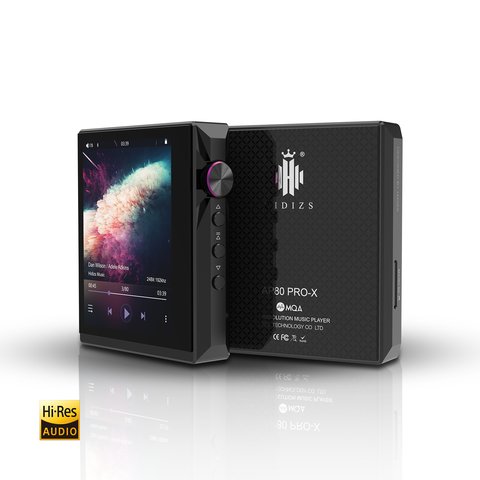
Hidizs’ AP80 line has grown into a small family of its own, and the naming can get confusing fast. The AP80 Pro-X and the newer AP80 Pro Max are both compact, all-in-one players aimed at the same general audience, but they are not the same device wearing a different sticker. Here is what actually separates them, and which one makes more sense depending on what you already own.
Spec Comparison
| Spec | Hidizs AP80 Pro-X | Hidizs AP80 Pro Max |
|---|---|---|
| Dimensions | 61.2 x 54.5 x 13.8mm | 82.8 x 51 x 15.5mm |
| Display | 2.45-inch touchscreen | 2.95-inch (360×640) HD touchscreen |
| DAC configuration | Dual ESS ES9219C DAC chips | Dual ESS ES9219C DAC chips (revised implementation) |
| Dynamic range | Not separately headline-rated | Up to ±122dB DNR |
| THD+N | Not separately headline-rated | As low as 0.0005% |
| Balanced output power | ~190mW+190mW at 32 ohms | Up to ~190mW balanced output |
| Outputs | 3.5mm single-ended, 4.4mm balanced | 3.5mm single-ended, 4.4mm Pentaconn balanced |
| MQA support | Yes, full unfolding | Yes |
| Build material | Aluminium chassis | Aluminium alloy with dual-sided glass |
| Special editions | Limited Red Copper edition | Copper Edition, limited to 999 units |
The Real Difference: Size and Screen, Not Just the DAC
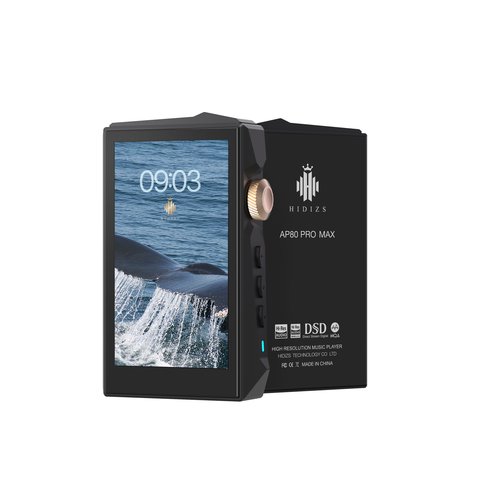
It is tempting to assume “Pro Max” simply means a more powerful chip inside an identical body, the way that phrase gets used elsewhere in consumer electronics. That is not quite what is happening here. Both players use the same ES9219C DAC family, so the core decoding hardware is closely related. The bigger, more tangible upgrade in the Pro Max is physical: a noticeably larger 2.95-inch HD touchscreen versus the Pro-X’s 2.45-inch panel, and a case dimension that trades some of the Pro-X’s pocketability for a display that is genuinely easier to navigate and read text on.
Hidizs also quotes tighter dynamic range and distortion figures for the Pro Max, at up to ±122dB DNR and 0.0005% THD+N, suggesting a refined analog output stage rather than a wholesale change to the DAC chips themselves. In practice, that shows up as a slightly cleaner background and marginally more resolved top end rather than a dramatic sonic leap.
How to Choose Between Them
- Prioritize pocketability if you carry it daily. The Pro-X’s smaller footprint genuinely disappears into a pocket in a way the larger Pro Max does not.
- Prioritize the Pro Max if screen size and legibility matter to you. Browsing a large FLAC library or reading album art details is noticeably easier on the bigger panel.
- Consider the Pentaconn 4.4mm connector on the Pro Max if your existing balanced cables use that specific plug standard rather than a generic 4.4mm jack.
- Factor in price versus the marginal sonic gain. The dynamic range and distortion improvements on the Pro Max are real on paper, but the audible difference for most listeners is subtle rather than transformative.
Color and Edition Options
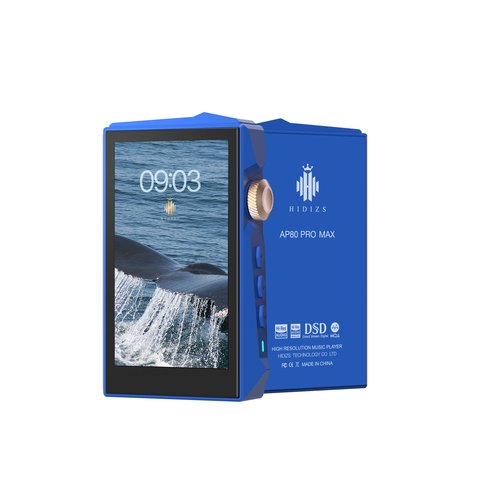
Both players are offered in multiple standard colorways, and both have limited special editions aimed at collectors: the Pro-X has a Red Copper limited run, while the Pro Max offers its own Copper Edition capped at 999 units, priced noticeably above the standard aluminum finish. Neither special edition changes the core internals meaningfully; the premium is mostly about materials and exclusivity rather than a different sound signature.
Software and Firmware Parity
Both players run on similar underlying firmware and menu structures, so if you have already used one Hidizs AP80 model, the other will feel immediately familiar rather than requiring you to relearn a new interface. Firmware updates for both are distributed through the same Hidizs download center, and update frequency has been comparable across the two models since the Pro Max’s release, with neither one receiving noticeably better long-term software support than the other so far.
This matters more than it might seem, because a common frustration with budget and midrange DAPs generally is abandoned firmware a year or two after launch. Since both models share so much of their software foundation, fixes and improvements developed for one often carry over conceptually to the other, even if the actual firmware files remain model-specific and are not interchangeable.
A Practical Side-by-Side Test
I spent an afternoon swapping between both players using the same pair of IEMs and the same handful of test tracks, alternating every few songs to keep my impressions fresh. The size difference is the first thing you notice physically, not the sound. Once actually listening, the Pro Max’s larger screen made browsing a big FLAC library noticeably less fiddly, while the smaller Pro-X disappeared into a jacket pocket in a way the Pro Max simply could not. Sonically, both stayed close enough that I would not confidently pick one out in a blind test with the same IEMs, which reinforces that this is more of a form-factor and refinement decision than a night-and-day sound quality choice.
Fixing Common AP80 Setup Problems
- Problem: The player isn’t recognized when connected to a computer. Switch the USB mode in the settings menu from charging-only to data transfer, since both models default to a charge-only USB profile out of the box.
- Problem: Balanced 4.4mm output sounds noticeably quieter than expected. Confirm the cable is genuinely wired for balanced output rather than a single-ended cable with a 4.4mm plug adapter, which will not deliver the expected power gain.
- Problem: MQA files play but don’t show the MQA indicator. Check that the file itself is a genuine MQA-encoded stream rather than a standard FLAC, and confirm MQA decoding is enabled in the player’s audio settings.
- Problem: The touchscreen becomes unresponsive after a firmware update. Perform a full power-off restart rather than just locking the screen, and if that doesn’t resolve it, reflash the latest firmware from Hidizs’s support page.
- Problem: Album art or metadata doesn’t display for some tracks. Rebuild the music library index from the settings menu, since a partial scan during a prior sync can leave some files without cached metadata.
Frequently Asked Questions
Is the AP80 Pro Max just a bigger version of the Pro-X?
Mostly in terms of screen size and body dimensions, yes. The DAC family is closely related between the two, with the Pro Max getting refined dynamic range and distortion figures rather than a completely different chipset.
Which one is more pocketable?
The Pro-X, thanks to its smaller 61.2 x 54.5 x 13.8mm footprint compared to the Pro Max’s larger 82.8 x 51 x 15.5mm body.
Do both support MQA?
Yes, both players include MQA decoding support.
Is the balanced output connector the same on both?
Both use a 4.4mm balanced jack, though the Pro Max specifically uses the Pentaconn 4.4mm standard, which is worth double-checking against your existing balanced cables.
Bottom Line
Neither player makes the other obsolete. The Pro-X remains the more pocketable, still very capable option, while the Pro Max trades a bit of size for a larger screen and a slightly more refined analog output stage. Pick based on how you actually carry and use a DAP day to day rather than assuming the newer name automatically means a better-sounding player.
Ryan holds a computer science degree and has spent years testing DAPs, dongles, and IEMs against real listening sessions rather than spec sheets alone, writing for softwaredriverdownload.com.