The HiBy FC5 name has been used for two genuinely different pieces of hardware, and mixing them up is an easy mistake to make when reading older reviews alongside newer ones. This is a timeline of what the FC5 has been, not a single-product review, because the two revisions use different DAC chips, different amp chips, and in the newer case, a completely different physical feature set.
| Quick Fact | Detail |
|---|---|
| Brand | HiBy |
| Model | FC5 (two hardware revisions) |
| Original DAC | ES9281PRO, dual ES9603Q amp chips |
| Newer DAC | Dual CS43198, dual SGM8261-5 amp chips |
| Outputs | 3.5mm single-ended, 4.4mm balanced |
| Distinguishing feature | Newer revision adds a 1.1-inch colour display |
Timeline: how the FC5 has evolved
Original HiBy FC5
The FC5 launched as a balanced portable dongle DAC built around an ES9281PRO DAC chip, paired with a dual ES9603Q amplifier configuration. At $159, it sat above HiBy’s simpler dongles and offered a spec sheet aimed at people who wanted MQA decoding and DSD playback in a pocketable form factor.
At the time it launched, that combination of a flagship-tier ESS DAC chip and a dedicated dual-amp stage was relatively uncommon in a dongle this size, and it is part of why the original FC5 built a following among people upgrading from single-chip entry dongles. The metal shell and the inline USB-C connector also made it feel closer to a small standalone amp than a throwaway adapter, which mattered for a product asking a real price rather than pocket change.
- ES9281PRO DAC chip
- Dual ES9603Q amp chips
- PCM up to 32-bit/384kHz
- DSD128 via DoP
- MQA 8X decoding
- SNR of -114dB
- 125mW + 125mW at 32 ohms
- 4.4mm balanced output plus 3.5mm single-ended, USB-C input
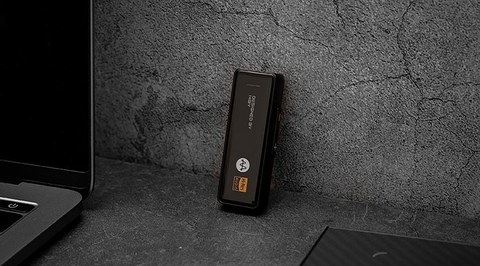
Reviewers at Headfonics generally praised the original FC5 for a clean, low-noise-floor signature and a shell that looked more expensive than its price. That review remains a good reference point for anyone shopping the original hardware secondhand, since it is no longer the current model in HiBy’s lineup.
FC5 with Display (newer variant)
The newer FC5 revision, often listed as “FC5 with Display,” keeps the FC5 name but changes almost everything under the hood. It swaps to dual CS43198 DAC chips and dual SGM8261-5 amp chips, and adds a 1.1-inch colour screen that shows the active sample rate, format, and volume level at a glance — something the original FC5 could not do at all, since it had no display.
- Dual CS43198 DAC chips
- Dual SGM8261-5 amp chips
- 1.1-inch colour display
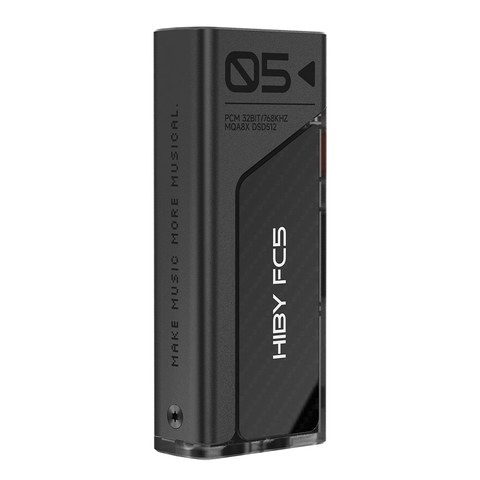
- “Cyborg-inspired” industrial design with a carbon-effect panel
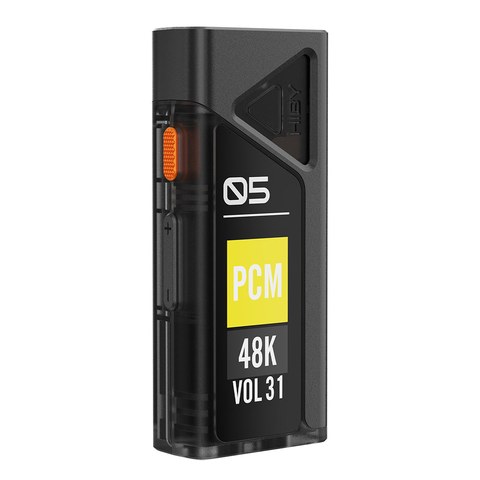
The addition of a display is not a small change for a dongle this size. Being able to glance at the sample rate and volume without pulling up a phone app is genuinely useful, particularly for confirming that a streaming app or OS is actually passing bit-perfect audio through rather than silently resampling it.
The “cyborg-inspired” design language is a departure from the plainer aluminium bar look of the original, and it is clearly meant to signal that this is a distinct generation of product rather than a running change to the same unit. The carbon-effect panel and exposed screw detailing give it a more industrial look on the shelf, for whatever that is worth to a buyer who mostly cares about how it sounds.
Sound signature across both revisions
Despite the very different internals, reviews of both versions converge on a similar description: clean, neutral, well-resolved, and a low noise floor. That consistency suggests HiBy has been tuning toward the same house sound across hardware generations rather than chasing a completely different signature with each revision. Outlets that have covered one or both units include Headfonics, Head-Fi, Audio Science Review, Audiophile-Heaven, The HiFi Cat, and Androidbrick.
Where the two units are likely to differ in practice is less about tonal balance and more about output behaviour and usability. The dual ES9603Q amp stage in the original and the dual SGM8261-5 stage in the newer unit are different amp topologies, and small differences in channel separation or how each handles very sensitive IEMs would not be surprising, even if neither review set flags a dramatic difference.
Which one should you actually buy?
If you are shopping new, the FC5 with Display is very likely what a retailer will ship you under the FC5 name today, and the added screen is a genuine usability upgrade over the original for very little extra bulk. If you are buying secondhand or comparing against an old review, it is worth explicitly confirming which hardware revision is actually being described, since a review of the original ES9281PRO-based unit does not necessarily apply to the CS43198-based version, and vice versa.
It is also worth checking the included accessories rather than assuming they match across revisions. Cable types, adapter tips, and the carrying pouch have all been known to change between hardware generations even under the same product name, so a secondhand unit missing its original box is not necessarily missing parts — it may simply have shipped with a different accessory set than a newer listing shows.
- Check the listing photos for a display window — its presence means you are looking at the newer revision
- Cross-reference the DAC chip mentioned in the listing or manual against the two chip families above
- If buying used with no clear spec sheet, ask the seller directly which version it is before paying
Troubleshooting Common FC5 Issues
- Problem: The FC5 isn’t detected by a phone or laptop. Confirm your USB-C cable supports data transfer rather than charging only, and check that your device’s OS permissions allow USB audio accessories.
- Problem: No sound from the balanced 4.4mm output on the newer display model. Confirm the display is actually showing balanced mode active, since some players default to single-ended output even with a balanced cable connected.
- Problem: The display freezes or shows an incorrect sample rate on the newer revision. Unplug and reconnect the USB-C cable to force a fresh handshake with the source device, since a stale connection can leave the display showing stale format data.
- Problem: DSD files won’t play or fall back to PCM. Confirm your media player app is configured to pass DSD over DoP rather than converting it automatically, since some Android players silently downsample DSD by default.
- Problem: Battery drain on the host phone feels excessive. This is expected with any external DAC pulling power over USB-C; lowering output volume and avoiding balanced mode for casual listening reduces the draw somewhat.
Frequently asked questions
Are the original FC5 and FC5 with Display the same product?
No. They share a model name but use different DAC chips (ES9281PRO versus dual CS43198), different amp chips, and the newer version adds a colour display the original does not have.
Does the FC5 with Display sound better than the original?
Both are described across reviews as clean and neutral with a low noise floor. There is no strong consensus that one clearly outperforms the other tonally — the practical upgrade in the newer unit is the display, not necessarily the sound.
Do either FC5 revisions need a special app?
No, both function as standard USB DAC dongles and work with any media player. HiByMusic adds extra format and gain detail for users who want it, but it is not required.
Can I tell which FC5 revision I have from the outside?
Yes — the newer version has a visible 1.1-inch colour screen on the front face. If your unit has no screen at all, it is the original ES9281PRO-based FC5.
Comparisons like this one come from cross-checking multiple independent reviews against the actual spec sheets HiBy has published for each hardware revision, rather than assuming a shared product name means shared internals.