Singxer built its reputation on digital interfaces and DDCs, so the SA-90 mono power amplifier is a bit of a departure for the brand – and a welcome one for anyone who’s been happy with Singxer’s build quality in the digital domain and wondered if that same approach would translate to amplification. Sold as a matched pair of mono blocks, the SA-90 is a Class AB design aimed at listeners who want serious power without stepping up to a full high-end amplifier budget.
| Spec | Detail |
|---|---|
| Brand | Singxer |
| Model | SA-90 |
| Type | Class AB mono power amplifier, sold as a matched pair |
| Rated Power | 90W into 8Ω / 180W into 4Ω |
| Peak Power (1% THD+N) | ≈120W into 8Ω / ≈200W into 4Ω |
| Gain Switching | 16dB / 23dB |
| Inputs | Balanced XLR, RCA (single-ended) |
| Noise / SNR | <2.3uV A-weighted / >140dB A-weighted |
Power output
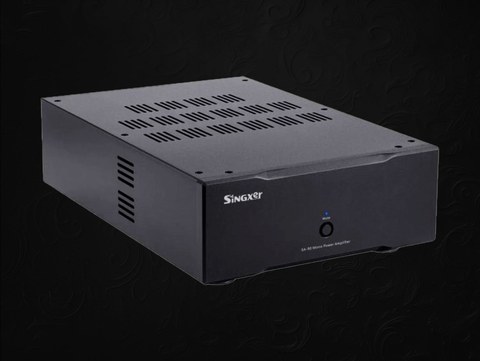
Each SA-90 monoblock is rated at 90W into 8 ohms and 180W into 4 ohms, with maximum output climbing to roughly 120W at 8 ohms and 200W at 4 ohms at 1% THD+N. That doubling of power as impedance halves is a good sign of a healthy, well-regulated power supply behind the amplifier stage – a lot of budget amps struggle to sustain that ratio under real load.
- Class AB topology, sold and used as a stereo pair of monoblocks
- High/low gain switching at 16dB and 23dB, with single-ended/balanced input switching
- Noise level under 2.3uV A-weighted (RCA input, low gain)
- SNR greater than 140dB A-weighted under the same conditions
Power supply
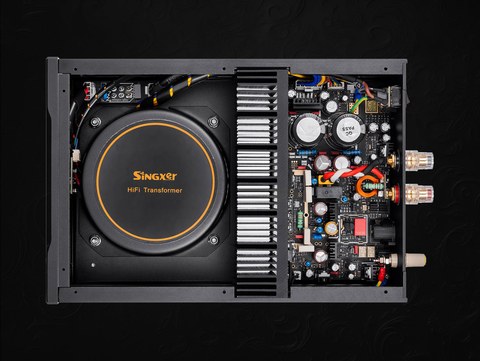
Each channel gets its own shielded toroidal transformer rated at 300W continuous, with short-term peak capacity reaching 500W, backed by 20,000uF of electrolytic capacitance per channel. Running mono blocks means each amplifier has a fully dedicated power supply rather than sharing one transformer and capacitor bank across both channels the way a conventional stereo amp does, which removes one common source of channel interaction under dynamic musical passages.
Inputs and connections
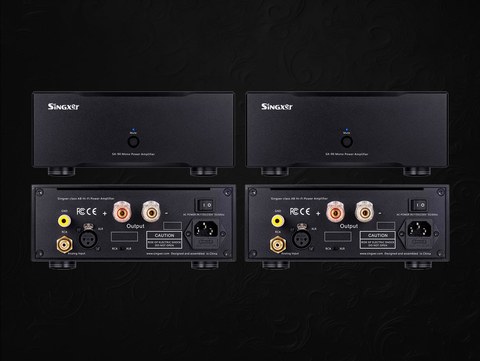
- Balanced XLR input for lower noise pickup over longer cable runs
- RCA input with a dedicated ground terminal, useful for resolving ground loop hum in mixed-brand systems
- Speaker terminals rated for the amplifier’s full output current
- Gain switch to match sensitivity with different preamps, from a low-output passive preamp to a hotter active line stage
The gain switching is worth paying attention to during setup. Running high gain with an already hot-output preamp can leave you with almost no usable range at the bottom of your volume control, while running low gain with a weak-output source can force the preamp to work near its own ceiling. Matching the gain setting to your specific preamp, rather than leaving it on the default, makes a real difference to how usable the volume control feels day to day.
Using them as monoblocks
Because the SA-90 ships and is typically sold as a pair, each unit drives a single channel entirely on its own, from its own transformer through to its own output stage. This is the traditional monoblock advantage: physically separating the two channels means crosstalk between them has to travel through your speaker cables and room rather than through a shared chassis and power supply. For stereo listening in a normal room, the practical benefit is usually smaller than the marketing around monoblocks suggests, but it does simplify amplifier placement – you can put one block near each speaker and run shorter speaker cable runs with longer interconnects instead, which some rooms and speaker layouts benefit from.
Pairing considerations
The SA-90 works well as a step-up amplifier for anyone currently running a modest integrated amp who wants more headroom and current delivery without moving to esoteric price tiers. It pairs naturally with a dedicated preamp or a DAC with a built-in volume control, such as Singxer’s own SU-2 USB interface feeding into a DAC with preamp functionality, letting you build a fully separates-based system without needing an integrated amp in the middle.
- Speaker sensitivity below roughly 87dB will benefit most from the SA-90’s power reserves
- Rooms larger than a typical bedroom setup will make better use of the 4-ohm power figures
- Ensure adequate ventilation around each monoblock, since Class AB amplifiers under sustained high-volume listening do generate meaningful heat
Living with a pair of monoblocks
Practically speaking, running two separate chassis instead of one stereo amp changes your rack layout more than it changes your listening routine. You’ll need two power outlets rather than one, ideally on the same circuit to avoid any ground potential differences between the pair, and you’ll want to plan cable runs to each speaker individually rather than running both channels from a single central location. Some owners place each monoblock directly behind or beside its corresponding speaker, which shortens the speaker cable run considerably and can simplify cable management if your listening room allows for it.
Heat output is worth planning around too. Class AB designs run their output devices with some standing bias current even at idle, and with two separate chassis each drawing power independently, you’ll want enough clearance on all sides of both units for airflow rather than stacking them or placing them in an enclosed cabinet with poor ventilation.
It’s also worth thinking about how you’ll power the pair on startup. Two large toroidal transformers switching on simultaneously can pull a noticeable inrush current, and some owners prefer staggering the power-up of each monoblock by a second or two, either manually or through a power sequencer, rather than flipping both on at exactly the same instant from a shared power strip.
Common Setup Problems and Fixes
A pair of monoblocks introduces a few wrinkles a single stereo amp doesn’t, and most owner complaints trace back to one of these:
- Problem: Volume control feels cramped with almost no usable range at the bottom – this usually means the gain switch is set to 23dB with an already hot-output preamp; drop it to the 16dB setting.
- Problem: Audible hum or buzz through the speakers – often a ground loop on the RCA input; use the dedicated ground terminal, or switch to the balanced XLR input if your preamp supports it.
- Problem: One monoblock shuts down or sounds thin at high volume – check for adequate airflow around the chassis, since Class AB output stages generate real heat and can trigger thermal protection if boxed in.
- Problem: No output from one channel after wiring – reversed polarity at the speaker terminals won’t damage the amp, but it will invert phase; double-check the terminal connections against the manual.
- Problem: A power strip trips when both units are switched on together – two large toroidal transformers powering up simultaneously can pull a noticeable inrush current; stagger the power-up of each monoblock by a second or two instead.
- Problem: Background hiss is audible with sensitive speakers – try the lower 16dB gain setting first before assuming it’s a hardware fault.
FAQ
Is the SA-90 sold as a single amp or a pair?
It’s designed and typically sold as a matched pair of monoblocks, with each unit driving one channel.
What class of amplification does it use?
Class AB, chosen for a balance of efficiency and low distortion compared to pure Class A designs.
How much power does each monoblock produce?
90W into 8 ohms and 180W into 4 ohms rated, with peak figures around 120W and 200W respectively at 1% THD+N.
Does it have balanced inputs?
Yes, both XLR balanced and RCA single-ended inputs are provided, with a gain switch to match either input type to your preamp’s output level.
What speaker types pair well with it?
Speakers with average or below-average sensitivity in mid-size to larger rooms tend to benefit most from the SA-90’s current delivery and power headroom.
I came to this amp expecting a digital-audio brand’s first amplifier to feel like an afterthought, and it didn’t – that’s worth saying plainly rather than burying in a spec table.