Cayin already has a well-regarded tube integrated in the A-50T MKII, and it would have been easy to treat the Jazz 90 as a minor variation on that formula. It isn’t. The Jazz 90 is a distinctly different design with its own tube complement, its own power delivery, and a modern connectivity layer that makes it a genuinely separate proposition rather than a refresh of an existing product.
| Tube Complement | 2x 12AX7/ECC83, 2x 6SN7, 4x KT88 (EL34-switchable) |
| Power Output | 2x50W (ultralinear) or 2x28W (triode) |
| Phono Stage | Built-in MM phono stage |
| Bluetooth | 5.1 (Qualcomm QCC5125 + ESS ES9018K2M DAC), LDAC/aptX HD/aptX LL/AAC |
| Speaker Terminals | Separate 4-ohm and 8-ohm outputs |
| Headphone Output | Front-panel 6.35mm jack |
| Finish Options | Silver or black chassis |
What’s actually inside
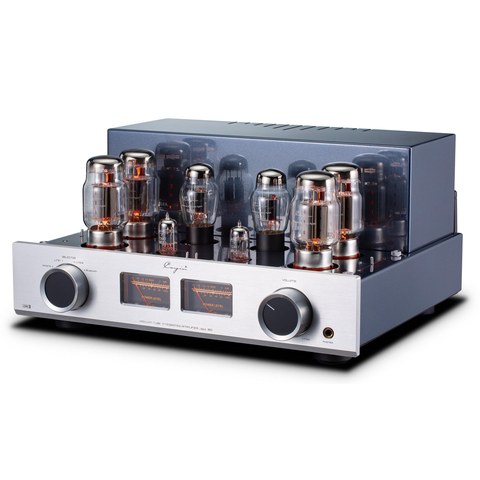
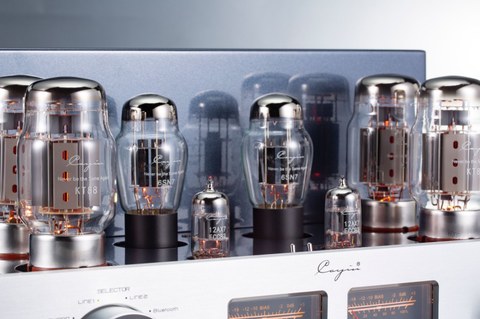
The tube lineup is substantial for an integrated amp at this level: two 12AX7/ECC83 tubes handle input duties, two 6SN7 tubes work as drivers, and four KT88 power tubes do the heavy lifting, all fully visible across the top of the chassis. That’s a proper push-pull power section, delivering 2×50 watts in ultralinear mode or 28 watts per channel if you switch the amp into triode mode. The choice between those two modes isn’t a gimmick — triode mode trades some outright power for the smoother, more harmonically rich character tube enthusiasts tend to chase, while ultralinear mode prioritizes control and headroom for harder-to-drive speakers.
Cayin also built in a switch to swap the KT88 power tubes for EL34s, which is a meaningful option rather than a footnote. KT88s and EL34s have genuinely different characters — broadly, KT88s lean toward more headroom and tighter control, while EL34s are often associated with a rounder midrange — so this switch effectively gives the Jazz 90 two different amplifiers’ worth of tonal character in one chassis, without needing to physically swap and re-bias a full tube complement yourself.
Keeping tabs on tube health
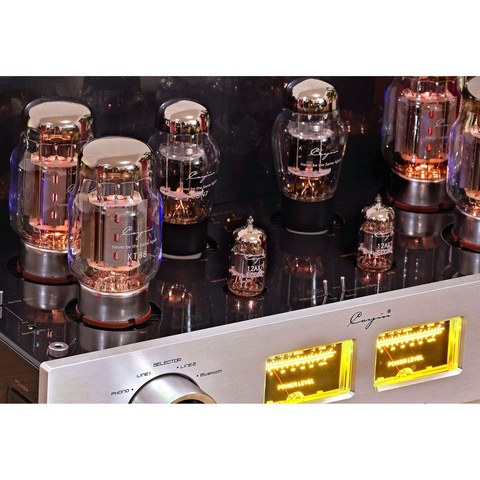
Running four power tubes means more that can drift out of spec over time, and Cayin addressed that directly with a Bias Monitoring Indicator system that continuously watches power tube current and triggers protection if a reading looks abnormal. Paired with the visible VU-style meters on the front panel, it turns tube maintenance from a guessing game into something you can actually observe, which matters more than it might sound like it does — tube amps that silently drift out of bias over months are a common and often invisible source of gradually degrading sound.
Modern connectivity built around an analog core
Where the Jazz 90 clearly departs from a purely traditional tube integrated is in its input section. There’s a built-in MM phono stage for turntables without their own preamp, which is a genuinely useful inclusion rather than an afterthought given how many buyers in this category are running a turntable somewhere in their system. Bluetooth 5.1 comes courtesy of a Qualcomm QCC5125 chip paired with an ESS ES9018K2M DAC, and it supports LDAC, aptX HD, aptX LL, and AAC — meaning wireless streaming from a phone or laptop sounds meaningfully better than the basic SBC-only Bluetooth found on many integrated amps that bother to include it at all.
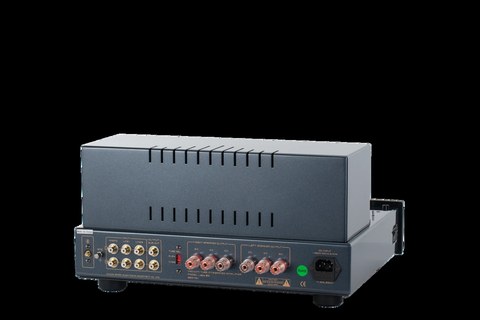
Speaker flexibility is handled with separate 4-ohm and 8-ohm terminals, letting the amp be properly matched to a wider range of speaker impedances than a single universal output tap would allow. A front-panel 6.35mm headphone jack rounds things out, so the Jazz 90 can double as a personal listening amp late at night without needing to power the speakers at all.
What reviewers picked up on
Coverage from the Son-Video.com blog and Alpha Audio both frame the Jazz 90 as a genuine attempt to bridge classic tube design with how people actually listen now — streaming from a phone as often as spinning a record. HomeCineSolutions’ write-up echoed that, calling out the combination of heritage tube circuitry and contemporary connectivity as the amp’s defining trait rather than treating either half as the main event. None of the coverage frames this as a replacement for Cayin’s existing A-50T MKII; it’s positioned as a separate model with its own tube complement and its own priorities, aimed at buyers who specifically want the phono stage and modern Bluetooth codec support built in from the start.
Who it’s for
The Jazz 90 makes the most sense for someone assembling a single-box system around both a turntable and everyday streaming, who also wants the option to tune the amp’s character between triode and ultralinear modes, or between KT88 and EL34 power tubes, without buying separate equipment for each preference. If you don’t need a phono stage or Bluetooth at all, a more purely analog integrated amp might be a simpler match, but few tube integrateds in this space combine this many practical, everyday-use features with a serious four-tube power section.
Where to find one
Availability for the Jazz 90 has been spread across a handful of specialist hi-fi retailers rather than wide big-box distribution, which is typical for a Cayin release at this level. Vinyl Revival, Audio Excellence Canada, Noteworthy Audio, and Starspicker Audio have all carried it, alongside Cayin’s own site. Because stock and finish options (silver or black chassis) can vary between retailers, it’s worth checking current availability directly rather than assuming every dealer carries both finishes at any given time.
Common Issues and How to Resolve Them
Tube integrated amps like the Jazz 90 are generally reliable, but a handful of issues come up often enough to be worth knowing about in advance.
- No sound after first power-on: Give the tubes a minute or two to warm up before expecting full output; tube amps do not deliver sound instantly the way solid-state amps do, and this is normal behavior rather than a fault.
- Bluetooth won’t pair: Clear the device from your phone or laptop’s Bluetooth list and re-pair from scratch, and make sure no other paired device is still holding the connection open in the background.
- Phono input sounds thin or distorted: Double-check your turntable does not have its own built-in preamp already active, since running two phono stages in series — the turntable’s and the Jazz 90’s — produces exactly this kind of distortion.
- Bias indicator shows an abnormal reading: Power down and let the amp cool before inspecting the tubes for visible damage; if the reading persists after a cold restart, contact your dealer rather than continuing to operate the amp.
- Hum or buzz through the speakers: Check for a ground loop between the amp and other connected equipment, and try a different wall outlet before assuming the amp itself is at fault, since ground loops are a common source of hum in any tube-based system.
Frequently asked questions
Is the Cayin Jazz 90 the same amplifier as the A-50T MKII?
No. They’re separate models with different tube complements and design priorities. The Jazz 90 is a newer, differently designed integrated amp, not a variant or successor of the A-50T MKII.
Can I use turntables with and without a built-in phono preamp?
Yes for either, though the Jazz 90’s built-in MM phono stage is specifically meant for turntables that don’t already have their own preamp. If your turntable has one built in, you’d typically connect it to a line input instead.
What’s the practical difference between triode and ultralinear mode?
Ultralinear mode delivers the full rated 50 watts per channel with tighter control, while triode mode drops output to about 28 watts per channel in exchange for a smoother, more harmonically rich character that many tube enthusiasts prefer for certain music and speakers.
Does switching between KT88 and EL34 tubes require rebiasing by hand?
The amp is designed with this kind of switching in mind and includes a Bias Monitoring Indicator system to help track tube condition, though you should always follow Cayin’s documented procedure for changing power tube types rather than assuming a fully automatic process.