Budget in-ear monitors usually have to pick a lane and stick with it, either tuned dark and safe or bright and detailed, with little room to change your mind once you have bought them. The Aune IR300 tries a different approach, building mechanical tuning options directly into the shell so a single pair of earphones can cover a surprisingly wide range of sound signatures. At around 139 euros, it lands squarely in the budget-to-entry-midrange bracket, and I spent a couple of weeks running through every nozzle and module combination to see how much that flexibility really changes the sound.

How the tuning system works
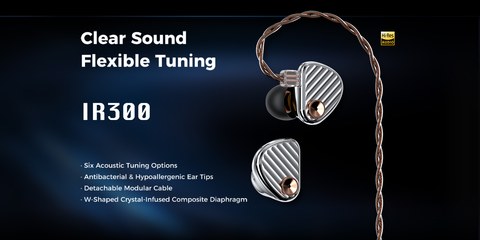
Instead of relying on switches or a companion app, the IR300 uses interchangeable physical parts to reshape the frequency response. There are three interchangeable nozzles and two acoustic modules, which combine for six total configurations. Swapping between them changes the amount of treble energy and the overall tonal balance, so you can nudge the earphones toward a warmer, more relaxed signature or a brighter, more analytical one depending on the music or your mood that day.
- Single dynamic driver built around a W-shaped crystal-infused composite diaphragm
- Six possible tunings from three nozzles times two acoustic modules
- Detachable modular cable using a standard connector
- Antibacterial and hypoallergenic ear tips included in the box
This is a genuinely useful feature rather than a marketing gimmick, since it means the IR300 can work for genres as different as acoustic jazz and electronic music without needing a second pair of earphones. A full breakdown of each configuration’s tonal character is available from Mobile Audiophile.
Build quality and comfort
The shells are metal and noticeably more compact than a lot of competing IEMs in this price range, which makes a real difference for anyone with smaller ears or anyone planning to wear them for hours at a stretch. Combined with the tip selection in the box, I never had an issue getting a comfortable, stable seal, and I was able to wear them through several multi-hour listening sessions without any hot spots or pressure discomfort.
Sound quality across the configurations
Set to the warmest nozzle and module combination, the midrange has a pleasant amount of body and thickness, with both male and female vocals given good placement and a natural sense of separation from the instrumentation around them. Switching to the brighter configuration sharpens up the detail retrieval and adds air to the top end without becoming harsh, which is impressive given the price point. Detail and separation stay strong across the range, and I did not find any configuration that felt like a clear miss.
The treble across all six configurations manages to stay crisp and airy rather than overwhelming, which is often where budget dynamic-driver IEMs struggle. Aune seems to have prioritized keeping the top end usable across every tuning rather than making one configuration great and the rest an afterthought.
Who should consider the IR300
If you are the type of listener who switches genres a lot, or if you share your earphones with someone whose taste in tuning differs from yours, the tuning flexibility here has real practical value beyond just being a novelty. For a single fixed price, you are effectively getting several different-sounding earphones in one package. Combined with a detachable cable that lets you upgrade later without buying a whole new pair, the IR300 is a sensible pick for anyone stepping up from entry-level in-ears without wanting to spend a lot more money.
Getting the fit and tuning right
Because the tuning system depends on physical parts rather than software, it is worth spending a bit of time methodically working through all six combinations before settling on a favorite rather than judging based on the first one you try out of the box. I found it helpful to pick two or three familiar tracks that I know well across different genres and cycle through each configuration with the same tracks, rather than switching songs and configurations at the same time, which makes it much harder to isolate what is actually changing.
Storage and organization matter too, since losing a nozzle or module means losing access to one of the six tunings. The included case has dedicated slots for the spare parts, and I would strongly recommend using it rather than tossing loose nozzles into a bag pocket where they are easy to misplace.
Cable and source pairing
The stock cable is perfectly serviceable, but because the connector is a standard detachable type, aftermarket cables are an easy way to fine-tune the presentation further if you want to push the tuning even beyond what the nozzle and module combinations already offer. A slightly higher-purity copper cable added a touch more air to the treble in my testing, though the difference was subtle compared with the much larger swing you get from the mechanical tuning system itself.
As for source gear, the IR300’s sensitivity means it does not need much power to sing, so a basic phone dongle or a laptop headphone jack is enough for most listening. It does scale a little with a cleaner source, showing marginally better separation and a slightly lower noise floor, but it is far from demanding in that respect.
FAQ
How many sound configurations does the Aune IR300 have?
Six, created by combining three interchangeable nozzles with two acoustic modules.
Does the IR300 come with a detachable cable?
Yes, it uses a modular detachable cable, so you can replace or upgrade it independently of the earphone shells.
What kind of driver does it use?
A single dynamic driver built around a W-shaped crystal-infused composite diaphragm.
Is the IR300 comfortable for long listening sessions?
Yes, the compact metal shells and included ear tip selection make it comfortable for multi-hour sessions for most ear shapes.
What is the approximate price of the IR300?
Around 139 euros, placing it in the budget-to-entry-midrange bracket.
Long-term ownership notes
After extended use, the modular design continues to pay off in ways beyond just tuning flexibility. If a cable eventually wears out or a nozzle gets lost, replacement parts and aftermarket accessories for IEMs using standard connector types are widely available, so the IR300 is not the kind of product you have to retire the moment one small part fails. That serviceability is worth factoring into the value equation alongside the initial price and sound quality, since it extends how long the earphones stay useful in your rotation.
After more than a decade of buying and reselling in-ear monitors as a hobby, tuning flexibility like this is the kind of feature that keeps a pair in my rotation long after flashier but less adaptable models get boxed up.