The ISDT PD60 is a pocket-sized charger built around one clever idea: instead of needing its own power brick, it runs off USB-C power delivery from your phone charger, laptop, or a power bank. This manual guide covers the setup steps and the settings that matter most.
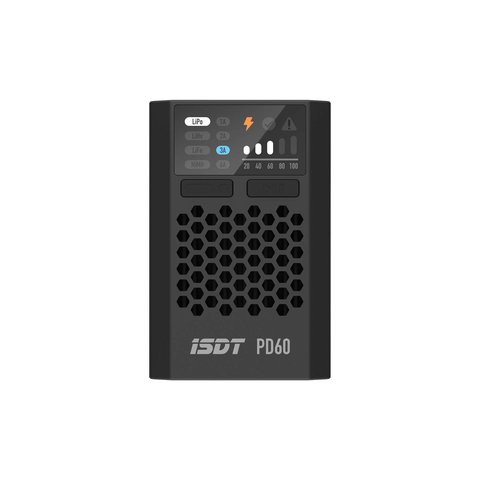
Key Specs
- Maximum power: 60W, output range 1-20V
- Charge current settings: 1A, 2A, 3A, or 6A
- USB-C input supporting QC2.0/3.0 and PD2.0/3.0, accepting 5-20V up to 3A
- Supports 1-4S LiPo/LiFe/LiHV and 1-12S NiMH/NiCd
- Balance current up to 0.5A per cell
- Dimensions approximately 85 x 56 x 21mm, weight about 87g
Powering It: Any USB-C PD Source Works
The setup step that surprises new owners is just how flexible the power input is:
- A phone charger rated for USB PD or Quick Charge works fine
- A laptop’s USB-C port can power it during a charge session
- A USB-C power bank lets you charge packs away from a wall outlet entirely
- No separate power brick ships with the unit because none is needed
Connecting Your Battery
The PD60 uses an XT60 main connector alongside a JST-XH balance port, matching most common LiPo packs without an adapter:
- Plug the main XT60 lead into your battery
- Plug the balance lead into the matching balance tap
- Select chemistry and cell count using the two onboard buttons
- Choose a charge current: 1A, 2A, 3A, or 6A depending on your USB-C source’s capability
Matching Charge Current to Your Power Source
Because total output is capped at 60W, the actual achievable charge current depends on both your selected setting and what your USB-C source can supply:
- A basic 18W phone charger will only support the lower current settings
- A 45-65W USB-C PD charger unlocks the full 6A setting on lower cell-count packs
- Higher cell-count packs draw more voltage, which reduces the max current within the 60W ceiling
NiMH and NiCd Support
Beyond lithium chemistries, the PD60 also handles nickel-based packs up to 1-12S, which is unusually broad for such a compact charger, making it useful for older transmitter or receiver battery packs in addition to modern LiPo.
Comparing the PD60 to Traditional Bench Chargers
The PD60 trades outright power for portability, which matters most in specific situations:
- Traveling hobbyists benefit most, since a phone charger doubles as the power source
- Home workbench users with a fixed setup may prefer a higher-power DC charger like the SC-608
- The PD60’s 60W ceiling suits smaller packs better than large multi-cell batteries
Balance Charging Accuracy on a Compact Charger
Despite its small size, the PD60’s balance circuitry handles up to 0.5A per cell, which is enough to keep pace with the main charge current on smaller packs without lagging significantly behind, something not guaranteed on all compact chargers.
Firmware Updates Over USB-C
Unlike the Bluetooth-based update process on some other ISDT chargers, the PD60 receives firmware updates through the same USB-C port used for power, connected to a PC running ISDT’s update utility, which keeps the process simple and avoids any pairing steps.
Packing It for a Trip
Because the PD60 needs no dedicated power brick, a typical travel kit shrinks down to just the charger itself, a short XT60 charge lead, and whatever USB-C PD charger or power bank you are already carrying for your phone and laptop, which is a meaningful weight and space saving over a traditional charger setup.
A Quick Note on Cable Quality
Since the PD60 depends entirely on USB-C power delivery, using a high-quality, properly rated USB-C cable matters more than it would on a charger with dedicated power hardware. A cheap or underrated cable can bottleneck the wattage reaching the charger even if the power source itself is capable of more.
Who the PD60 Is Best Suited For
The PD60 makes the most sense for hobbyists who travel often, fly small to mid-size multirotors, or simply want one less power brick cluttering a desk, while those regularly charging large packs at high current are better served by a higher-wattage DC charger paired with a proper power supply.
Final Thoughts on the Portable Charging Approach
The broader trend of USB-C powered chargers like the PD60 reflects how much power delivery standards have matured in recent years. What would have required a dedicated bench supply not long ago now runs off the same charger already sitting in most people’s bags, which is a meaningful shift for anyone who charges batteries away from a fixed workbench on a regular basis.
I charged a 4S LiPo using nothing but a laptop’s USB-C port and the PD60, something that would have seemed unlikely with older bench chargers that needed a dedicated power supply. The charge current capped out lower than the full 6A rating because the laptop’s port could not push enough wattage, but for a slow overnight top-up it worked exactly as expected.
“Being able to charge a pack from the same power bank I use for my phone is the feature that sold me on it.”
— Alex R., RC Hobbyist, PeerSpot Reviewer
Frequently Asked Questions
Does the PD60 come with its own power adapter?
No, it is designed to run entirely off USB-C PD or Quick Charge sources you likely already own, such as a phone charger or power bank.
What is the maximum cell count the PD60 supports?
1-4S for LiPo/LiFe/LiHV chemistries, and up to 1-12S for NiMH/NiCd packs.
Why can’t I get the full 6A charge current?
Your USB-C power source may not supply enough wattage. Lower-power chargers or power banks will cap the achievable current below the PD60’s rated maximum.
Can firmware be updated on the PD60?
Yes, firmware updates are delivered over the same USB-C port used for charging power.
Conclusion
The PD60’s real innovation is not raw power, it is convenience: dropping the need for a dedicated power brick and instead using whatever USB-C PD source is already in your bag. Match your charge current setting to what your power source can actually deliver, and it becomes one of the most travel-friendly balance chargers available.
Ryan studied computer science and has since made a habit of benchmarking and reviewing hardware before recommending it to readers, including testing USB-C powered chargers like the PD60 against traditional bench chargers for travel use. He writes at softwaredriverdownload.com.