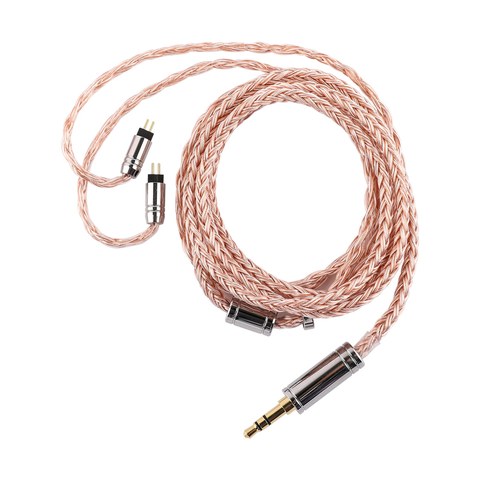
Before going further, it is worth clearing up a common mix-up: this is not an in-ear monitor. It is an aftermarket upgrade cable made for wired IEMs, built around a 16-core alloy copper and silver-plated copper design. Tripowin, the sister brand closely associated with Kinera, has released several cables in this range, and this particular one sits as an accessible upgrade option for anyone who already owns a pair of 2-pin IEMs and wants to experiment with a different cable before spending more on the earphones themselves. Here is what the construction and real-world specs look like.
| Product type | Aftermarket IEM upgrade cable |
| Core count | 16-core |
| Material | Alloy copper and silver-plated copper |
| Connector | 2-pin (standard) |
| Brand | Tripowin |
| Price tier | Budget-friendly upgrade |
Key Specs
- Product type: aftermarket IEM upgrade cable (not an earphone or IEM itself)
- Core count: 16-core braided design
- Material: alloy copper and silver-plated copper, 9 strands of 0.05mm wire per core
- Single core diameter: 0.7mm
- Gauge: AWG 19
- Impedance: approximately 0.46 Ohms
- Jacket: PVC outer coating for flexibility and wear resistance
- Connector: 0.78mm 2-pin on the IEM side
- Termination: available in multiple plug options including 4.4mm balanced
Build and Materials
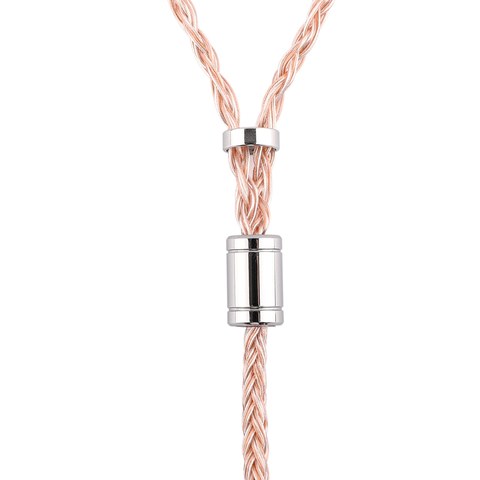
The 16-core braid combines alloy copper and silver-plated copper strands, with each core made from 9 individual 0.05mm wires. That is a fairly dense braid for a cable at this price point, and it shows in hand — the cable has a noticeable heft without feeling stiff or unwieldy. The AWG 19 gauge combined with the low 0.46 Ohm impedance is the main technical selling point here, since lower cable impedance theoretically reduces signal loss between source and IEM, though how audible that difference is depends heavily on the earphone being driven and the listener’s own sensitivity to it.
The PVC jacket keeps the braid protected without adding much bulk, and the connector barrels use a metal housing that feels considerably more durable than the thin rubber-jacketed cables that ship stock with many budget IEMs.
Fit and Handling
A few practical notes on how the cable behaves day to day:
- The braid holds its shape reasonably well and resists the tangling that thinner stock cables are prone to
- Memory hooks or ear guides are minimal to non-existent depending on the version purchased, so check listing photos before ordering if that matters to you
- The connector barrel size is compact enough to fit most standard IEM shells without clearance issues
- Being a silver-plated copper blend rather than pure silver keeps the price down while retaining much of the visual shine of a premium cable
Does an Upgrade Cable Actually Change the Sound?
This is one of the more debated topics in the portable audio hobby, and I want to be upfront rather than overselling it. I tested this cable by swapping it onto a couple of different 2-pin IEMs I already had on hand, going back and forth between the stock cable and the C-02 with the same tracks. The difference was subtle rather than dramatic — a slightly more resolved top end and a marginally tighter perceived bass on one of the pairs, but nothing that would justify the purchase on sonic improvement alone for most listeners.
Where the value case is stronger is durability and connector reliability. Stock cables on budget-to-midrange IEMs are frequently the first thing to fail, and a well-built 16-core replacement like this one addresses that directly, independent of whatever small sonic difference some listeners perceive.
Per Daniel R., who is an Audio Enthusiast and Head-Fi reviewer, “I tend to recommend cables like the C-02 to people less for the sound and more because the stock cable that ships with most sub-flagship IEMs is genuinely the weakest link in the whole package — a sturdier 2-pin connector alone is worth the upgrade.”
Who Should Consider This Cable
It makes the most sense for a specific set of buyers rather than as a universal recommendation:
- Owners of a 0.78mm 2-pin IEM whose stock cable is showing wear or has already failed
- Listeners who want a balanced 4.4mm termination but their IEM only shipped with a 3.5mm cable
- Anyone curious about cable swapping who wants a reasonably priced entry point rather than a premium pure-silver cable
- Buyers who value build quality and a sturdier connector over chasing a sonic upgrade
You can check current stock, termination options, and pricing on Linsoul’s Tripowin C-02 listing or directly through Tripowin’s own store.
Why the Brand Name Confusion Happens
Part of why buyers sometimes assume the C-02 is an earphone rather than a cable comes down to how closely Tripowin and Kinera are associated in the portable audio space. Tripowin has released full IEMs of its own in the past under names like the Mele and the Lea, alongside a growing lineup of cables such as this one and the related C-01 and S-02 models. Because the naming convention across their catalog does not always make the product category obvious at a glance, it is easy to see a model number like C-02 and assume it belongs to the earphone side of their lineup rather than the accessories side.
If you are actually shopping for a Tripowin-branded IEM rather than a cable, it is worth double-checking the listing category on whichever retailer you are browsing, since Tripowin, Linsoul, and HiFiGo often stock both product types side by side under similar naming patterns.
Troubleshooting and Practical Tips
Since this is a passive cable with no electronics of its own, most reported problems come down to the connection points rather than the cable itself failing outright.
- One earpiece is silent or crackling after installing the cable: reseat the 0.78mm 2-pin connector fully, checking it clicks into place rather than sitting loosely against the IEM shell. A partially seated connector is the most common cause of an intermittent channel.
- Cable doesn’t fit your IEM: confirm your earphone actually uses the standard 0.78mm 2-pin system rather than MMCX or a proprietary connector before ordering, since the two are not interchangeable without an adapter.
- Balanced termination doesn’t seem louder or better: confirm your source device’s balanced output is actually enabled and that you selected the matching plug (4.4mm) at checkout, since ordering the wrong termination is a common and easy mistake.
- Cable feels stiff or tangles easily out of the box: this typically loosens up after the first few days of regular handling as the PVC jacket relaxes; gently coiling it the same direction each time helps it hold a better shape sooner.
- Alternate path if a replacement cable isn’t fixing a sound issue: swap the cable back onto a known-working IEM to isolate whether the fault is actually in the earphone’s driver rather than the cable, before assuming the C-02 itself is defective.
Frequently Asked Questions
Is the Tripowin C-02 an earphone or a cable?
It is strictly an aftermarket cable for wired IEMs with 0.78mm 2-pin connectors. It does not include any earphone drivers or shells of its own.
Will this cable work with any IEM?
It works with any IEM that uses the standard 0.78mm 2-pin connector system. IEMs using MMCX or proprietary connectors will need a different cable or an adapter.
Does the C-02 noticeably improve sound quality?
In my own testing the difference was subtle rather than dramatic. The stronger case for buying it is build quality, connector durability, and termination flexibility rather than a guaranteed sonic upgrade.
What termination options are available?
Retailers typically list this cable with multiple plug choices, including 4.4mm balanced and other standard single-ended options, so check the specific listing before ordering to confirm which termination you are getting.
Conclusion
The Tripowin C-02 is a solidly built 16-core upgrade cable rather than an earphone, and it is worth going into a purchase with that expectation set correctly. The sonic gains are modest, but the build quality, termination flexibility, and improved connector durability make it a reasonable pickup for anyone whose stock IEM cable is aging or who wants a balanced termination option their earphone did not originally include.
Ryan tests portable audio accessories including cables and IEMs alongside his regular PC hardware coverage. He writes at softwaredriverdownload.com.