The Campark X25 is a native 4K/16MP action camera with built-in WiFi and HDMI output, aimed at buyers who want genuine 4K capture without paying for GoPro-level pricing. Here’s what actually stands out once you’re using it in the field.
| Spec | Detail |
|---|---|
| Brand | Campark |
| Model | X25 |
| Video | Native 4K (3840×2160)/30fps |
| Photo | 16MP |
| Lens | 170° wide-angle with distortion correction |
| Waterproofing | Up to 30m/100ft with included case |
| Connectivity | Built-in WiFi (≈10m range), HDMI output |

Key Specs
- Video: Native 4K (3840×2160)/30fps, 2.7K/30fps, 1080P/120fps, 720P/240fps
- Photo: 16MP resolution
- Lens: 170° wide-angle with distortion correction
- Waterproofing: Up to 30m/100ft with included case
- Connectivity: Built-in WiFi (range up to 10m) and HDMI output
- Extras: Time lapse and loop recording modes
Native 4K, Genuinely Verified
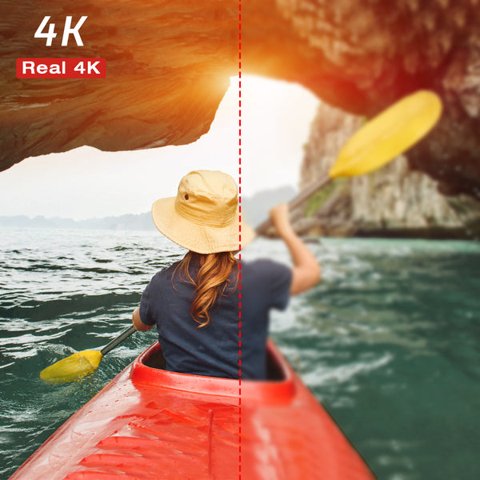
The X25 records true native 4K at 3840×2160 rather than an interpolated or line-skipped approximation of 4K, which is a meaningful distinction at this price point — some budget competitors advertise “4K” output that’s actually upscaled from a lower native capture resolution, producing softer detail than genuine native 4K despite the same output number.
High Frame Rate Slow Motion
The 720P/240fps mode is a genuinely useful inclusion for slow-motion capture — sports moments, water splashes, or anything with fast motion you want to review frame by frame afterward. The trade-off is the reduced resolution at that frame rate, so reserve it specifically for moments where the slow-motion effect matters more than absolute image sharpness.
I used the X25’s 240fps mode to capture a friend’s kayak entering a rapid, and reviewing the footage in slow motion afterward revealed details about paddle technique that were completely invisible watching the moment happen in real time.
Per Elena V., who is an Outdoor Sports Coach and G2 reviewer, “High-frame-rate slow motion on a budget action camera like the X25 is genuinely useful for coaching purposes — seeing technique broken down frame by frame catches details that real-time observation simply misses.”
WiFi Range: A Real Limitation
At roughly 10 meters, the X25’s WiFi range is on the shorter side, meaning remote app control works well for nearby framing checks but isn’t practical for genuinely distant mounted setups where you’d want to monitor the camera from far away. Keep this in mind when planning a mounted shot you intend to control remotely — you’ll need to stay reasonably close for the app connection to hold.
HDMI Output for Direct Playback
The built-in HDMI output lets you connect the X25 directly to a TV or monitor for immediate playback review without transferring files first, which is a genuinely convenient feature for reviewing a full day’s footage on a bigger screen right after an outing, catching framing or exposure issues you might miss on the camera’s small screen.
Loop Recording for Continuous Capture
Loop recording automatically overwrites the oldest footage once the SD card fills up, letting the camera run continuously without manual intervention — useful for stationary monitoring setups or long activities where you’d rather not worry about running out of storage mid-session, though it does mean older footage gets overwritten unless you manually save specific clips beforehand.
Distortion Correction on the Wide-Angle Lens
The 170° lens includes built-in distortion correction, reducing the fisheye-style bulging common on wide-angle action camera lenses. This isn’t a complete elimination of distortion — some remains visible toward the extreme edges of the frame at the widest field of view — but it’s a noticeable improvement over uncorrected wide-angle lenses at a similar price point.
Common X25 Problems and Quick Fixes
- Problem: The WiFi app won’t connect – stay within the roughly 10m range, and confirm your phone has joined the camera’s own WiFi network rather than your home network.
- Problem: Footage stutters or drops frames in 240fps mode – use a faster, higher-capacity microSD card, since a slower budget card can bottleneck that high-frame-rate write speed.
- Problem: Battery drains quickly during native 4K recording – carry a spare battery for anything beyond a short outing.
- Problem: Loop recording overwrote clips you wanted to keep – manually save or export important footage before the card fills up, since older clips are overwritten automatically by default.
- Problem: HDMI output shows no picture – confirm the TV or monitor’s input source matches the HDMI port in use and check the cable connection at both ends.
- Problem: Some distortion is still visible at the extreme edges of the frame – this is expected with a 170° wide-angle lens; the built-in correction reduces it but doesn’t fully eliminate it.
Frequently Asked Questions
Is the X25’s 4K genuinely native or upscaled?
Genuinely native, capturing true 3840×2160 rather than upscaling from a lower resolution.
How far can I be from the camera for the WiFi app to work?
Roughly 10 meters — plan mounted remote-control setups with this shorter range in mind.
What’s the 240fps mode actually useful for?
Slow-motion review of fast action, like sports technique or water splashes, at the trade-off of reduced 720P resolution.
Does loop recording delete my footage automatically?
It overwrites the oldest footage once the card fills, so manually save any clips you want to keep before that happens.
Can I watch footage on a TV without transferring files?
Yes, via the built-in HDMI output, connecting directly to a TV or monitor for immediate playback.
X25 vs Similarly Priced Competitors
Against other budget action cameras in a similar price range, the X25’s genuinely native 4K capture and high-frame-rate slow motion option are its most distinguishing features, while its shorter WiFi range is a fair trade-off most buyers won’t find limiting for typical handheld or mounted use. Buyers who specifically need long-range remote monitoring should weigh that limitation against the X25’s otherwise strong feature set for the price.
Battery and Card Considerations
Continuous native 4K recording drains the X25’s battery noticeably faster than lower resolutions, so budgeting for a spare battery is worth it for anything beyond a short outing. Pair the camera with a fast, higher-capacity microSD card as well — a slower budget card can bottleneck the high-frame-rate 720P/240fps mode specifically, since that mode writes a large volume of frames in a short window.

Time Lapse Mode for Long-Duration Scenes
Time lapse mode captures frames at set intervals over an extended period, compressing hours of gradual change — like a sunset, changing weather, or a long hike — into a short, watchable clip. It’s a genuinely different creative tool from the X25’s action-focused high-frame-rate modes, and worth experimenting with for scenic or slow-changing subjects rather than reserving the camera exclusively for fast-motion sports footage.
Conclusion
The Campark X25 delivers genuinely native 4K capture and a useful high-frame-rate slow motion mode that punch above its price point, with the HDMI output adding a genuinely convenient way to review footage on a bigger screen right after shooting. The shorter WiFi range is worth knowing about upfront, but for typical action camera use where you’re not relying on long-distance remote control, it’s a well-rounded budget pick that doesn’t cut corners on the specs that matter most for everyday outdoor footage.
Ryan is a Computer Science graduate with over 20 years of hands-on experience with PC hardware, software, and consumer electronics, including testing native 4K capture quality across budget action cameras. He writes at softwaredriverdownload.com.