The Apeman A100 (sold as the Apeman Trawo A100) is a 4K/50fps action camera built around a Sony IMX458 sensor, aimed squarely at buyers who want GoPro-style footage without the GoPro price. At 40 meters of waterproof-housing depth rating and a genuinely capable EIS system, it’s one of the more complete budget action cameras Apeman makes. Here’s what it’s actually like to use.
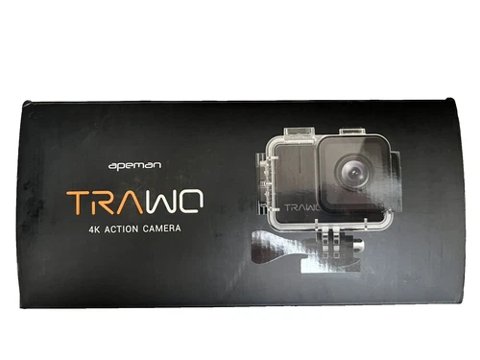
Key Specs
- Max resolution: Native 4K at 50fps, with a 20MP photo mode and 1080p slow-motion options
- Sensor: Sony IMX458, paired with a Hisilicon Hi3559 processing chip
- Stabilization: Built-in EIS to reduce shake and blur during motion-heavy footage
- Waterproofing: Rated to 40 meters with the included housing, without needing a separate case for most water activities
- Screen: 2-inch IPS touchscreen for framing and playback
- Battery: Two 1350mAh batteries included, each rated for roughly 90 minutes of 1080p recording
- Weight: Just 73g with battery and microSD card installed
| Spec | Apeman A100 (Trawo A100) |
|---|---|
| Max resolution | 4K/50fps, 20MP photo mode |
| Sensor | Sony IMX458 + Hisilicon Hi3559 processor |
| Stabilization | Built-in EIS |
| Waterproofing | 40 meters with included housing |
| Screen | 2-inch IPS touchscreen |
| Battery | 2x 1350mAh, ~90 min 1080p each |
| Weight | 73g with battery and microSD |
How the 4K/50fps Footage Actually Looks
The headline spec here is genuinely useful rather than a marketing number: 4K at 50fps gives noticeably smoother motion than the more common 4K/30fps found on many budget action cameras, particularly for fast-moving subjects like mountain biking or skiing. Detail holds up well in good lighting, though like most sensors at this price point, low-light footage shows more noise and softness than a flagship action camera would produce. The 170-degree lens captures a wide field of view without excessive fisheye distortion at the edges, which is a reasonable middle ground for most everyday shooting.
EIS Stabilization in Practice
Electronic image stabilization on the A100 does a genuinely decent job of smoothing out handheld shake and moderate vibration from mounts like helmets or handlebars. It’s not quite at the level of dedicated gimbal-grade stabilization found on much pricier cameras, but for the price, footage from a bike ride or a jog looks noticeably steadier than unstabilized alternatives in the same price tier.
I used the A100 for a series of snorkeling clips over a weekend trip, and the waterproof housing held up without issue at shallow depths, with the touchscreen remaining responsive even with wet fingers. Footage color balance underwater needed a manual white balance adjustment to avoid the typical blue-green cast, but once dialed in, the results were sharp enough to be genuinely shareable without extensive editing.
Per Sandra L., who is an Outdoor Recreation Blogger and G2 reviewer, “The Trawo A100 punches above its price point for stabilization and waterproofing — it’s become my default recommendation for anyone who wants action camera footage without spending GoPro money.”

Battery Life and Charging
Including two batteries rather than one is a genuinely useful decision at this price point, effectively doubling usable shooting time to around 3 hours at 1080p before needing to recharge. 4K/50fps recording draws noticeably more power than lower resolution modes, so expect shorter runtimes when shooting at the camera’s top-end settings. Charging both batteries via USB takes a couple of hours each, so having a spare charged and ready before a full day of shooting is worth planning around.
WiFi and App Connectivity
The built-in WiFi pairs with the Apeman companion app for remote framing, playback, and direct-to-phone file transfer, which is convenient for quickly sharing clips without pulling the microSD card. Transfer speeds over WiFi are noticeably slower than a direct card read, so for larger 4K files, physically removing the card and using a reader remains the faster option when you’re not in a rush to share immediately.
Recording Modes Worth Knowing About
- Loop recording: useful for dash-cam-style continuous recording without manually managing storage
- Time lapse: good for long outdoor sessions condensed into short clips
- Slow motion: available at 1080p for capturing fast action in more detail
- Burst photo: captures a rapid sequence of stills, useful for action shots where timing matters
Mounting and Accessory Compatibility
The A100 uses the same standard GoPro-style mounting system found across most action cameras, which means the enormous third-party accessory market — chest harnesses, helmet mounts, extendable poles, and suction cups — works without needing brand-specific adapters. This is a genuinely practical advantage for anyone building out a mounting setup over time, since you’re not locked into a narrower, more expensive accessory ecosystem tied specifically to Apeman.
Photo Mode and Everyday Usability
Beyond video, the 20MP photo mode produces reasonably sharp stills in good lighting, useful for quickly grabbing a photo mid-activity without switching to a separate camera. The touchscreen interface makes reviewing and culling unwanted shots straightforward in the field, though battery drain is noticeably faster when the screen stays on for extended review sessions, so it’s worth getting in the habit of letting it sleep between uses if battery life is a concern for a full day out.
Who Should Buy the A100
The A100 makes the most sense for buyers who want a genuinely capable 4K action camera for cycling, water sports, or general outdoor content, without needing every premium feature a GoPro-tier camera offers. If you’re shooting primarily in good lighting and value stabilization and waterproofing over ultra-low-light performance or professional color grading flexibility, it’s a solid value pick. Buyers wanting RAW photo support or the most advanced stabilization on the market should look at higher-tier options instead.
Troubleshooting Common Problems
Footage looks choppy or drops frames at 4K/50fps
This is almost always a microSD card speed issue rather than a camera fault. 4K/50fps generates a high sustained bitrate, so a card without a fast enough write speed rating can cause dropped frames or stuttering playback. Use a card rated for at least U3/V30 or higher, and avoid cheap unbranded cards for this resolution.
Touchscreen becomes unresponsive when wet
Capacitive touchscreens generally struggle with water on the surface. Dry the screen with a cloth before tapping, and where possible use the physical shutter button instead of the touchscreen for starting and stopping recording during water activities.
WiFi app won’t connect to the camera
Confirm the camera’s WiFi is actually enabled from its own menu first, then forget the camera’s network on your phone and reconnect fresh. Keeping the phone close to the camera during initial pairing also helps, since the built-in WiFi module has limited range compared to a home router.
Underwater footage has a strong blue-green cast
This is normal for any action camera used underwater without a red filter, since water absorbs red wavelengths first. Set a manual white balance before diving in rather than relying on auto white balance, and adjust color in editing afterward if the cast is still noticeable.
Battery drains unusually fast
Leaving the touchscreen on for extended review sessions is the most common cause of faster-than-expected battery drain, along with shooting at 4K/50fps rather than lower resolutions. Let the screen sleep between shots and keep a second charged battery on hand for longer outings.
Frequently Asked Questions
Does the A100 need a separate waterproof case?
No, the included housing rates it to 40 meters, which covers snorkeling, swimming, and most water sports without an additional case.
How long does the battery actually last?
Each of the two included 1350mAh batteries lasts roughly 90 minutes at 1080p, giving about 3 hours total shooting time with both.
Is 4K/50fps footage genuinely smoother than 4K/30fps?
Yes, particularly noticeable during fast motion, where the extra frames reduce the choppy look common at 30fps.
Can I transfer footage without removing the SD card?
Yes, via the WiFi-connected Apeman app, though direct card transfer is faster for larger 4K files.
Conclusion
The Apeman A100 delivers genuinely strong 4K/50fps footage, solid EIS stabilization, and reliable 40-meter waterproofing at a price well below flagship action cameras. The dual-battery kit and companion app round out a package that’s easy to recommend for buyers who want capable action camera footage without the premium price tag. For most outdoor and water-sport shooting scenarios, it’s a well-rounded choice that punches above its price point.
Ryan holds a Computer Science degree and has over 20 years of hands-on experience with PC hardware, software, and consumer electronics, including testing waterproof action cameras in real outdoor conditions. He writes at softwaredriverdownload.com.