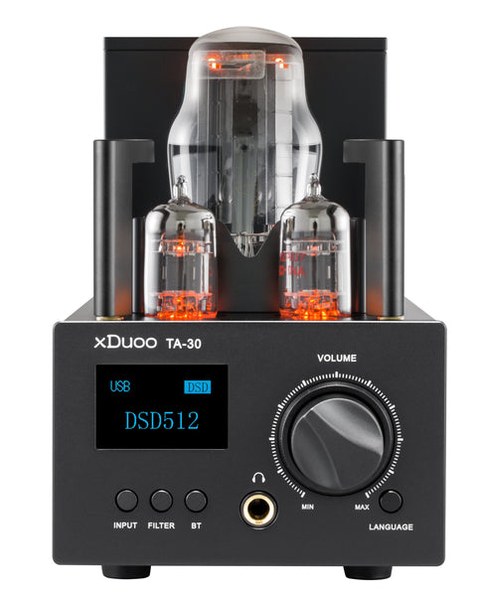
The TA-30 pairs two visible vacuum tubes with a thoroughly modern ESS ES9038Q2M DAC chip, aiming to give desktop listeners the option of tube coloration without giving up current digital format support or Bluetooth streaming. It sits in xDuoo’s desktop amp lineup as a tube-forward alternative to the brand’s more purely solid-state options like the XA-02.
Specifications at a Glance
| DAC chip | ESS ES9038Q2M with a built-in Time Domain Jitter Eliminator |
| Tubes | 5Z3P for high-voltage rectification, ECC82 for audio signal processing |
| Power output | Up to 3000mW at 32 ohms |
| Bluetooth | 5.0 via Qualcomm CSR8675, SBC/AAC/aptX/aptX LL/aptX HD/LDAC |
| Digital inputs | USB, coaxial, optical |
| Format support | Up to DSD512 natively, down to standard 16-bit MP3 |
What the Tubes Actually Contribute
In a hybrid design like this, the tubes sit in the amplification stage rather than the digital-to-analog conversion itself, since that job belongs entirely to the ES9038Q2M chip. What the 5Z3P and ECC82 tubes add is a characteristic warmth and slight roll-off in the upper frequencies that many listeners associate with classic tube amplifiers, without inheriting the higher noise floor or lower resolution that pure vintage tube gear can suffer from. The rectifier tube handles power supply duties while the ECC82 shapes the actual audio signal passing through, a combination reviewers at Headfonia described as delivering noticeably more texture than the brand’s solid-state amps at a similar price.
Bluetooth as a First-Class Input
Unlike some desktop tube amps that treat wireless streaming as an afterthought or omit it entirely, the TA-30 builds Bluetooth 5.0 in as a genuine option alongside its wired digital inputs. With LDAC support, Android users in particular can stream near-lossless quality wirelessly straight into the tube stage, which is a convenient middle ground if you do not want a USB cable running to your desktop at all times but still want the tube amp’s sound signature for casual listening.
Setting Up the TA-30
- Connect your source (USB, coaxial, or optical) or pair a Bluetooth device using the pairing button on the front panel.
- Select the correct input source using the front panel selector.
- Allow the tubes roughly a minute or two to warm up for the most stable sound, as is typical for any tube-based amplifier.
- Adjust the volume knob to a safe starting level before connecting headphones, since the amp’s high power output can be uncomfortably loud at higher settings with sensitive IEMs.
- Plug in your headphones and fine-tune volume from there.
Who Should Consider It
The TA-30 is aimed at desktop listeners who specifically want that tube-influenced sound signature but do not want to deal with the higher cost, larger footprint, or fussier maintenance of full vintage tube gear. If you primarily listen through efficient in-ear monitors, its power output is arguably overkill, and a smaller solid-state dongle or dac/amp may suit you better; it shines more with full-size headphones that can actually use the available headroom.
Tube Maintenance and Longevity
One question that comes up often with hybrid designs like this is how much upkeep the tubes actually require. In normal use, vacuum tubes in a device like the TA-30 are rated for a long service life measured in thousands of hours, and most home listeners will not need to think about replacement for years of regular evening use. Keeping the unit in a reasonably ventilated spot on a desk, rather than enclosed in a tight cabinet, helps the tubes run at a stable temperature and supports that long lifespan.
Comparing the TA-30 to a Fully Solid-State Desktop Amp
Against a purely solid-state option like xDuoo’s own XA-02, the TA-30 trades some raw measured performance and maximum power for a warmer, more textured presentation that a chip-based amp cannot fully replicate. Neither approach is objectively better; it comes down to whether you personally prefer the neutral, high-headroom presentation of a solid-state design or the softer, rounder character that tube amplification tends to add. Listeners coming from vintage tube gear for the first time often find the TA-30 a comfortable middle ground, since it keeps modern digital format support intact rather than forcing a tradeoff between old and new technology.
Troubleshooting Common Issues
- Tubes don’t appear to glow: the 5Z3P and ECC82 in the TA-30 produce a subtle glow rather than a dramatic vintage-style filament glow, so a faint amber tint is normal; check the amp is actually powered on and passing signal before assuming a tube has failed.
- Audible hum or buzz through headphones: this is usually a grounding issue between the amp and other connected equipment; try a different power outlet, and make sure the amp is not sharing a power strip with noisy devices like a monitor or router.
- Bluetooth won’t pair: hold the pairing button on the front panel until the LED indicator changes state, and make sure the source device’s Bluetooth is not still connected to a different speaker or headphone from an earlier session.
- Output feels quieter than the rated 3000mW suggests: confirm you are using the correct headphone impedance setting or gain switch if the unit has one, since leaving it on a low-gain setting for high-impedance headphones can make the amp feel underpowered.
- Noticeable channel imbalance after swapping tubes: reseat both tubes fully in their sockets, since a tube that is not making full contact is a common cause of one channel sounding weaker after a tube change.
FAQ
Do the tubes in the TA-30 need to be replaced periodically?
Like any tube-based device, the tubes are a wear item over a long timeframe, though they typically last a good number of years under normal home use before any change in sound suggests replacement.
Can I roll in different tubes to change the sound?
Some owners do experiment with compatible replacement tubes to adjust the character of the amp, but always confirm compatibility with the exact tube specification before swapping.
Does the TA-30 work as a standalone DAC without using the tube amp stage?
The tube stage is part of the amplification path by design, so the tube’s coloration is present whenever the headphone output is in use.
Is Bluetooth audio quality noticeably worse than the wired USB input?
With LDAC and a good source device, the difference is fairly small for most listeners, though a direct USB connection will always offer the most direct, lowest-latency signal path.
How loud can this amp get with sensitive IEMs?
With up to 3000mW on tap, it can easily overpower sensitive in-ear monitors at low volume settings, so start conservatively and raise the volume gradually.
Does the TA-30 need a warm-up period every time it is turned on?
A short one to two minute warm-up gives the tubes time to stabilize, though the amp is usable almost immediately if you are in a hurry; the sound simply settles slightly more over the following minutes.
Can I use headphones and speakers from the same output at once?
The headphone jack is the primary output for driving headphones directly, while a separate line-level connection would be needed to feed powered speakers alongside or instead of headphones.
Tube gear has a reputation for being finicky, but the TA-30 has been one of the more forgiving hybrid designs I have lived with day to day.