When Moondrop announced the Blessing 3 would move to a dual dynamic driver setup, I was skeptical. Most hybrid IEMs stick to one dynamic driver for bass and let balanced armatures handle everything above it, so a second dynamic driver sounded like a marketing gimmick at first. After spending real time with a review unit, though, the engineering behind it is more thoughtful than a spec sheet headline suggests.
| Spec | Detail |
|---|---|
| Driver configuration | 2x 10mm dynamic drivers (H.O.D.D.U.S) plus 4 balanced armature drivers |
| Impedance | 14.8Ω ±15% |
| Sensitivity | 120dB/Vrms |
| Frequency response | 10Hz–30kHz (effective 20Hz–20kHz) |
| Price tier | Mid-tier hybrid IEM segment |
| Compatibility | 0.78mm 2-pin detachable cable connector; efficient from phones and dongle DACs |
The six-driver layout, explained plainly
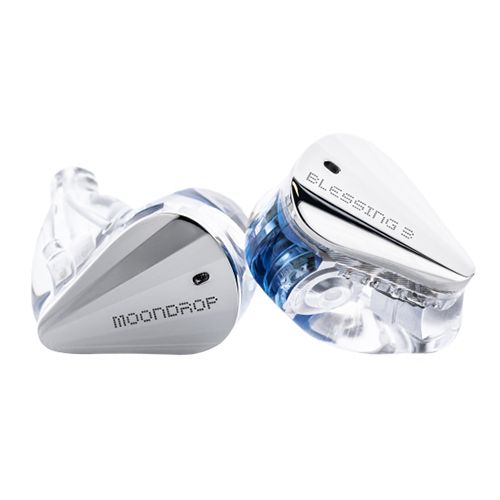
The Blessing 3 packs six drivers per side: two 10mm dynamic drivers plus four balanced armature drivers, commonly written as a 2DD+4BA configuration. The two dynamic drivers sit in what Moondrop calls a Horizontally Opposed Dual Dynamic Driver Unit System, shortened to H.O.D.D.U.S in their marketing material. In plain terms, the two dynamic drivers face each other inside the shell rather than firing in the same direction, which is meant to cancel out some of the internal air pressure resonance that a single dynamic driver can create.
- 2 x 10mm dynamic drivers, horizontally opposed configuration
- 4 balanced armature drivers split across midrange and treble duties
- Impedance: 14.8Ω ±15%
- Sensitivity: 120dB/Vrms
- Frequency response: 10Hz–30kHz (effective 20Hz–20kHz)
Why two dynamic drivers instead of one
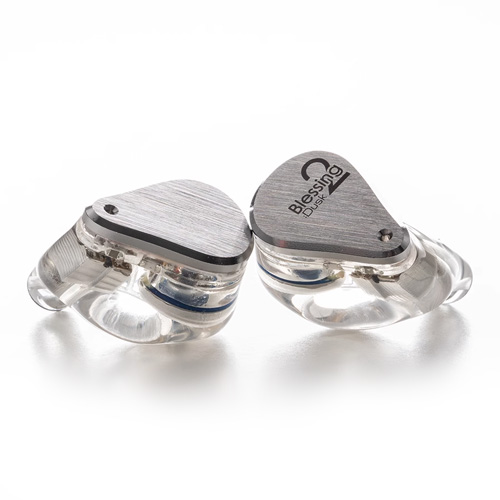
In a typical single dynamic driver design, the diaphragm has to move a meaningful volume of air inside a sealed shell, and that air pressure pushes back against the diaphragm’s own motion, which can smear transient response at the extremes. By placing two dynamic drivers opposite each other, the pressure waves partially cancel, which in theory lets each driver move more freely and produce cleaner, faster bass. In practice, the low end on the Blessing 3 does sound noticeably tighter and quicker than the single-dynamic Blessing 2, with less of the slight bloom I noticed in the older model.
The four balanced armatures then split into a two-way crossover for mids and highs, similar in spirit to the Blessing 2’s approach but refined with updated armature models and an updated acoustic filter network to smooth out the handoff points between drivers.
Does the extra driver actually matter for sound quality
Yes, though maybe not in the way a marketing page implies. The biggest audible difference over the earlier Blessing 2 isn’t raw driver count, it’s bass control. Fast bass lines in electronic and hip-hop tracks sound noticeably more defined rather than smeared, and the low end extends a bit deeper without becoming boomy. Mids and treble are also cleaner, but that owes more to updated armature parts and crossover tuning than to the dual-dynamic gimmick specifically.
If you already own the Blessing 2 and are happy with its tuning, the driver upgrade alone probably is not enough reason to jump to the Blessing 3 unless bass tightness has been a specific complaint for you.
Build quality and comfort
The shell uses a metal faceplate over a resin body with 0.78mm 2-pin detachable connectors, matching the connector standard used across most of Moondrop’s lineup. Fit felt secure through a few hours of continuous wear, though as always, individual ear shape will matter more than any general comfort claim.
How the crossover network was refined
Beyond the headline dual dynamic driver story, a good chunk of the Blessing 3’s improvement over its predecessor comes down to unglamorous crossover engineering. Moondrop refined the passive crossover network that splits signal between the dynamic drivers and the four balanced armatures, smoothing out the frequency handoff points where one driver’s output blends into the next. On the Blessing 2, I could occasionally pick out a faint seam in the upper-bass-to-lower-midrange transition on certain recordings with a lot going on in that range, like layered rock instrumentation. On the Blessing 3, that seam is essentially inaudible, which speaks to how much of “driver upgrade” marketing is really about the supporting circuitry rather than the drivers themselves getting all the credit.
This matters for anyone deciding whether the Blessing 3 is worth the price jump purely based on the driver count headline. The six-driver total configuration gets the attention, but the tuning discipline behind the crossover is arguably just as responsible for how coherent the final sound is.
Real-world listening notes
I spent a few weeks using the Blessing 3 as my primary desk IEM during work hours, mixing in podcasts, video calls, and actual critical listening sessions on evenings and weekends. During calls, the improved midrange clarity made voices sound noticeably more natural than on older single-dynamic-driver IEMs I’ve used for the same purpose. During music sessions, genres with fast, complex bass lines — drum and bass, certain metal subgenres, dense electronic production — are where the dual dynamic driver setup earns its keep most obviously. Slower, more atmospheric music doesn’t showcase the upgrade nearly as dramatically, which is worth knowing if your listening habits skew toward ambient or acoustic genres rather than bass-forward production.
Troubleshooting Fit and Cable Issues
- Seal feels incomplete or bass sounds thin: try a different stock eartip size before assuming a driver problem, since a partial seal affects bass the most on any dynamic-driver IEM.
- One side sounds quieter: reseat the 2-pin cable connector firmly on that side, since a slightly loose connector is a common and easy-to-miss cause of channel imbalance.
- Cable feels stiff or tangles easily: this is a stock cable characteristic rather than a fault, and swapping to an aftermarket 0.78mm 2-pin cable is a straightforward fix if it bothers you.
- Alternate path: if the stock cable’s termination does not match your source (single-ended vs balanced), a compatible 2-pin aftermarket cable lets you switch termination without buying new IEMs.
Frequently asked questions
What driver configuration does the Moondrop Blessing 3 use?
Two 10mm dynamic drivers in a horizontally opposed layout, plus four balanced armature drivers, for six drivers total per side.
Is the dual dynamic driver setup just marketing, or does it actually help?
It genuinely contributes to tighter, faster bass response by reducing internal air pressure resonance, though the overall sound improvement over the Blessing 2 also comes from updated armature drivers and crossover tuning.
Does the Blessing 3 need a dedicated amplifier?
Not strictly. At 14.8Ω and 120dB/Vrms sensitivity it is efficient enough for phones and dongles, though a clean source will let you hear the driver improvements more clearly.
Is the Blessing 3 a big upgrade from the Blessing 2?
The biggest gains are in bass control and separation. If your priority is smoother, more relaxed mids and highs rather than bass tightness, the improvement may feel incremental rather than transformative.
Wrapping up
The Blessing 3’s driver engineering is a legitimate step forward rather than just a bigger number on a spec sheet, and the dual dynamic driver approach solves a real problem that single-driver designs run into. Whether it’s worth the upgrade cost from an existing Blessing 2 depends entirely on whether tighter bass is something you have been missing.
About the author: I have spent more hours than I’d like to admit reading driver whitepapers so that reviews like this one don’t have to repeat marketing claims uncritically.