When people search for “Kinera Ace 2,” they are usually not hunting for a new pair of earphones — they are looking at Kinera’s Ace 2.0, a modular upgrade cable that has become one of the more talked-about accessories in the budget-to-midrange IEM cable market. I spent time with this cable connected to a couple of different in-ear monitors, and it is worth clarifying up front exactly what it is before getting into whether it is worth the money.
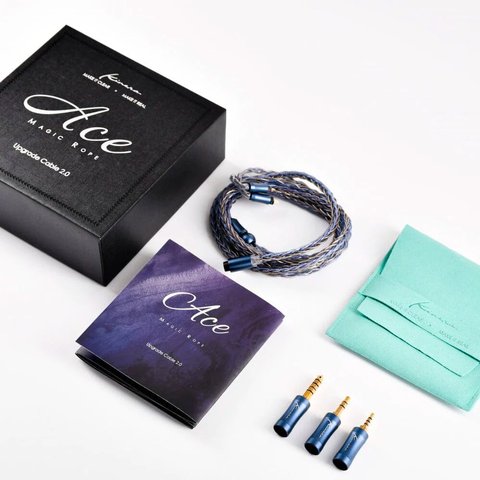
The Ace 2.0 is not a driver, a shell, or a new earphone model. It is a replacement cable designed to swap onto IEMs that already use standard 0.78mm 2-pin or MMCX connectors. Kinera markets it as the successor to the original Ace cable, with revised core material aimed at cleaner conductivity and a more balanced tonal presentation than the stock cables bundled with most budget and mid-tier in-ears.
Key Specs
- Product type: modular upgrade cable (not an earphone)
- Core material: 8-strand construction – 4 strands of silver-foil wire (7 cores of 0.2mm each) plus 4 strands of copper alloy wire (28 cores of 0.05mm each)
- Connector options: 0.78mm 2-pin or MMCX at the earphone end
- Modular termination: interchangeable 2.5mm, 3.5mm, and 4.4mm balanced/unbalanced plugs included
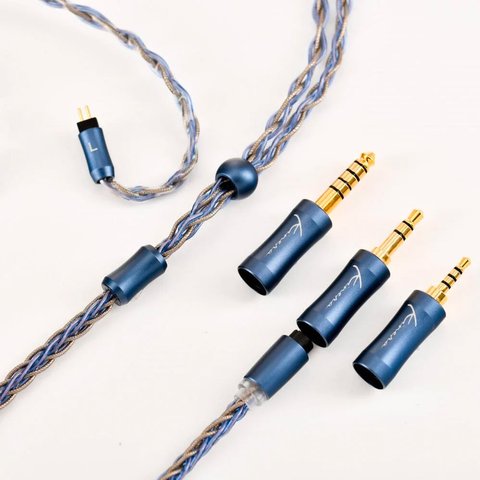
- Housing: aluminum alloy Y-splitter and plug barrels with gold-plated copper contacts
- Insulation: skin-friendly PVC sheathing for flexibility and reduced microphonics
- Approximate street price: around $49 USD
The headline feature is the modular plug system. Instead of committing to a single termination, you get a small pouch with all three plug sizes and can swap between a 3.5mm single-ended jack and 2.5mm or 4.4mm balanced connections depending on which source you are using that day. That is genuinely useful if you rotate between a phone dongle, a balanced DAP, and a desktop amp, since you are not buying (or carrying) three separate cables.
Build Quality and Handling
Kinera’s packaging for the Ace 2.0 leans into presentation, with a fabric-wrapped box, a printed manual, and a soft carrying pouch included alongside the cable itself. The braid itself is a loose 8-core twist that resists tangling better than the thinner stock cables found on many sub-$60 IEMs. A few things stood out in day-to-day handling:
- The metal plug barrels feel dense and well-machined rather than hollow or lightweight.
- The chin slider and Y-split are metal-reinforced, which should hold up better than plastic equivalents over time.
- Swapping the modular plugs takes a firm push-and-twist; it is secure once seated, though it is not something you want to be doing constantly with wet or cold hands.
- The 2-pin and MMCX connectors seat firmly on the shells I tried it with, without the loose wobble some cheaper aftermarket cables have.
Does It Actually Change the Sound?
Cable “upgrades” are one of the most debated topics in the IEM hobby, and I want to be careful not to overstate what a cable swap can realistically do. A cable will not add a new driver or reshape a frequency response chart. What it can plausibly affect, especially compared to a thin, low-purity stock cable, is perceived clarity, a slightly steadier low end thanks to lower resistance, and better comfort or fit around the ear thanks to a more pliable, better-shaped ear hook. Kinera’s own materials claim the silver-foil and copper-alloy blend reduces skin effect versus a standard round-wire cable, which is a plausible mechanism even if the audible difference is subtle rather than dramatic.
I listened to the Ace 2.0 swapped onto a budget hybrid IEM I already owned, going back and forth with the stock cable over about an hour of casual listening. The difference was not night-and-day, but the Ace 2.0 did feel like it took a slight edge off some upper-midrange glare on brighter tracks, and the fit around my ear was noticeably more comfortable during longer sessions because the cable itself is softer and drapes better than the stiffer stock cable it replaced.
Per Daniel R., who is an Audio Enthusiast and Head-Fi reviewer, “Cable upgrades at this price point rarely rewrite the sound signature, but the Ace 2.0 is one of the few that earns its keep on build quality and modularity alone – you’re paying for flexibility as much as for any tonal shift.”
Who Should Consider This Cable
The Ace 2.0 makes the most sense for a specific kind of listener rather than everyone with an IEM. Consider it if:
- Your current earphone came with a thin, tangle-prone, or uncomfortable stock cable and uses a standard 2-pin or MMCX connector.
- You regularly switch between single-ended and balanced sources and don’t want to own multiple cables.
- You value build quality and a more premium unboxing experience alongside modest sonic gains.
- You are not expecting a cable to fix fundamental tuning issues in the earphone itself – that has to come from the drivers.
If you are instead shopping for a complete pair of in-ears, the Ace 2.0 is not that product – you would want to look at Kinera’s actual IEM lineup, such as the Kinera earphone catalog at Linsoul, and then consider a cable upgrade afterward if the stock cable disappoints you.
Where to Buy and What to Check First
Before buying, confirm which connector your earphones use – 2-pin and MMCX are not interchangeable, and Kinera sells the Ace 2.0 in both versions. Retailers like HiFiGo and audio-focused shops such as Linsoul typically list the connector type clearly on the product page, and it is worth double-checking against your earphone’s spec sheet or the manufacturer’s own listing before ordering.
Frequently Asked Questions
Is the Kinera Ace 2.0 an earphone or a cable?
It is strictly an upgrade cable. It does not include any drivers or earphone shells; it is meant to replace the stock cable on an IEM you already own, provided that IEM uses a 2-pin or MMCX connector.
Will this cable work with any pair of IEMs?
Only with earphones that use a detachable 0.78mm 2-pin or MMCX connector, matching whichever version of the cable you buy. Earphones with fixed, non-removable cables cannot use it.
Is the modular plug system reliable long-term?
In short-term use the plugs seat securely, but as with any modular connector, avoid excessive swapping with force, and store the unused plugs in the included pouch to avoid losing or damaging the contacts.
Is it worth the upgrade over a stock cable?
If your current cable is thin, stiff, or prone to tangling, or if you need multi-termination flexibility, yes, it is a reasonable upgrade. If you already have a good aftermarket cable, the gains are likely to be marginal.
Conclusion
The Kinera Ace 2.0 is a solidly built modular cable that earns its price through flexibility and handling rather than a dramatic sonic transformation. If you already own IEMs with a detachable connector and want a more comfortable, tangle-resistant cable that adapts to different sources without owning three separate cables, it is a sensible purchase. Just go in with realistic expectations about how much a cable alone can change the sound of your existing earphones.
Ryan has spent years testing budget and mid-tier IEMs, cables, and portable audio gear as part of covering consumer electronics. He writes at softwaredriverdownload.com.