A quick correction before anything else: the ISDT BG-8S is not a battery charger. It is a battery checker, balancer, and small power bank built around ISDT’s BattGo technology, and understanding that distinction is the key to using it correctly. This guide breaks down what the BG-8S actually does and how to read its display.
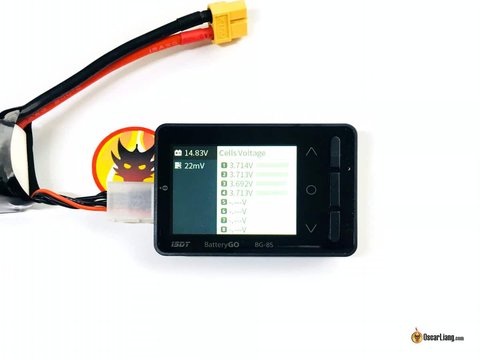
Key Specs
- Compatible with 1-8S batteries, voltage range 5-36V
- 2.4-inch, 320×240 sunlight-readable color display
- XT60 main connector plus a separate balance port
- USB output supports QC3.0 and BC1.2, up to 12V/2A for charging phones or other USB devices
- Supports LiHV, LiPo, LiIon, LiFe, NiMH, and NiCd chemistries
- Rated voltage accuracy of approximately +/-0.005V per cell
What the BG-8S Actually Does
The name BattGo comes from ISDT’s cell-monitoring protocol, and the BG-8S is essentially a precision voltmeter with a few extra tricks layered on top:
- Displays per-cell voltage for packs from 1S up to 8S
- Acts as an active balancer, bleeding higher cells down closer to the pack average
- Doubles as a USB power bank, outputting up to 12V/2A through Quick Charge or BC1.2 compatible ports
- Can test receiver and BEC voltage on RC aircraft setups
Reading the Manual: Pre-Flight Check Workflow
The most common use case is a pre-flight or pre-run safety check. The workflow described in the manual is straightforward:
- Plug the main XT60 lead into the battery’s main connector
- Plug the balance lead into the matching balance tap
- Read total pack voltage and individual cell voltages on the 2.4-inch display
- Watch for any cell that sits noticeably below the others, which signals a weak or aging cell
Using It as a Balancer
Beyond just reading voltages, the BG-8S can actively balance a pack by bleeding excess charge from cells that are higher than the rest. This is not a replacement for balance charging on a full charger, but it is a useful top-up tool between full charge cycles, especially for packs that see frequent partial cycling in drone racing.
The USB Power Bank Feature
One detail that surprises new owners is that the BG-8S can output USB power from whatever LiPo pack is connected to it, supporting fast-charge protocols:
- QC3.0 support for compatible Android devices
- BC1.2 support for broader USB device compatibility
- Up to 12V/2A output, enough to top up a phone at the flying field
Comparing the BG-8S to a Full Charger’s Balance Function
It helps to understand where the BG-8S fits relative to a full charger’s built-in balancing:
- A charger like the IMAX B6AC balances during a full charge cycle, drawing from the main charge current
- The BG-8S balances independently of charging, useful for quick top-ups between sessions without a full charge cycle
- Neither replaces the other; many hobbyists use both in their routine
Storing and Traveling With the BG-8S
Because it is small and battery-powered through whatever pack is plugged in, the BG-8S travels well:
- It fits easily in a field bag alongside spare batteries
- The sunlight-readable display is genuinely useful outdoors, unlike many standard LCD screens
- Keep the XT60i connector clean, since dirt or debris there can cause inconsistent voltage readings
What BattGo Compatible Batteries Add
Some newer LiPo packs include a small BattGo chip embedded in the battery itself, which the BG-8S can read directly for extra information beyond raw voltage:
- Charge cycle count stored on the pack itself
- Manufacturing date and rated capacity
- A running history of past voltage readings on compatible packs
Packs without a BattGo chip still work fine with the BG-8S, they simply do not expose this extra history data.
When a Cell Reading Signals a Real Problem
Not every voltage difference between cells is cause for alarm, but a few patterns on the BG-8S display are worth acting on:
- A single cell reading more than 0.1V below the others after a full charge
- A cell that will not hold voltage over a few minutes of monitoring
- Physical puffing on a pack combined with an unusually low cell reading
Any of these are good reasons to retire a pack rather than keep cycling it.
I used a BG-8S to check a stack of 6S packs before a flying session and found one pack with a cell sitting about 0.15V below the rest, something I would not have caught with a simple pack-voltage checker. Balancing it down on the BG-8S for a few minutes brought the cells back in line before I put it through a proper charge cycle later that day.
“I keep it in my field bag purely for the pre-flight cell check, the phone charging is just a nice bonus.”
— Chen W., FPV Drone Pilot, RC Groups Reviewer
Frequently Asked Questions
Is the ISDT BG-8S a battery charger?
No, it is a battery checker, balancer, and USB power bank. It does not perform full charge cycles the way a dedicated charger like the ISDT SC-608 or D2 does.
How many cells can the BG-8S handle?
It supports 1S through 8S batteries across a 5-36V range, covering most common RC LiPo, LiFe, and LiHV packs.
Can I charge my phone with the BG-8S?
Yes, its USB output supports QC3.0 and BC1.2 up to 12V/2A, drawing power from whatever battery is connected.
How accurate is the voltage reading?
ISDT rates it at roughly +/-0.005V per cell, which is precise enough to catch a weak or unbalanced cell before it becomes a safety issue.
Conclusion
The BG-8S fills a gap that a lot of RC hobbyists do not realize exists until they use one: a fast, accurate way to check individual cell health before a flight or run, without hooking a whole pack up to a full charger. Once you stop thinking of it as a charger and start thinking of it as a diagnostic tool, it earns its spot in a field bag quickly.
Ryan studied computer science and has since made a habit of benchmarking and reviewing hardware before recommending it to readers, including carrying pre-flight battery checkers like the BG-8S to field-test packs before every session. He writes at softwaredriverdownload.com.