The Foxeer Mega 3.5 is a 166mm deadcat-style carbon frame made for 3.5-inch freestyle builds. It supports analog and several digital video systems, but its 85g frame weight means motor, battery and tune choices should be planned as a complete system.
I built a Mega 3.5 frame with a slightly larger stack than intended and had to notch one of the standoffs for clearance. Checking the frame’s documented stack clearance before ordering parts would have avoided the extra work.
This guide explains the frame geometry, camera and VTX compatibility, recommended assembly order, weight control and the vibration problems that can appear on a powerful 3.5-inch build. It also covers the main difference between the 3.5-inch and related 4-inch Mega versions.
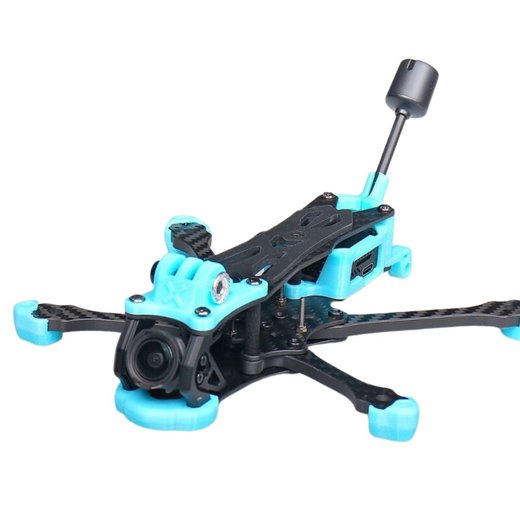
Key specifications
Item Details Frame style Deadcat freestyle Propeller class 3.5-inch Wheelbase 166mm Material Toray T700 carbon Frame weight About 85g without TPU Centre mounting 25.5mm M2 Rear…
What the deadcat layout changes
A deadcat frame moves the front motors outward so the front propellers are less likely to appear in an HD camera view. The trade-off is asymmetric geometry, which can produce…
Plan the target weight before buying motors
The frame itself is relatively heavy for a 3.5-inch class. A large digital air unit, heavy action camera and oversized battery can push the finished build into a weight range…
Video-system and camera fit
The rear mounting area supports several common digital and analog VTX layouts with the correct TPU or hardware. The camera area accepts micro-size cameras, but lens position…
Key specifications
| Item | Details |
|---|---|
| Frame style | Deadcat freestyle |
| Propeller class | 3.5-inch |
| Wheelbase | 166mm |
| Material | Toray T700 carbon |
| Frame weight | About 85g without TPU |
| Centre mounting | 25.5mm M2 |
| Rear mounting | 20 × 20mm or 25.5 × 25.5mm M2 |
| Camera support | 19mm and 20mm classes |
| Video systems | O3, analog, Vista, HDZero and Walksnail with suitable mounts |
What the deadcat layout changes
A deadcat frame moves the front motors outward so the front propellers are less likely to appear in an HD camera view. The trade-off is asymmetric geometry, which can produce different pitch and roll behaviour compared with a true-X frame.
Modern flight-controller firmware can fly the layout well, but the mechanical build must be straight. A twisted arm or uneven motor height makes the asymmetry harder to tune.
Plan the target weight before buying motors
The frame itself is relatively heavy for a 3.5-inch class. A large digital air unit, heavy action camera and oversized battery can push the finished build into a weight range where small motors run hot and flight time falls.
Choose motor size, KV, battery voltage and propeller as one system. A 6S build may use lower KV than a 4S build. Do not copy only the motor number from another build without matching its battery and all-up weight.
Video-system and camera fit
The rear mounting area supports several common digital and analog VTX layouts with the correct TPU or hardware. The camera area accepts micro-size cameras, but lens position matters if prop-free footage is the goal.
Dry-fit the camera, VTX and antenna before soldering. Confirm that the USB port, microSD slot and antenna connector remain accessible after the top plate is installed.
Recommended build order
- Check the kit and identify the 3.5-inch plates.
- Deburr carbon edges and clean dust.
- Dry-assemble the arms and lower plates.
- Install motors and route wires before the electronics stack.
- Fit the ESC and FC with correct isolation.
- Mount the VTX with airflow and cable strain relief.
- Install the camera and check the full angle range.
- Place the receiver, GPS and antennas away from high-current wiring.
- Run continuity and smoke-stopper tests.
- Install the top plate and verify propeller clearance.
Do not mix screws from the 4-inch Mega kit or another Foxeer frame. A screw that is too long can touch a motor winding or damage an electronic board.
Battery and action-camera placement
A top-mounted battery should sit close to the centre of gravity. Moving it too far backward to clear the front camera can make the aircraft pitch differently and increase rear-motor load.
An action camera adds a large percentage to the total weight. Use a secure mount and test motor temperature after short flights. If the build is intended mainly for onboard HD recording, the digital air-unit recording may be a better weight compromise than a second camera.
Tune and vibration strategy
Start with mechanically sound parts and conservative filters. A bent 3.5-inch propeller can create strong high-frequency vibration. Replace damaged props before increasing filtering or lowering PID values.
Because the front and rear geometry differ, pitch response may not exactly match roll with copied settings. Make small changes and check motor temperature after each test.
Common Mega 3.5 build problems
| Build problem | Likely cause | Practical fix |
|---|---|---|
| Arms do not sit flat | Hardware fitted in the wrong order | Loosen the stack, align every plate, then tighten gradually |
| Camera view shows props | Camera too far back or angle too low | Move the camera forward or change the side-plate position |
| Jello in HD video | Loose camera mount, bent prop or soft stack | Balance the mechanical build before changing filter settings |
| VTX overheats | No airflow or antenna problem | Fit the antenna first and leave an air path around the VTX |
| Frame resonates | Loose arm bolts or damaged carbon | Inspect each arm and use thread-lock only on metal-to-metal joints |
If the front props still appear in the camera, check the lens position and camera angle before changing the frame. A wide lens pushed too far back can still see prop tips on a deadcat layout.
If pitch flips overshoot while roll feels normal, confirm frame alignment, motor direction and centre of gravity, then adjust tune values gradually. Do not treat the difference as proof that the FC is faulty.
Mega 3.5 versus Mega 4-inch parts
The related 4-inch version has a longer wheelbase and different propeller clearance. Arms, TPU and camera spacing should not be assumed interchangeable.
Measure the frame and check the product description before ordering spares. The number printed in a reseller title is more reliable than the colour or general plate shape.
Who the frame suits
The Mega 3.5 suits pilots who want a strong digital freestyle build and accept more frame weight than an ultralight toothpick. It is less suitable when the priority is minimum weight, quiet indoor flight or very long endurance.
Before starting a new build, check that spare arms and the correct TPU files remain available. A durable frame still needs replaceable crash parts.
Sources and further reading
Conclusion
Measure the exact frame revision, dry-fit every component and solve mechanical vibration before tuning software. A careful build with accessible wiring and available spare arms is more reliable than a crowded build based only on headline compatibility.
Frequently Asked Questions
Is the Foxeer Mega 3.5 a complete drone?
No. It is a frame kit that needs motors, flight electronics, video system, receiver and battery.
Does it support DJI O3?
The frame is sold with O3 support using the appropriate rear and camera mounting parts.
What is the wheelbase?
The 3.5-inch deadcat version is listed at 166mm.
Why do pitch and roll feel different?
Deadcat geometry is asymmetric. First check build alignment and centre of gravity, then tune gradually.
Can Mega 4-inch parts fit the 3.5-inch frame?
Do not assume they fit. The wheelbase, arms and clearance differ, so order parts for the exact size.
Ryan covers streaming, drone, and camera gear at softwaredriverdownload.com, drawing on years of setting up and breaking down rigs for reviews.