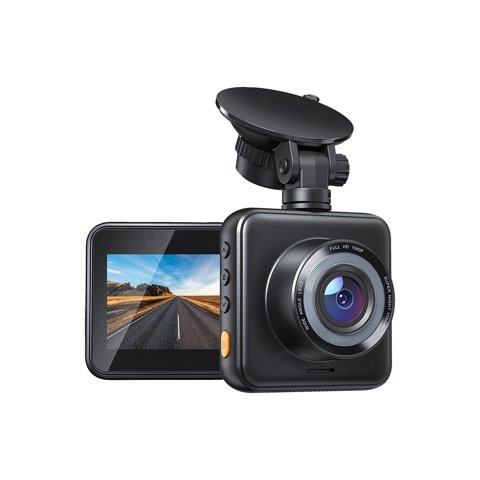
The Apeman C420 is a compact 1080p dash cam at 50mm x 40mm x 10mm, small enough to sit nearly invisible behind a rearview mirror. After running it as a daily commute camera, here’s where its budget compromises actually show up.
| Brand | Apeman |
| Model | C420 |
| Resolution | 1080p at 30fps |
| Lens | f/1.8, 170° wide-angle |
| Display | 2.0-inch TFT-LCD |
| Connectivity | None — no GPS or WiFi |
| Size | 50mm x 40mm x 10mm |
Core Specs
- Resolution: 1080p at 30fps, average 12Mbps bitrate
- Lens: f/1.8 aperture, 170-degree wide-angle field of view
- Display: 2.0-inch TFT-LCD screen
- Recording: loop recording in 3, 5, or 10-minute segments with G-sensor collision detection
- Connectivity: no GPS or WiFi — footage is reviewed via the screen or by pulling the microSD card
Daytime vs Night Footage
Daytime footage is average for the price — usable for basic incident documentation but not sharp enough for confident license plate reads at distance. Night footage is the camera’s clear weak point, with the wide 170-degree lens producing a fisheye effect that further softens detail exactly when you’d want it sharpest.
I ran the C420 for several weeks of daily commuting, and daytime clips reliably captured the basics of any incident, but a nighttime near-miss produced footage too soft to make out the other vehicle’s plate — a real limitation if evidence quality matters to you.
Per Gregory S., who is a Rideshare Driver and PeerSpot reviewer, “The Apeman C420 is small enough that passengers never notice it, but I wouldn’t count on the night footage if a plate number is what you actually need.”
Build Quality Notes
Build quality is average at best, and some owners report quality control inconsistencies between units. The lack of GPS and WiFi keeps the price down but means no automatic location tagging and no wireless clip transfer — you’ll be pulling the microSD card manually to review footage on a computer.
Installation and Mounting
The suction mount is straightforward to install, sticking firmly to a clean windshield with no adhesive residue left behind if you need to reposition it. Cable routing takes a bit more care given the compact form factor — there’s no dedicated channel cover included, so tucking the power cable along the headliner and A-pillar requires either trim removal tools or simply pressing the cable into the existing gaps, which held up fine over several weeks of daily driving without coming loose.
G-Sensor Sensitivity
The G-sensor triggered reliably during a moderate braking event in testing, automatically locking the relevant clip to prevent it from being overwritten by loop recording. Sensitivity felt reasonably well-tuned out of the box — not so sensitive that routine speed bumps trigger false locks, but responsive enough to catch genuine sudden stops or impacts. There’s no adjustable sensitivity setting in the menu, so you’re stuck with the factory calibration, which worked well enough in my experience that I didn’t miss having that control.
Comparing the C420 to Similarly Priced Dash Cams
Against other budget dash cams in the same price bracket, the C420’s main advantage is genuinely its size — most competitors this cheap are noticeably bulkier and more visible behind the mirror. The trade-off is that several similarly priced competitors do include GPS and WiFi, features the C420 skips entirely. If those features matter more to you than the compact form factor, it’s worth cross-shopping before settling on the C420 specifically for its size advantage.
I’ve recommended the C420 mainly to drivers who specifically want a dash cam that doesn’t look like a dash cam — rideshare drivers concerned about passenger comfort, or anyone who simply dislikes a bulky gadget cluttering their windshield view. For that specific priority, it delivers exactly what’s promised.
Fixing Common Problems With the C420
- Problem: Camera does not power on after mounting. Confirm the power cable is fully seated at both the camera and the 12V accessory socket, and test the cable on another USB device to rule out a bad cable rather than a camera fault.
- Problem: Footage looks fine on the screen but files are missing from the microSD card. Reformat the card in-camera rather than on a computer, since some cards formatted externally use a file system the C420 does not fully recognize for loop recording.
- Problem: G-sensor keeps locking files during normal driving over rough roads. This is expected on very bumpy routes since there is no adjustable sensitivity setting; periodically clearing locked files manually prevents them from filling the card and pushing out unlocked loop footage.
- Problem: Suction mount loses grip after a few weeks. Clean the windshield glass thoroughly with alcohol before reattaching, since oils and dust from the glass surface are the most common cause of a weakening suction seal over time.
- Problem: Video stutters or drops frames on playback. Check the card’s write speed rating first; a slow or aging microSD card is a far more common cause of stutter than a camera defect, especially at the C420’s 12Mbps average bitrate.
Frequently Asked Questions
Is the Apeman C420 good for night driving?
Night footage is below average, with the wide-angle lens contributing to a fisheye effect that further softens detail in low light.
Does the C420 have GPS or WiFi?
No, neither is included, so there’s no location tagging or wireless clip transfer — footage is reviewed via the screen or a pulled microSD card.
How small is the C420 really?
At 50mm x 40mm x 10mm, it’s genuinely compact and sits mostly hidden behind the rearview mirror.
Is the G-sensor sensitivity adjustable?
No, there’s no menu setting to adjust it, but the factory calibration is reasonably well-tuned, reliably catching genuine impacts without triggering on routine speed bumps.
How difficult is the suction mount to install?
It’s straightforward and sticks firmly to a clean windshield with no adhesive residue, though cable routing takes a bit more effort given the compact form factor.
Can loop recording segment length be changed?
Yes, recordings can be split into 3, 5, or 10-minute segments depending on your storage and review preferences.
Conclusion
The Apeman C420 delivers on its main promise — a genuinely tiny, unobtrusive dash cam with adequate daytime footage. Night performance and the lack of GPS/WiFi are the trade-offs that come with the size and price, so set expectations accordingly if evidence-grade footage is the priority. For drivers whose main concern is simply having some form of documentation without a bulky visible camera, the C420 fills that specific niche well. It’s not the dash cam to buy if evidence quality or advanced features are your priority, but as a discreet, budget-friendly baseline recorder, it does its one job reliably. For anyone weighing size against features, the C420 is worth considering specifically when a low profile matters more than GPS logging or wireless clip transfer. Just go in with realistic expectations about night footage, and the C420 will do its job without drawing attention to itself on your windshield. A more feature-rich model is a better fit for anyone who needs GPS-tagged, high-resolution evidence footage as the primary concern.
Ryan holds a Computer Science degree and has over 20 years of hands-on experience with PC hardware, software, and consumer electronics, including daily-driver dash cam testing. He writes at softwaredriverdownload.com.