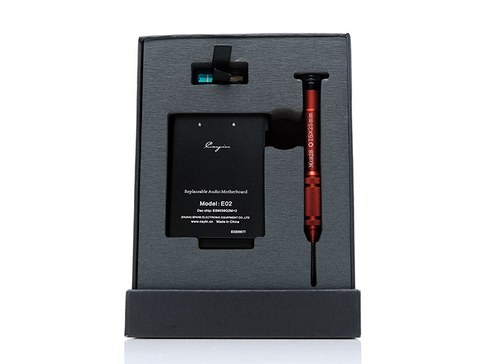
Cayin’s N6ii digital audio player has one unusual party trick: its DAC and amplifier stage isn’t fixed. It lives on a small swappable motherboard that slots into the bottom of the player, so instead of buying an entirely new DAP every time you want a different sound signature, you buy a new module. The E02 is one of those modules — the fourth released for the N6ii — and it’s worth being upfront about what that means before getting into how it sounds: this is not a standalone amplifier or dongle you can use on its own. It only exists, and only works, attached to an N6ii chassis.
Cayin E02 Quick Specs
| Compatible player | Cayin N6ii only (not the N6iii) |
| DAC chips | Dual ES9038Q2M |
| Amplification | Class AB balanced, discrete four-channel topology |
| Release order | Fourth module released for the N6ii |
| Strengths | High output power, clean line-out, forward and dynamic presentation |
| Installation | Tool-free, user-swappable, no soldering |
| Price | $419 |
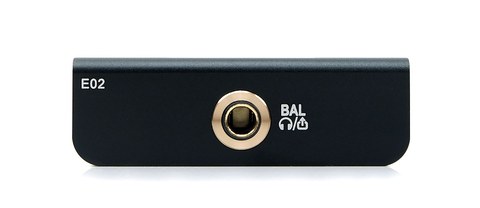
What the E02 adds to the N6ii is a genuinely different amplification approach from the modules that came before it. It runs Class AB balanced amplification paired with dual ES9038Q2M DAC chips, wired through a discrete-engineered four-channel balanced topology. In plain terms, that’s a real balanced circuit built from discrete components rather than a simpler chip-based implementation, and Headfonics described it at release as Cayin’s most dynamic-sounding and most powerful N6ii motherboard to date — a meaningful claim given how many modules had already shipped for this platform by that point.
The practical upside of that engineering choice shows up in two places. First, output power: this is a card built to properly drive harder headphones through the balanced output rather than just nudging up the volume ceiling. Second, line-out quality: because the balanced circuit is fully discrete rather than relying entirely on the DAC chips’ own output stage, the line-out signal feeding into a separate amp is cleaner than what a simpler module can manage.
Sonically, both Headfonics and Twister6 describe the E02 as a step up in texture and layering through the midrange, with vocals in particular sounding more separated from the instrumental layers behind them. Treble comes across with a touch more sparkle and air compared to the module it succeeded, and Twister6’s comparison notes called out better overall dynamics — the sense of a track’s loud and quiet moments having more contrast rather than being compressed toward a flat middle ground. Battery life holds up reasonably well for a design this power-focused, a detail that matters more than it sounds like it should once you’re a few hours into a train ride or flight.
Should you buy the E02 specifically?
The honest answer depends entirely on whether you already own an N6ii. If you do, and you’re currently running an older or more basic module, the E02 at $419 is a meaningful upgrade path rather than a full new purchase — you keep the same chassis, screen, storage, and Android-based OS, and only swap the part that actually does the DAC and amp work. If you don’t own an N6ii, there’s no version of this purchase that makes sense on its own; you’d need to buy the player itself first, and the module is simply one of several amp/DAC “flavors” Cayin sells for it.
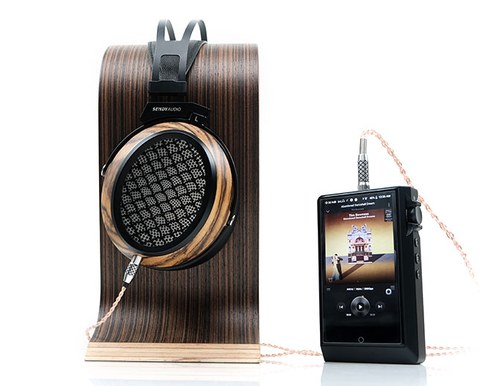
Within the N6ii’s own module lineup, the E02 tends to get recommended to listeners who want power and dynamics first, and a more forward, engaging presentation second. If your priority instead is the absolute smoothest or most tonally neutral output, it’s worth comparing notes against Cayin’s other N6ii modules before committing, since Cayin has built several with meaningfully different personalities rather than just different power ratings. Swapping the module is physically straightforward — a few screws and the supplied tool, no soldering — but it’s still worth handling carefully since you’re working directly with the DAP’s internal circuit board.
Troubleshooting Common E02 Issues
Since the E02 is a physical module rather than a standalone device, most reported problems come down to installation or gain staging rather than a defective card.
- N6ii doesn’t power on or recognize the module after swapping: Power the player fully off before removing or installing any module, then confirm the E02 is fully seated with the supplied tool’s screws snug (not overtightened) before powering back on.
- Balanced output sounds noticeably quieter than expected: Confirm the headphone’s balanced cable is genuinely wired for balanced operation and the 4.4mm or equivalent connector is fully inserted; a mislabeled or improperly wired “balanced” cable is a common cause of this complaint across modular DAPs generally, not just the N6ii.
- Line-out signal sounds noisy through an external amp: Try a different line-out cable first, since cheap cables are a more common culprit than the module itself, and double check the external amp’s input gain isn’t set unreasonably high for a line-level source.
- Battery drains faster after installing the E02: Expected to some degree, since this module is tuned for higher output power, which draws more current than a lower-power module. If the drop feels extreme, check that Bluetooth, Wi-Fi, and screen brightness settings weren’t also changed around the same time.
- Module feels stuck when trying to remove it: Don’t force it. Recheck that all mounting screws are fully removed first; forcing a module that still has a screw engaged risks damaging the connector pins on both the module and the player.
A quick word on the difference between the N6ii and N6iii platforms
It’s easy to mix these up because the names are so close, but the E02 is built specifically for the N6ii, not the newer N6iii. The two players use different module standards, so an N6ii module like the E02 will not physically fit or function in an N6iii chassis. If you’re shopping for modules and see one labeled for the N6iii instead, such as the E203, that’s a different card for a different (newer) player, not an alternative version of the same product.
Why the modular approach is worth understanding before you buy
The idea of a DAP with a swappable DAC/amp board sounds like a gimmick until you actually price out the alternative. A dedicated portable DAP with a fixed internal amp typically means starting over — new chassis, new screen, new battery, new firmware — every time you want a meaningfully different sound signature or more driving power. Cayin’s module system decouples that decision from everything else the player does. The screen, the storage, the Android-based interface, and the physical body all stay the same; only the part responsible for turning digital audio into an analog signal changes.
That matters most for people who already have a favorite chassis and just want to chase a different tonal balance or higher output for a new pair of headphones. It’s a genuinely different ownership model from almost anything else in portable audio, and it’s the main reason cards like the E02 get reviewed and discussed as their own products rather than as accessories — the module is, for practical listening purposes, most of what defines how the player actually sounds.
Frequently asked questions
Can I buy the Cayin E02 as a standalone amplifier?
No. It’s a DAC/amp motherboard module that only functions installed inside a Cayin N6ii digital audio player. It has no independent power supply, housing, or connectivity of its own.
Is the E02 compatible with the Cayin N6iii?
No. The N6ii and N6iii use different module designs, so E02 modules are built and sold specifically for the N6ii and will not fit the newer N6iii chassis.
Is installing the E02 into an N6ii difficult?
No, it’s designed to be user-swappable with a small included tool, typically just a few screws. It’s still worth taking care since you’re handling the player’s internal board directly.
What’s the main sonic difference between the E02 and earlier N6ii modules?
Reviewers consistently point to better dynamics, midrange texture, and treble airiness compared to earlier balanced modules, thanks to the discrete four-channel balanced design and dual ES9038Q2M DAC chips.