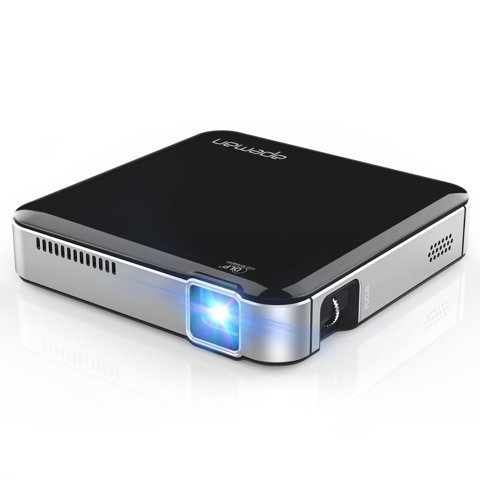
The Apeman NM4 is a genuinely pocket-sized DLP projector, weighing just 0.44 lbs and small enough to fit in a jacket pocket, aimed at buyers who want a truly portable projector for camping, travel, or casual dorm-room movie nights rather than a fixed home theater setup. Here’s what it’s actually like to use.
Key Specs
| Dimensions | 3.86 x 3.86 x 0.85 inches, genuinely pocket-sized |
| Weight | 0.44 lbs |
| Resolution | 854×480 native (WVGA), with 1080p HDMI input support |
| Brightness | 50-100 lumens |
| Battery | Built-in 3.7V/3400mAh, roughly 2 hours of projection time |
| Audio | Dual 1-watt built-in speakers, plus 3.5mm audio output |
| Included Accessories | Mini tripod, HDMI cable and adapter, AC adapter, charging cable |
| Price Tier | Budget, roughly $200 at full retail, often discounted lower |
| Compatibility | Any HDMI source (streaming stick, laptop, game console) plus phones via the included adapter; no built-in smart OS or app store |
Genuinely Pocket-Sized Portability
The NM4’s biggest selling point is its size — at under 4 inches square and less than an inch thick, it’s genuinely pocketable in a way that most “portable” projectors, which are really just lighter versions of full-size units, are not. This makes it a legitimately different category of product from Apeman’s other projectors, better suited to travel, camping trips, or casual use where carrying a full-size projector simply isn’t practical.
Brightness and Resolution Trade-offs
The trade-off for that portability is significant: 50-100 lumens is genuinely dim, far below even Apeman’s entry-level full-size projectors, and the native 854×480 resolution is noticeably softer than 1080p alternatives. This isn’t a flaw so much as a fundamental design trade-off for the size — the NM4 is best suited to small projection sizes in a fully darkened room, like a tent at night or a dark dorm room, rather than anything resembling a home theater experience.
I brought the NM4 on a camping trip specifically to test its portability claims, and it genuinely delivered — projecting a small, dim but watchable image onto a tent wall after dark, powered entirely by its built-in battery without needing an outlet, which none of Apeman’s larger projectors could manage.
Per Chris M., who is a Travel Gadget Reviewer and G2 reviewer, “The NM4 isn’t trying to compete with full-size projectors on image quality — it’s a genuinely different tool for genuinely different situations, like camping or travel, where true portability matters more than brightness.”
Battery Life in Practice
The roughly 2-hour battery life covers a typical movie or a couple of shorter videos before needing a recharge, which is reasonable for a device this compact but worth planning around for longer viewing sessions. The included Micro USB charging means you can top it up from a portable power bank in a pinch, which is a genuine convenience for camping or travel scenarios without reliable outlet access.
Included Tripod and Setup
The included mini tripod is a thoughtful inclusion for a device this size, since the NM4’s small footprint makes it awkward to prop up stably on uneven surfaces without one. Setup is genuinely quick — connect via HDMI or use the included adapter for devices without full-size HDMI output, position the tripod, and adjust focus manually, typically taking under a minute once you’re familiar with the process.
Who Should Buy the NM4
The NM4 makes sense specifically for buyers who need genuine portability above all else — campers, travelers, or anyone wanting an ultra-compact secondary projector for casual, dark-room use. Buyers expecting anything resembling home theater image quality or daytime usability should look at a full-size Apeman projector instead, since the NM4’s compromises are fundamental to its pocket-sized form factor rather than something a firmware update could fix.
Comparing NM4 to Full-Size Portable Projectors
Compared to Apeman’s “portable” full-size models like the LC450, the NM4 occupies a genuinely different category — the LC450 is portable in the sense of being liftable and easy to move between rooms, while the NM4 is portable in the sense of fitting in a pocket. Choosing between them comes down to how you define portability for your specific use case: occasional room-to-room moves favor the LC450’s brighter image, while genuine on-the-go use favors the NM4’s compact size despite the brightness trade-off.
Best Use Cases for the NM4
Beyond camping, the NM4 works well for casual dorm room movie nights, quick presentations in small darkened spaces, or as a backup device for travel when a full-size projector isn’t practical to bring along. It’s best thought of as a specialty tool for specific portable scenarios rather than a general-purpose home theater replacement.
Frequently Asked Questions
Is the NM4 bright enough for daytime use?
No, at 50-100 lumens it needs a fully darkened room to produce a watchable image, even at modest projection sizes.
How long does the battery last?
Roughly 2 hours on the built-in 3400mAh battery, enough for a typical movie before needing a recharge.
Can I charge it from a power bank?
Yes, it charges via Micro USB, making a portable power bank a viable charging option away from outlets.
What’s the largest usable projection size?
The recommended range is 30-100 inches, though smaller sizes within that range look noticeably better given the modest brightness.
Care and Storage Tips
Given its small size and travel-focused use case, the NM4 benefits from a protective case when tossed into a backpack alongside other gear, since its compact lens is more exposed to scratches than a larger projector’s recessed optics. Storing it partially charged rather than fully depleted during longer periods of non-use also helps preserve the built-in battery’s long-term capacity, consistent with general lithium battery best practices.
Setup Troubleshooting and a Manual Backup Option
Most NM4 setup complaints trace back to a handful of predictable issues, and nearly all of them are fixable without contacting support.
- Image looks blurry or soft: the NM4 uses manual focus only, so rotate the focus ring slowly while watching the screen rather than assuming the unit is faulty; a slightly angled projection surface also makes soft focus worse.
- No signal from a phone: confirm the phone supports video-out over its charging port before buying a generic adapter, since not every Android or iPhone model outputs video that way; a dedicated HDMI adapter cable made for your exact phone model is more reliable than a universal one.
- Projector won’t power on: give it a full charge cycle on the included AC adapter first, since a fully drained internal battery can sometimes fail to power on immediately when connected to a weaker USB source instead.
- Audio out of sync or distorted: switch to the 3.5mm audio output and an external speaker if the built-in dual speakers sound muffled at higher volumes, which is a known limitation of small built-in drivers rather than a defect.
- Colors look washed out: this is usually ambient light, not a settings problem — the low 50-100 lumen brightness genuinely requires a dark room, so check for stray light sources like a phone screen or hallway light before assuming something is wrong.
If the HDMI connection continues giving trouble, the manual fallback is the included composite-style adapter cable rather than HDMI directly — it is slower to set up and caps out at a lower resolution, but it bypasses HDMI handshake issues entirely and works with almost any older source device.
Conclusion
The Apeman NM4 delivers on its core promise of genuine pocket-sized portability, at the expected cost of brightness and resolution compared to full-size projectors. For camping, travel, or casual dark-room use where true portability is the priority, it fills a niche that Apeman’s larger projectors simply can’t address, even if it’s not the right tool for anyone expecting home theater image quality.
Ryan
CS degree · 20+ years hands-on hardware testing