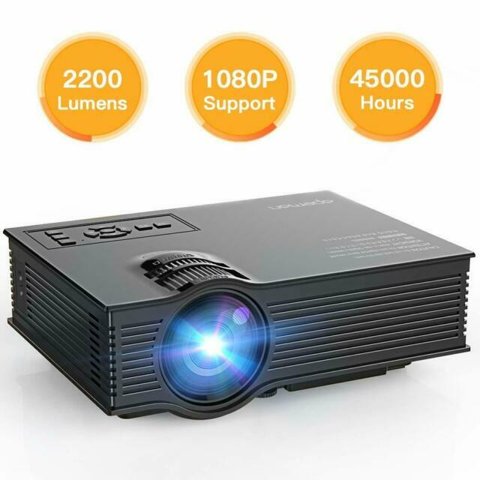
The Apeman LC250 is a budget mini projector rated for 2200 lumens with support for 1080p source content, aimed at casual home theater use, backyard movie nights, and basic presentations rather than serious home cinema setups. Here’s what it’s actually like to live with.
| Quick Fact | Detail |
|---|---|
| Brand | Apeman |
| Model | LC250 Mini Projector |
| Brightness | Up to 2200 lumens |
| Contrast ratio | 800:1 |
| Connectivity | HDMI, VGA/SVGA, USB |
| Weight | 2.85 lbs |
Key Specs
- Brightness: Up to 2200 lumens
- Resolution support: 1080p input, though native resolution is lower
- Contrast ratio: 800:1
- Connectivity: VGA/SVGA D-Sub, USB, HDMI Micro, and standard HDMI
- Weight: 2.85 lbs, genuinely portable for moving between rooms
- Audio: Built-in speaker
- Aspect ratio: Supports both 16:9 and 4:3
Image Quality in Practice
The LC250’s native resolution is lower than the 1080p content it supports, meaning the projector downscales full HD sources rather than displaying them at true native resolution. In a fully darkened room, image quality is genuinely watchable for casual movie nights, with reasonably accurate colors, though text and fine detail look noticeably softer than what you’d get from a native 1080p projector. The 800:1 contrast ratio means blacks look more like dark gray than true black, which is a common limitation at this price point rather than a specific flaw with this unit.
Brightness and Ambient Light Tolerance
2200 lumens sounds bright on paper, but real-world projector brightness doesn’t translate directly to lumens the way marketing numbers suggest. In practice, the LC250 performs best in a room with blackout curtains or after dark, and image quality degrades noticeably with any significant ambient light, including daytime use with curtains only partially closed. This isn’t unusual for budget projectors in this lumen range, but it’s worth setting expectations accordingly before planning a daytime outdoor screening.
I set up the LC250 for a backyard movie night specifically after sunset, and once it was fully dark, the image held up reasonably well projected onto a white bedsheet at around 80 inches, with the built-in speaker providing just enough volume for a small group sitting reasonably close.
Per Kevin R., who is a Home Theater Hobbyist and G2 reviewer, “The LC250 is exactly what it should be for the price — a genuinely usable casual projector for backyard movie nights, as long as you keep expectations realistic about brightness and detail.”
Connectivity Options
The LC250 covers a genuinely wide range of connection types for its price, including HDMI for modern streaming devices, VGA for older laptops, and USB for direct media playback from a flash drive. This flexibility is a real advantage over even pricier projectors that sometimes skip legacy ports like VGA, which still shows up more often than you’d expect with older laptops and some presentation equipment.
Setup and Focus Adjustment
Manual focus adjustment via a physical ring is straightforward, though achieving perfectly crisp focus across the entire image can take a bit of trial and error, particularly at larger projection sizes where edge sharpness tends to fall off more than the center. Keystone correction, if included, is typically manual rather than automatic on projectors in this price range, so squaring up the image against a wall or screen benefits from careful initial placement rather than relying on software correction after the fact.
Portability and Everyday Practicality
At just under 3 lbs, the LC250 is genuinely easy to move between rooms or pack for a trip, unlike bulkier home theater projectors that are effectively fixed installations once set up. This portability is one of its more underrated practical strengths, making it a reasonable option for anyone who wants an occasional-use projector rather than a permanent home theater fixture in one dedicated room.
Comparing to Pricier Apeman Projectors
Compared to Apeman’s higher-tier projectors like the LC400 or LC550, the LC250 trades brightness and image refinement for a lower price point. If budget is the primary constraint and your use case is genuinely casual — the occasional movie night rather than frequent serious viewing — the LC250 covers the basics reasonably well. Buyers who plan to use a projector as their primary home entertainment setup on a regular basis are generally better served stepping up to one of Apeman’s brighter models instead.
Who Should Buy the LC250
The LC250 makes sense for buyers who want an affordable, portable projector for casual movie nights, presentations, or occasional gaming, without expecting home-cinema-grade image quality. If sharp detail, deep blacks, or daytime brightness are priorities, a pricier projector with higher native resolution and better contrast will serve you noticeably better. For its price and intended casual use case, the LC250 delivers reasonable value.
Getting the Best Image From the LC250
A few simple habits noticeably improve the viewing experience: project onto a proper white or light gray screen rather than a colored wall, keep the room as dark as realistically possible, and position the projector at the recommended distance range rather than pushing for the largest possible image, which stretches brightness and sharpness thinner the further you go. These small adjustments make a bigger difference to perceived quality than any setting in the projector’s own menu.
Fixing Common LC250 Problems
- Problem: The image looks dim even in a dark room. Check that eco or power-saving mode isn’t enabled in the settings menu, since it deliberately reduces brightness to save power at the cost of picture quality.
- Problem: The picture won’t come into sharp focus. Adjust the manual focus ring slowly while watching a high-contrast test image or text, and re-square the projector to the screen first, since an angled projection makes even a perfect focus adjustment look soft at the edges.
- Problem: No sound from the built-in speaker despite a connected source. Confirm the source device’s audio output is set to HDMI or the correct port rather than defaulting to its own internal speaker.
- Problem: The image is trapezoidal rather than rectangular. Use manual keystone adjustment if available, and prioritize squaring the projector’s physical placement to the screen first, since digital keystone correction reduces resolution.
- Problem: The projector won’t power on. Confirm the power cable is fully seated at both ends, and try a different outlet, since a loose or partially inserted cable is a common overlooked cause.
Frequently Asked Questions
Does the LC250 display true 1080p resolution?
No, it supports 1080p input but downscales it to a lower native resolution, so detail is softer than a true 1080p native projector.
Can I use it during the day?
Image quality drops noticeably with ambient light, so it’s best used in a darkened room or after dark for outdoor use.
Does it have built-in speakers?
Yes, though volume and clarity are modest — an external speaker is a worthwhile addition for larger gatherings.
What connections does it support?
HDMI, VGA/SVGA, and USB, covering both modern streaming devices and older laptops.
Conclusion
The Apeman LC250 is a reasonable pick for casual, budget-conscious projector use, delivering watchable image quality in dark rooms and genuinely flexible connectivity. It’s not built to compete with dedicated home theater projectors on detail or contrast, but for backyard movie nights and simple presentations, it covers the basics at an accessible price.
Ryan holds a Computer Science degree and has over 20 years of hands-on experience with PC hardware, software, and consumer electronics, including testing budget home theater projectors. He writes at softwaredriverdownload.com.