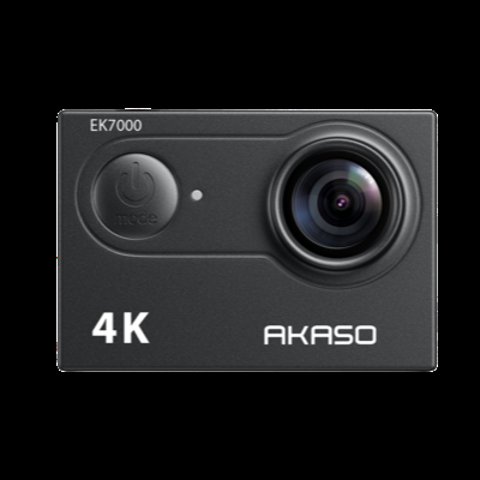
EK7000
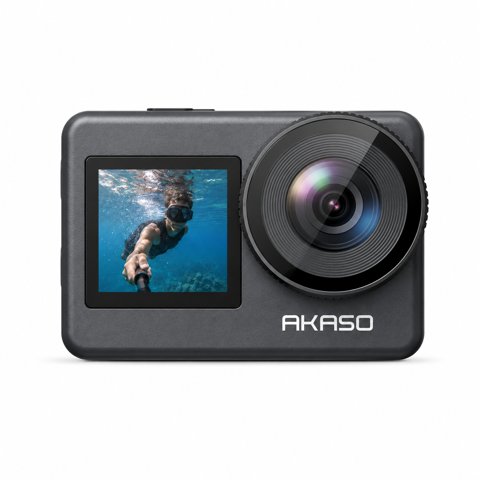
Brave 7
The EK7000 and Brave 7 represent two different generations of Akaso’s action camera design, and while both shoot 4K, the gap between them is wider than a simple spec comparison suggests. Here’s how they actually stack up for buyers deciding between Akaso’s older and newer camera lines.
Spec-by-Spec: EK7000 vs Brave 7
| Spec | EK7000 | Brave 7 |
|---|---|---|
| Max Video | 4K/25fps, 1080p/60fps | 4K/30fps with more mode options |
| Stabilization | None | 6-axis EIS |
| Screen | Non-touch, 2″ | Touchscreen |
| Zoom | None | Digital zoom included |
| App | iSmart DV (older, simpler) | AKASO GO (actively updated) |
| Firmware Updates | Manual SD card method | Automatic via app |
The gap here isn’t subtle — the Brave 7 improves on the EK7000 in nearly every practical category, from stabilization to interface to firmware update convenience. This makes sense given the generational difference between the two, but it’s worth being explicit about rather than assuming they’re roughly equivalent options at similar price points. Buyers who last shopped for an Akaso camera years ago may still associate the brand primarily with the EK7000, so it’s worth updating that mental model before comparing prices.
Stabilization: The Most Consequential Difference
The EK7000’s complete lack of stabilization is the single biggest practical gap between the two cameras. Any mounting situation involving vibration or fast movement — bike handlebars, helmets, motorcycle mounts — shows visibly shakier footage on the EK7000 compared to the Brave 7’s 6-axis EIS. For stationary or already-stable mounting, this gap matters far less, but it’s the first thing to consider if you’re deciding between the two.
Software Ecosystem: A Widening Gap
Beyond the hardware, the software experience has diverged significantly. The Brave 7 pairs with the actively developed AKASO GO app, benefiting from ongoing updates and automatic firmware upgrade prompts, while the EK7000 remains tied to the older iSmart DV app and a manual, SD-card-based firmware process. This isn’t just a minor inconvenience — it reflects where Akaso is actually investing development effort, and buyers choosing the EK7000 today are choosing a line that’s unlikely to see meaningful software improvements going forward.
I set up both cameras for a comparison shoot on the same bike trail, and the difference wasn’t subtle — the EK7000’s footage showed noticeably more shake on rough sections, and updating its firmware afterward required a manual SD card process that took considerably longer than the Brave 7’s one-tap app update.
Per Patrick S., who is a Videography Instructor and PeerSpot reviewer, “I stopped recommending the base EK7000 to students a while back — the Brave 7 costs a bit more but the stabilization and app experience are different enough that it’s worth the extra money for almost anyone starting out.”

Photo Quality and Everyday Usability
Beyond video, the Brave 7’s touchscreen makes reviewing and deleting unwanted photos or clips directly on the camera far more practical than the EK7000’s button-based playback navigation. For anyone who regularly culls footage in the field rather than waiting to review everything on a computer, this convenience adds up over repeated use, even though it doesn’t show up on a spec sheet comparison.
Where the EK7000 Still Makes Sense
The EK7000 isn’t without a place in the lineup — it’s typically the more affordable option, and for buyers with genuinely simple, stationary use cases (a tripod-mounted camera, a fixed security-style setup), the stabilization gap matters little. If price is the primary constraint and you don’t need touchscreen convenience or built-in stabilization, the EK7000 remains a functional, if dated, choice.
Which Should You Buy?
- Pick the Brave 7 if you want stabilization, a touchscreen, and an actively maintained app ecosystem — the better choice for most buyers today.
- Pick the EK7000 only if price is the deciding factor and your use case is stationary or otherwise vibration-free.
Frequently Asked Questions
Is the Brave 7 a clear upgrade over the EK7000?
Yes, in nearly every practical category — stabilization, interface, and software support all favor the Brave 7 significantly.
Is there any reason to still buy the EK7000?
Mainly price and simplicity for stationary, low-vibration use cases where stabilization doesn’t matter much.
Does the EK7000 still receive firmware updates?
Occasionally, but through a manual SD-card process rather than the automatic app-based updates the Brave series receives.
Can I review and delete footage directly on the camera?
Both allow this, but the Brave 7’s touchscreen makes the process noticeably faster and more intuitive than the EK7000’s button-based navigation.
Is the price difference between the two large?
Typically modest, which makes the Brave 7’s improvements an easy value proposition for most buyers comparing the two directly.
Common Problems and Fixes
A handful of issues show up regularly with both cameras, and most have simple fixes:
- EK7000 won’t connect to the iSmart DV app — force-close and reopen the app, confirm the camera’s Wi-Fi is active, and reconnect your phone to the camera’s Wi-Fi network rather than your home network before opening the app.
- Brave 7 firmware update stuck or fails — make sure the camera has at least half a battery before updating, keep it powered and connected throughout, and avoid interrupting the process even if it seems to be taking longer than expected.
- Footage is shaky despite the Brave 7’s EIS — confirm stabilization is actually enabled in the camera’s on-screen settings, since it isn’t always on by default in every recording mode.
- EK7000 SD card not recognized — format the card in-camera rather than on a computer, and confirm it’s rated for at least Class 10 speeds, since slower cards can cause recognition issues on older hardware.
- Overheating during extended 4K recording — this affects both models in hot weather or direct sunlight; shooting in shorter sessions or in a well-ventilated mount reduces the chance of an automatic shutdown mid-recording.
Conclusion
The Brave 7 represents a genuine generational improvement over the EK7000, particularly in stabilization and software support. Unless your use case is specifically stationary and price is the only concern, the Brave 7 is the more sensible choice for nearly all buyers today. The modest price gap between the two makes the Brave 7’s improvements an easy value proposition rather than a difficult trade-off to weigh.
Ryan is a Computer Science graduate with over 20 years of hands-on experience with PC hardware, software, and consumer electronics, including side-by-side action camera testing. He writes at softwaredriverdownload.com.