The WOLFBOX MF200 is a compressed air duster built around a swappable 6,000mAh battery cartridge, aimed at users who don’t want to wait around for a recharge mid-cleaning session. Here’s what sets it apart from WOLFBOX’s other duster models, and when the extra cost is actually worth it.
| Spec | Detail |
|---|---|
| Max Speed | Up to 110,000 RPM, airflow over 210 MPH |
| Battery | Swappable 6,000mAh (22.2Wh) cartridge |
| Speed Settings | 3 adjustable settings |
| Weight | 0.84 lb |
| Included Accessories | 4 nozzles, 2 brushes |
| Charging | USB-C, full charge in about 2.5 hours |
| Runtime | Up to 100 minutes per battery on setting 1 |
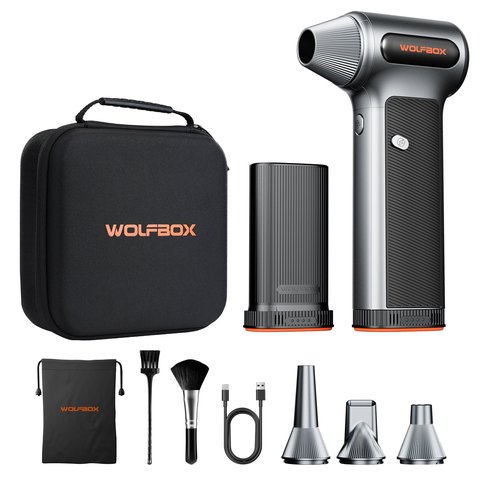
Key Specs
- Up to 110,000 RPM with airflow speed over 210 MPH
- Swappable 6,000mAh (22.2Wh) battery cartridge
- 3 adjustable speed settings, from light dust to heavy sawdust
- Weighs 0.84 lb, comes with 4 nozzles and 2 brushes
- USB-C charging, full charge in about 2.5 hours
- Up to 100 minutes of runtime on the first speed setting per battery
Why the Swappable Battery Matters
Unlike the MF50 and MF100, which rely on a single built-in battery, the MF200’s cartridge design lets you buy a spare and keep cleaning without waiting through a full recharge cycle. This matters most for longer jobs, like clearing out a workshop or a heavily dust-caked PC build, where a single 100-minute charge might not be enough. It also means the tool itself can outlast any individual battery — when a cartridge eventually degrades from repeated charge cycles, you replace just the battery instead of the whole unit.
A spare battery is worth budgeting for if you plan to use this for anything beyond quick desk cleanups — the swappable design is the MF200’s main advantage over the cheaper MF50 and MF100, but it only pays off if you actually own a second cartridge to swap in.
Where It’s Most Useful
- Workshop and garage cleanup involving sawdust or metal shavings
- Extended PC and server hardware cleaning sessions
- Car detailing, including vents, seat tracks, and floor mats
- Outdoor use, like clearing snow or debris from small gaps
- Photography and video gear maintenance during longer field sessions
Battery Swapping in Practice
Swapping a cartridge takes just a few seconds — you release the depleted battery, slide the charged one in, and continue working without powering down or waiting. This is the same basic principle as swappable-battery power tools from brands like DeWalt or Makita, just applied to a smaller handheld cleaning device. If you already own other tools with a swappable battery ecosystem, note that WOLFBOX’s cartridge is proprietary and not interchangeable with other brands.
For full specs, see WOLFBOX’s official MF200 product page.
Is the Extra Cost of a Spare Battery Worth It?
A spare battery cartridge adds noticeably to the total cost of owning an MF200, so it’s worth being honest about your actual usage pattern before buying one. If most of your cleaning sessions run under the roughly 100-minute single-charge runtime, a spare battery mostly sits unused. If you regularly hit workshop cleanup sessions, detail multiple vehicles in a row, or use it professionally, the spare pays for itself quickly in avoided downtime waiting on a recharge.
Long-Term Cost of Battery Replacement
One underappreciated benefit of the swappable design is what happens years down the line when the original battery’s capacity has noticeably declined from repeated charge cycles. Rather than replacing the entire tool, MF200 owners can simply buy a fresh cartridge and continue using the same motor housing and nozzle set indefinitely. This is a meaningfully different long-term cost structure than the MF50 or MF100, where a degraded built-in battery effectively means replacing the whole unit.
Common MF200 Problems and Fixes
- Battery cartridge won’t lock into place: Check the contacts on both the cartridge and the tool for dust or debris, and make sure the cartridge is oriented correctly before applying pressure to seat it.
- Runtime feels shorter than the rated 100 minutes: Higher speed settings drain the cartridge considerably faster than the first speed setting used for the official runtime figure, so runtime shortens on higher power modes.
- Spare battery won’t charge: Confirm the charging cable supports data and power, not just power, and try a different USB-C cable before assuming the cartridge itself has failed.
- Tool feels weaker than expected even on the highest setting: Check that the correct nozzle is attached, since a wide nozzle spreads airflow over a larger area and feels less forceful than a narrow concentrated tip at the same speed setting.
- Cartridge feels loose after months of use: Minor wear on the contact points is normal after repeated swaps; if it becomes loose enough to disconnect during use, contact WOLFBOX support about a possible cartridge or housing replacement.
Frequently Asked Questions
Are MF200 batteries compatible with the MF50 or MF100?
No, the swappable cartridge design is specific to the MF200; the MF50 and MF100 use built-in batteries instead.
Does the battery cartridge have its own power indicator?
Most units include an LED charge indicator on the cartridge itself, letting you check remaining charge before swapping it in.
Is the MF200 significantly heavier than the smaller models?
It’s a bit heavier at 0.84 lb versus 0.45-0.66 lb for the smaller models, though still light enough for one-handed use.
Do spare batteries need to be bought separately?
Yes, extra battery cartridges are typically sold separately from the base unit.
Can it be used outdoors in cold weather?
It’s rated for general outdoor use, though extreme cold can temporarily reduce lithium battery runtime like with most rechargeable tools.
Does the battery cartridge fit in a standard pocket?
It’s compact enough to carry easily, though it’s a bit bulkier than a typical phone battery pack given its higher capacity.
Does it ship with a wall charger or just a cable?
This varies by bundle; some listings include a USB-C cable only, expecting you to supply your own wall adapter.
Can I charge one battery while using the other?
Yes, that’s the core benefit of owning a spare cartridge — one charges separately while the other stays in active use in the tool.
Does the cartridge design add extra bulk to the grip?
The cartridge sits at the base of the handle, adding modest length rather than significantly changing how the tool feels to hold during normal use.
How many charge cycles does a battery cartridge typically last?
Like most lithium batteries, expect gradual capacity decline over hundreds of cycles rather than a hard cutoff, so runtime will slowly shorten over years of use.
Does a spare battery come with its own charging dock?
This depends on the specific bundle purchased; check the listing to confirm whether a standalone charger is included with spare batteries.
Can I travel with the MF200 on a plane?
Lithium battery devices generally need to go in carry-on rather than checked luggage per airline rules, and it’s worth checking your specific airline’s watt-hour limits before flying with it.
Is the swappable battery water-resistant?
The battery cartridge isn’t designed for water exposure, so avoid using the MF200 in heavy rain or submerging the battery compartment.
Conclusion
The MF200 makes the most sense if you need to clean for longer stretches than a single charge allows, and you’re willing to invest in a spare battery to unlock that advantage. For lighter, shorter cleaning tasks, the smaller MF50 or MF100 will likely be enough on their own without the added cost of a swappable battery system, so weigh the real value of that flexibility against your actual usage pattern.
Ryan
Computer Science graduate · longtime smart home and PC hardware tester