Anyone sitting on a drawer full of mismatched AA and AAA NiMH cells knows the tedium of reconditioning them one or two at a time. The SkyRC NC3000 Octa manual describes a charger built specifically to solve that problem — eight independent slots, each individually programmable, aimed squarely at bulk rechargeable battery testing and reconditioning.
Key Specs
- Slots: 8 independent, individually programmable
- Input: USB PD 65W (QC PD3.0)
- Max charge power: 48W
- Max discharge power: 30W
- Charge current: 0.20-3.00A adjustable
- Discharge current: 0.20-2.50A, in 0.10A steps
- Chemistries: NiMH/NiCd only (AA/AAA)
- Modes: Charge, Discharge, Break-in, Cycle, MaxBoost, Turbo, 3-Stage Charging (7 modes total)
- Display: 1.77″ color screen plus LED status indicators
- Connectivity: Bluetooth via the SkyCharger app
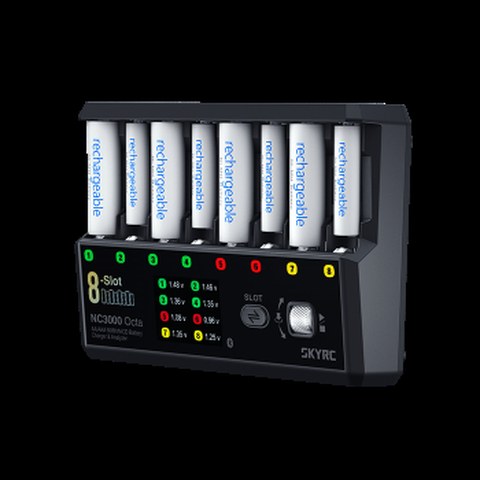
Why Eight Independent Slots Matters
The core value proposition here is simple: instead of babysitting a 2-slot or 4-slot charger through several rounds to get through a full battery drawer, the NC3000 Octa processes eight cells at once, each running its own independently selected mode and current. Mixed old and new cells, or a mix of AA and AAA, can all go through the same charging session without needing to be sorted into separate batches first.
- Each slot’s mode, current, and chemistry setting is fully independent of the other seven
- No need to group cells by condition before starting a session
- Well suited for households, classrooms, or small businesses running through large volumes of AA/AAA rechargeables
The Seven Charging Modes
- Charge — standard charging at your set current
- Discharge — drains a cell fully, often used before storage or capacity testing
- Break-in — gently cycles new or long-idle cells to reach proper capacity
- Cycle — repeated charge/discharge cycles to test or restore capacity
- MaxBoost — a higher-intensity charge profile for faster turnaround
- Turbo — prioritizes charging speed over gentle cell treatment
- 3-Stage Charging — a multi-phase profile balancing speed and cell longevity
For a mixed drawer of unknown-condition cells, running Cycle mode first on a suspect batch is a good way to weed out cells that have genuinely lost capacity from ones that just needed a proper reconditioning cycle.
Bluetooth and the SkyCharger App
The built-in Bluetooth connection pairs with SkyRC’s SkyCharger app, letting you monitor all eight slots’ progress from a phone rather than crouching in front of the charger’s small onboard screen. For a genuinely bulk-reconditioning workflow — say, testing forty AA cells collected from around the house over the years — being able to check status remotely while doing something else is a real time-saver.
- Real-time per-slot voltage, current, and capacity readouts in the app
- Notifications when a slot completes its programmed cycle
- Historical capacity data for tracking a cell’s health over multiple charge sessions
I ran a batch of about two dozen old AA cells pulled from various remotes and flashlights through the NC3000 Octa on Cycle mode, and it was genuinely satisfying to watch the app sort out which cells still held reasonable capacity versus which ones had quietly become dead weight in a drawer.
“Finally reconditioned an entire shoebox of old AA batteries in one overnight session instead of doing it four at a time. The app makes tracking capacity across that many cells actually manageable.” — Grace L., rechargeable battery hobbyist, posting in a battery reconditioning community
Practical Workflow for Reconditioning a Large Battery Collection
- Sort cells loosely by apparent age or last known use, though the Octa’s independent slots mean this is a convenience step, not a requirement
- Load up to eight cells and set each to Cycle mode for an initial capacity assessment
- Review results in the SkyCharger app once the cycle completes, flagging any cells with noticeably reduced capacity
- Retire clearly degraded cells and run a second Cycle pass on borderline ones to confirm before making a final call
- Repeat in batches of eight until the full collection has been assessed
This kind of workflow would be genuinely tedious on a 2-slot or 4-slot charger, which is really the whole reason a charger like the NC3000 Octa exists in the first place — it turns a multi-day chore into an evening’s worth of overnight sessions.
Who Actually Needs Eight Slots
- Households with a large collection of AA/AAA rechargeables across remotes, flashlights, and gadgets
- Hobbyists maintaining multiple RC transmitters or accessories that still use AA/AAA NiMH packs
- Anyone who has accumulated cells of unknown condition and wants an efficient way to sort the good from the degraded
- Small offices or classrooms managing shared battery pools for equipment
If you only ever charge two or three cells at a time, a smaller charger is more cost-effective — the Octa’s value is specifically in volume.
Frequently Asked Questions
Does the NC3000 Octa support LiPo or Li-ion batteries?
No, it is dedicated to NiMH/NiCd AA/AAA cylindrical cells only. It does not support lithium chemistries.
Can each of the eight slots run a different mode simultaneously?
Yes, each slot is fully independent, so you can run Charge mode in one slot and Cycle mode in another at the same time.
What power source does it need?
It uses USB PD 65W input (QC PD3.0 compatible), so a suitable USB-C PD charger or power bank is required to reach full charging capability.
Is the SkyCharger app required to use the charger?
No, the charger’s onboard 1.77″ display and LED indicators are sufficient for standalone use — the app is an optional convenience for remote monitoring and data logging.
Care Tips for the NC3000 Octa
- Keep all eight contact points clean, since a dirty or corroded slot contact can throw off readings on an otherwise healthy cell
- Use a genuine PD-capable USB-C source rated for the full 65W input to get consistent charging performance across all eight slots simultaneously
- Update firmware periodically through SkyRC’s tools, since Bluetooth app compatibility and charge algorithms have seen refinements after release
- Store the unit somewhere dry, particularly if it is used to process large batches of older cells that may have minor corrosion on their terminals
Conclusion
The NC3000 Octa manual makes clear this is a charger built for volume: eight independently programmable slots, seven distinct charging modes, and app-based monitoring make short work of reconditioning large batches of AA/AAA NiMH cells that would otherwise take hours across multiple smaller charging sessions.
Ryan keeps a running collection of rechargeable AA/AAA cells for household gadgets and enjoys stress-testing bulk chargers against genuinely large battery batches. He writes at softwaredriverdownload.com.