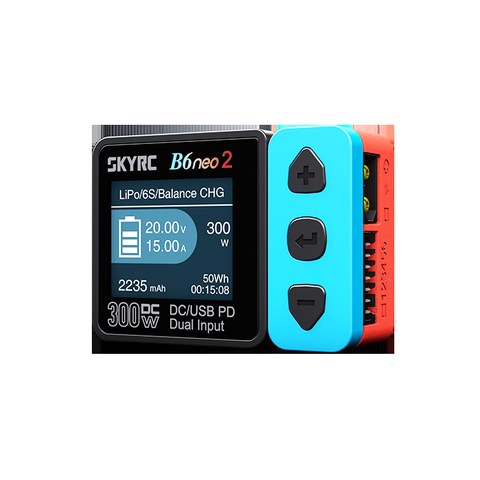
SkyRC has been chasing “more power in a smaller box” for a few generations of chargers now, and the SkyRC B6 Neo 2 is arguably where that trend peaks. It is smaller than a deck of cards, yet it is rated for a genuinely serious 300W of DC charge power when fed from a beefy DC source.
Key Specs
- Max DC charge power: 300W
- USB-C PD input: up to 80W
- Max discharge power: 24W
- Charge current range: 0.2-15.0A
- Discharge current range: 0.1-2.0A
- Chemistries: LiPo/LiFe/Li-ion/LiHV 1-6S, NiMH/NiCd 1-15S, Pb 3S/6S
- Display: 1.77″ TN color LCD, 128×160 resolution
- Dimensions: 70 x 50 x 31mm
- Weight: 82g
- Dual input: DC barrel jack or USB-C PD
Why the Dual Input Matters
The B6 Neo 2’s party trick is having two completely different ways to feed it power. Plug in a proper DC power supply through the barrel jack and it can pull the full 300W rating, letting you charge high-capacity 6S packs at genuinely fast rates. Plug in a USB-C PD source instead — a laptop charger, PD power bank, whatever you have on hand — and it caps at a still-respectable 80W, more than enough for smaller packs or slower top-off charges.
- At home or in the pit area: use a dedicated DC power supply for full 300W charging speed
- On the road or at the field: swap to USB-C PD and keep charging off a power bank or laptop brick
- No need to own two separate chargers for “fast home charging” and “portable field charging” — one unit covers both
Doubling as a Bench Power Supply
Because it accepts DC input and can regulate output, the B6 Neo 2 can also function as a basic bench power supply for other 12V-ish devices, which is a genuinely useful extra given how little space it takes up on a workbench. It will not replace a dedicated lab supply for precision electronics work, but for powering small RC accessories or testing gear it is a handy bonus feature.
Display and Everyday Use
The 1.77-inch color TN screen punches above its size — full charge current, voltage, capacity, and time-remaining readouts are all visible at a glance, and menu navigation is quick once you learn the button layout. I found the learning curve shorter than SkyRC’s older monochrome units simply because the color-coded status indicators make it obvious at a glance whether a pack is charging, balancing, or finished.
- Chemistry auto-detection speeds up day-to-day charging
- Balance ports support the full 1-6S lithium range without adapters
- NiMH/NiCd support up to 15S covers most receiver and transmitter pack needs
My honest first impression when I unboxed the B6 Neo 2 was skepticism — it genuinely looks too small to be a “real” charger. That skepticism did not survive the first 6S charge session; paired with a proper DC brick, it charged a 5000mAh 6S pack at a pace that matched chargers twice its physical size.
“I run the B6 Neo 2 off a DC power supply at home and toss it in my flight bag with a USB-C cable for the field. Same charger, two completely different power situations covered.” — Priya N., multirotor racer, posting on a drone racing forum
Comparing B6 Neo 2 to Full-Size Chargers
It is worth being honest about tradeoffs. A full-size iMAX-style bench charger will typically have a more detailed physical interface with dedicated buttons for every function, and often supports higher absolute charge currents when paired with a large AC power supply. The B6 Neo 2’s advantage is not raw ceiling numbers — it is that 300W in something this small simply did not exist a few years ago.
- Full-size bench charger: more physical controls, typically cheaper per watt, not portable
- B6 Neo 2: near bench-level power density in a pocketable unit, dual input flexibility
If you only ever charge at a single fixed location and never travel with your gear, a traditional bench charger may still be the more cost-effective choice. The B6 Neo 2 earns its price premium specifically for people who need both power and portability at once.
Getting the Most Out of Dual Input
- Keep a dedicated DC power supply at your primary charging location for full 300W speed
- Carry a USB-C PD wall adapter or power bank for travel and field use
- Check your PD source’s actual wattage rating — some budget PD chargers advertise high wattage but throttle under sustained load, which can bottleneck charge speed even though the B6 Neo 2 itself is capable of more
- Match charge current settings to your battery’s rated max charge rate rather than always maxing out the charger’s ceiling
Frequently Asked Questions
Does the B6 Neo 2 work with just a USB-C phone charger?
It needs a PD-capable USB-C source to reach meaningful output — a basic non-PD phone charger will not deliver enough power for fast charging, though the unit may still trickle-charge at reduced rates.
Can it charge 6S LiPo packs at full speed?
Yes, when powered via a DC supply capable of delivering the full 300W, the B6 Neo 2 can charge 6S packs at its rated current up to 15.0A.
Is it suitable as a travel charger?
Very much so — its small footprint and USB-C PD compatibility make it one of the more travel-friendly high-power chargers currently available.
Does it support NiMH batteries?
Yes, up to 15S NiMH/NiCd packs are supported, which covers the vast majority of receiver and hobby-grade NiMH battery configurations.
Care Tips for Long-Term Reliability
- Avoid stacking heavy gear on top of the unit in a bag — the small size makes it easy to forget it is in there
- Keep the USB-C port clean since it doubles as both a power input and a firmware/data connection
- Let the unit cool between back-to-back high-power 300W sessions rather than running it continuously all day
- Check balance lead connectors periodically for wear, since these see frequent plugging and unplugging in field use
Conclusion
The SkyRC B6 Neo 2 manages a rare combination: genuinely high charge power and a form factor small enough to disappear into a backpack pocket. Whether you are charging at home off a DC supply or in the field off a power bank, it adapts without asking you to compromise much either way.
Ryan tests compact and bench RC chargers side by side to see how much charging speed a pocket-sized unit can realistically deliver. He writes at softwaredriverdownload.com.