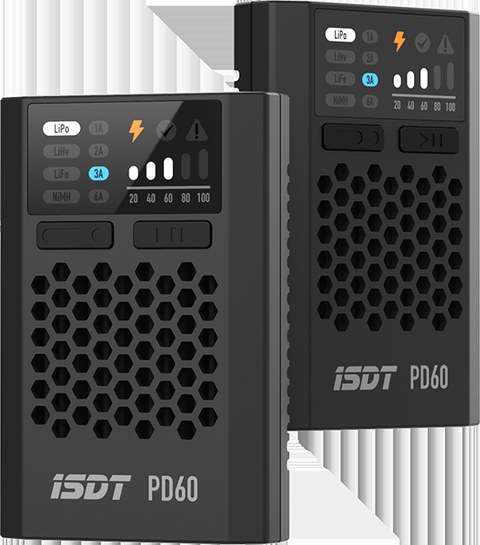
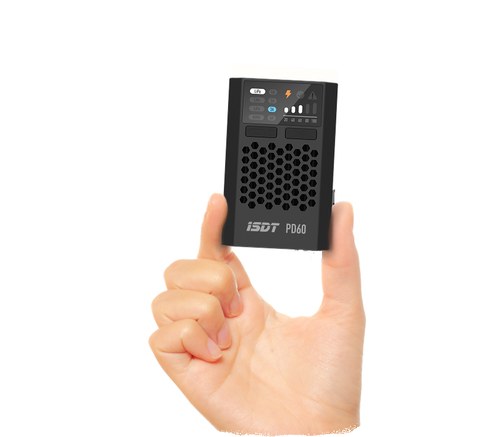
Pocket-sized chargers used to mean weak output and long charge times, but the ISDT UruavPD60 throws that assumption out the window. Also sold under the co-branded name ISDT & URUAV PD60 (URUAV is a well-known FPV retailer brand that partnered with ISDT on this unit, so you will see both names used interchangeably in listings), this tiny charger fits in a coat pocket yet still pushes a genuinely usable 60W through a single USB-C port.
I picked one of these up mainly for field-charging 4S LiPo packs between FPV freestyle flights, and it has quietly become the charger I reach for more often than my bench unit simply because I never have to think about bringing it along.
Key Specs
- Input: DC 5-20V via USB-C, supporting PD2.0/PD3.0 and QC2.0/QC3.0, max input current 3A
- Output: DC 1.0-20V
- Charge current: selectable 1A / 2A / 3A / 6A
- Max charge power: 60W
- Balance current: up to 0.5A per cell
- Chemistries: LiPo / LiFe / LiHV 1-4S, NiMH / NiCd 1-12S
- Dimensions: 56 x 85 x 21mm
- Weight: 87g
- Firmware updates via USB-C connection to a PC
What Makes the UruavPD60 Different
Most “portable” chargers are really just USB-powered trickle chargers that happen to have a balance port. The PD60 is not that. Because it draws from USB-C PD or QC fast-charge sources instead of plain 5V/1A USB, it can actually pull enough wattage to charge a 4S pack at a meaningful rate. That is the whole trick here: the charger itself is dumb simple, but the power delivery negotiation lets it borrow far more power than a standard USB port would ever offer.
A few things worth knowing before you buy one:
- You need a real PD or QC power source. A basic 5W phone charger will not work — the PD60 needs to negotiate a higher voltage/current profile, so a laptop charger, PD power bank, or dedicated PD wall adapter is required.
- Charge current is fixed to four presets (1/2/3/6A), not a dial-in value, which keeps the interface dead simple but means you cannot fine-tune to, say, 4.5A.
- Balance charging tops out at 0.5A per cell, which is plenty for storage and top-off charging but is not meant for aggressively fast full-pack charges on larger capacity batteries.
Setting It Up
Out of the box, connect a USB-C PD-capable source, plug in your battery’s main lead and balance lead, and the PD60 auto-detects cell count and chemistry in most cases. The onboard OLED-style display shows charge current, chemistry selection, and a simple battery-level bar so you always know where you stand mid-charge. Buttons are minimal by design — this is a “set it and forget it” charger rather than one with deep menu diving.
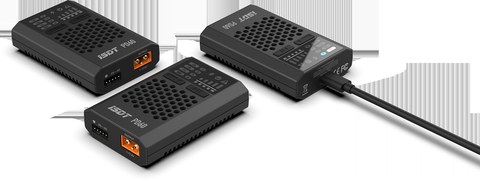
Firmware updates are handled by plugging the PD60 into a PC over USB-C and running ISDT’s desktop utility, which is a nice touch for a device this small — it means bug fixes and chemistry support additions can arrive after purchase rather than being locked to what shipped in the box.
Real-World Use
I have used mine at the flying field powered off a USB-C PD power bank, and honestly it kept pace fine with a single 4S 1300mAh pack between flights. It will not replace a proper multi-battery parallel charging setup if you are cycling through a dozen packs in an afternoon, but for one-off top-ups, travel, or as a backup charger thrown in a flight case, it earns its keep.
“I stopped carrying my full bench charger to local meetups after getting the PD60. It lives in my backpack now and handles the 2-3 packs I usually bring without any fuss.” — Marcus T., FPV freestyle pilot, posting on RCGroups
Who Should Buy This
- FPV pilots who want a genuine field charger that fits in a pocket
- Anyone who already carries a USB-C PD laptop charger or power bank and wants to skip a second bulky charger
- Multirotor and small fixed-wing hobbyists charging 1-4S packs
- NiMH/NiCd hobbyists needing up to 12S support for older receiver packs
It is a poor fit if you regularly charge 5S-6S packs (it tops out at 4S lithium) or need to charge multiple batteries simultaneously without a parallel board.
Comparing It to a Standard Bench Charger
It helps to be clear-eyed about what the PD60 is not trying to be. A full-size bench charger like an iMAX-style unit will out-charge the PD60 on raw speed, offer more granular current control, and typically support a wider chemistry range including higher cell counts. What the PD60 trades for that is size and power source flexibility — it does not need a wall outlet or a dedicated 12V supply, just any USB-C PD source you already own.
- Bench charger: faster, more precise, needs AC or dedicated DC supply, bulkier
- PD60: slower but genuinely portable, runs off gear you likely already carry (laptop charger, power bank)
For most hobbyists, the sensible answer is not choosing one over the other — it is keeping a bench charger at home for bulk charging sessions and a PD60 in the field bag for everything else. That is exactly how mine gets used day to day, and the two roles rarely overlap enough to cause friction.
Maintenance and Longevity Tips
- Keep the USB-C port free of dust and debris, since a poor connection can cause the PD negotiation to fail or downgrade to a lower power profile
- Store the unit in a dry case when traveling — it is small enough to easily toss in with flight gear, but that also means it can get knocked around unless it has some protection
- Update firmware periodically through ISDT’s desktop utility, since chemistry support and bug fixes have historically been added post-release
- Avoid leaving batteries connected after a charge completes for extended periods, standard practice for any lithium charger
Frequently Asked Questions
Does the ISDT UruavPD60 work with a regular phone charger?
Only if that charger supports USB-C Power Delivery or Quick Charge fast-charging protocols. A basic 5V/1A or 5V/2A charger will not provide enough power for the PD60 to operate at its rated output.
Is the ISDT UruavPD60 the same as the ISDT PD60?
Yes. It is the identical hardware, sold under a co-branded name through the URUAV retailer channel. Specs, firmware, and support are shared with the standard ISDT PD60.
Can it charge 6S LiPo batteries?
No, lithium chemistries are limited to 1-4S on this unit. If you need 5S-6S support, look at a larger ISDT or SkyRC charger instead.
How long does a 4S 1300mAh pack take to charge?
At the 3A setting, a 1300mAh 4S pack typically finishes in roughly 25-30 minutes depending on how depleted it was and how close to full voltage you are charging.
Conclusion
The ISDT UruavPD60 is a niche product done well: it is not trying to be your only charger, it is trying to be the charger you always have with you. Given how often “I didn’t bring a charger” ruins a flying session, that alone makes it worth the relatively modest price for FPV pilots and small-pack RC hobbyists.
Ryan has spent years testing portable and bench RC chargers for field reliability, including long-term use of USB-C PD charging setups for FPV gear. He writes at softwaredriverdownload.com.