A good desktop system usually falls apart at the headphone amplifier stage — people spend real money on a DAC and headphones, then bolt on whatever cheap amp happens to be in stock. Gustard’s Audalytic sub-brand built the HP70 specifically to fill that gap without cutting the corners that budget headphone amps usually cut.
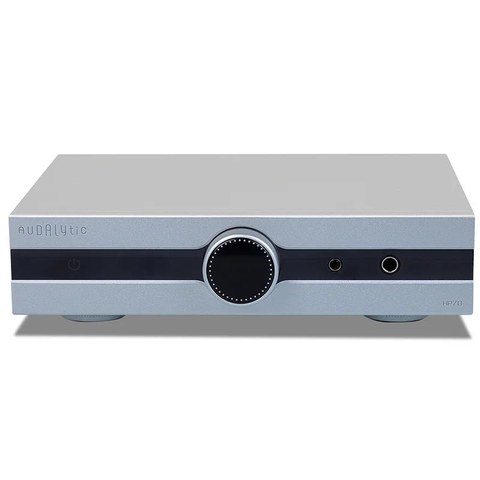
| Brand | Gustard (Audalytic sub-brand) |
| Model | HP70 |
| Type | Fully balanced, discrete Class A headphone amp / preamp |
| Volume control | R2R relay-based, four signal paths |
| Gain range | 0 to 28dB, adjustable |
| Outputs | 4.4mm balanced, 6.35mm single-ended |
| Power | Built-in 30VA supply, or external 15-18V DC |
Core design
The HP70 is a fully balanced, discrete Class A headphone amplifier that doubles as a line-level preamplifier. Key specifications:
- Discrete Class A amplifier stage using four pairs of power transistors for driving power and control
- Preamp stage built around two socketed LME49720 dual op-amps
- R2R relay-based volume control for lossless, precisely matched channel volume across all four signal paths
- Adjustable gain from 0 to 28dB to match a wide range of headphone sensitivities
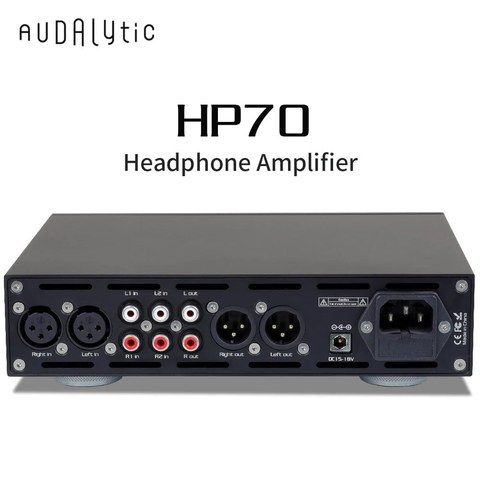
- 2 sets of RCA inputs and 1 set of XLR balanced input
- 4.4mm balanced and 6.35mm single-ended headphone outputs
- Built-in 30VA low-noise power supply, with support for external 15-18V DC power as an alternative
Why the socketed op-amps matter
Most headphone amps solder op-amps directly to the board. Socketing the LME49720 chips on the HP70’s preamp stage means they can be swapped for alternative op-amps down the line without any soldering, which is a meaningful feature for hobbyists who like to experiment with subtle tonal tuning. It’s a small detail, but it signals Gustard designed this for people who actually tinker with their gear rather than treating it as a sealed appliance.
Relay volume control versus a standard potentiometer
The R2R relay-based volume stage is worth calling out specifically at this price point. Instead of a continuously variable potentiometer — which is prone to channel imbalance at low volumes and wears mechanically over years of use — the HP70 switches between fixed, precisely matched resistor steps. That keeps left/right channel balance accurate across the entire volume range, including quiet listening levels where cheaper amps often drift noticeably off-center.
Using it as a preamp, not just a headphone amp
The HP70’s preamp output can be switched independently of the headphone output, letting you use it as a line-stage preamp feeding a power amplifier and speakers, then switch to headphones without needing to disconnect anything. That flexibility makes it a genuinely useful hub for a desktop system that alternates between speakers and headphones depending on time of day.
- Connect your DAC to either the RCA or XLR input depending on what your source offers
- Set gain according to your headphones’ sensitivity — start low and increase gradually rather than defaulting to maximum
- Use the preamp-out toggle to route signal to a power amp and speakers when you’re not wearing headphones
Full specifications are listed on Aoshida Audio’s product page, and the official user manual covers gain staging and input switching in more depth than most retailer listings.
Who it’s a good fit for
- Owners of moderate to hard-to-drive headphones who’ve outgrown a DAC’s built-in headphone jack
- Anyone who wants a single unit that covers both headphone listening and speaker-based line-stage duties
- Hobbyists who like the option to roll different op-amps for subtle tonal experimentation
Break-in and daily use notes
Class A amplifier stages run warmer than Class AB designs by nature of the topology, since the output transistors conduct continuously rather than switching off during part of the signal cycle. That’s a normal, expected characteristic rather than a fault — just make sure the HP70 has some airflow around it and isn’t tucked into a closed cabinet where heat can build up. Many owners also report the sound settling in slightly over the first couple of weeks as the discrete Class A stage and power supply capacitors reach a stable operating temperature and charge cycle.
Comparing to building your own headphone amp
Given the socketed op-amps and modular design philosophy, the HP70 sits in an interesting spot for hobbyists who might otherwise consider a DIY headphone amp kit. It offers the tinkering flexibility of a DIY build (op-amp rolling, essentially) with none of the assembly risk, plus a properly engineered relay-based volume stage that would be considerably harder to build reliably from a kit. For most buyers, that combination of flexibility and finished-product reliability is the more sensible route unless building your own gear is part of the hobby’s appeal for you specifically.
A note on matching headphones to this amp
With gain adjustable from 0 to 28dB, the HP70 covers a genuinely wide range of headphone sensitivities, but it’s still worth checking your specific headphones’ impedance and sensitivity rating against the amp’s output before assuming it’ll be an ideal match. Easy-to-drive dynamic headphones will likely want the lower end of the gain range to avoid excess noise floor at low volumes, while power-hungry planar magnetic headphones will benefit from the higher gain settings and the amp’s substantial four-transistor Class A output stage.
Common Setup Problems and Fixes
- Problem: No sound from the headphone output. Check that the preamp-out toggle isn’t routing signal only to the RCA/XLR preamp jacks instead of the headphone jack, since the HP70 can be switched between the two modes.
- Problem: Volume is too quiet even at high gain settings. Confirm your source is actually outputting a full-scale signal and that the correct RCA or XLR input is selected, since an unselected input will produce silence or near-silence regardless of the gain dial.
- Problem: Faint hum through headphones at idle. This is often a ground loop between the HP70 and an upstream DAC on a different outlet; try a cheap ground loop isolator or plug both units into the same power strip.
- Problem: The amp runs noticeably warm to the touch. This is expected behavior for a discrete Class A design, since the output transistors conduct continuously rather than switching off part of the cycle; just make sure it has open airflow and isn’t stacked directly under or over other gear.
- Problem: Channel imbalance at very low volume. The relay-based R2R volume stage should prevent this, but if it appears, first rule out a loose or partially inserted headphone plug before assuming a hardware fault.
- Problem: Swapped op-amps introduced unwanted noise or distortion. Reseat the replacement chip fully in its socket and double check pin orientation, since a socketed op-amp that isn’t fully seated is a common cause of intermittent noise after rolling.
FAQ
Is the HP70 balanced or single-ended?
It’s fully balanced internally and offers both 4.4mm balanced and 6.35mm single-ended headphone outputs.
Can I use it purely as a preamp without headphones connected?
Yes, the preamp output functions independently and can be routed to a power amplifier for speaker listening.
Are the op-amps user-replaceable?
Yes, the LME49720 op-amps are socketed rather than soldered, allowing swaps without desoldering.
What’s the maximum gain setting?
Gain is adjustable from 0 to 28dB, covering a wide range of headphone sensitivities from easy-to-drive to more demanding planar designs.
Does it need external power, or does it come with its own supply?
It has a built-in 30VA power supply but also accepts external 15-18V DC power as an alternative option.
Final thoughts
The HP70 lands in an unusually well-considered spot in the budget headphone amp market: genuinely balanced internals, a proper relay-based volume stage, and enough flexibility for hobbyists to tinker with op-amp rolling down the line. It’s a rare product in this price bracket that doesn’t feel like it’s cutting an obvious corner somewhere to hit its price point.
Headphone amps are the component category I get the most questions about from readers who’ve already bought a nice DAC and don’t realize their headphones are being held back by whatever amp stage came bundled with it.