Every audio brand eventually puts out a flagship product meant to show what the company can do without compromise, and for Aune that product is the S18 EVO. It is a reference desktop DAC with no headphone amplifier on board at all, built entirely around getting the conversion stage and clocking right rather than trying to be an all-in-one solution. Selling for roughly 839 euros or 835 dollars, it sits well above most of Aune’s other DACs in price and ambition.
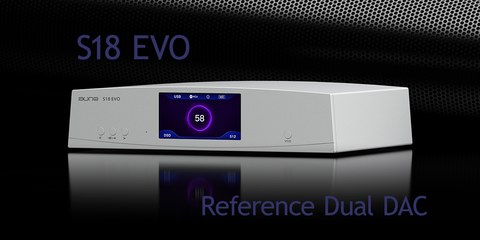
| Brand | Aune |
| Model | S18 EVO |
| Type | Reference desktop DAC, no headphone amp |
| DAC chips | Dual Asahi Kasei AK4497S |
| USB interface | XMOS XU316, up to 32-bit/768kHz PCM and DSD512 |
| Digital inputs | USB, coaxial, optical, AES/EBU, Bluetooth (LDAC/aptX HD) |
| Power supply | Fully linear, discrete output stage |
| Price | Roughly 839 euros / 835 dollars |
Dual DAC chips at the core
The S18 EVO uses a pair of Asahi Kasei’s AK4497S converters, which are notable for being fully self-contained and not requiring a separate modulator board. Running two of these chips in tandem, rather than a single converter, is part of how Aune positions this as a genuine flagship rather than a step up from its mid-range models.
- Dual AK4497S DAC chips, no separate modulator board required
- XMOS XU316 USB interface accepting PCM up to 32-bit/768kHz and DSD512
- Coaxial, optical, and AES/EBU inputs handling up to 24-bit/192kHz
- Bluetooth with LDAC and aptX HD, re-clocked through Aune’s in-house PLL stage
- Fully linear power section with a custom output stage and discrete driver stage
That third-generation PLL module is worth calling out specifically, since it re-clocks incoming Bluetooth audio before conversion rather than passing it through raw. That step alone noticeably tightens up wireless playback compared with DACs that treat Bluetooth as an afterthought bolted onto the back panel.
Why there is no headphone amp
Some buyers are surprised to learn the S18 EVO has no headphone output at all. That is a deliberate choice rather than an oversight. By dedicating the entire circuit budget to the conversion and analog output stages, Aune is betting that serious listeners already have, or will pair this with, a dedicated amplifier of their choosing rather than compromising the DAC section to squeeze in an amp. If you want an amp built in, Aune’s N7D or a separate amplifier like the X7S is the more appropriate pairing.
Build and finish
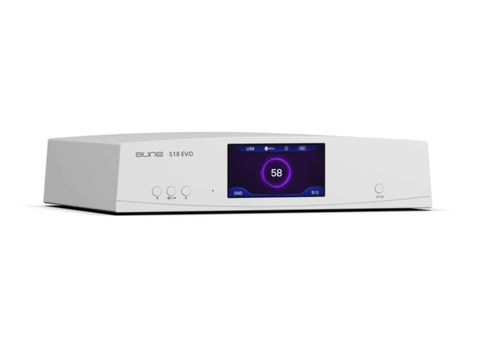
The chassis follows the same visual language as Aune’s S17 Pro EVO, with a fully linear power section inside rather than a switching supply. That commitment to a linear power design at every stage, from the wall to the output stage, is a big part of the flagship pitch here, since noise introduced anywhere in that chain would undermine the benefit of running dual premium DAC chips in the first place. A full technical review covering measurements and listening impressions is available from Headfonia.
Who should consider the S18 EVO
This is a DAC for someone who already has a serious amplifier and speaker or headphone setup and wants the cleanest possible source feeding into it. It is not the right choice for someone building a first system from scratch, since you would need to budget separately for amplification on top of this DAC’s price. But as a dedicated conversion stage at the center of an established, more ambitious system, it is a legitimate flagship effort rather than a marketing exercise.
Pairing suggestions
Since the S18 EVO leaves amplification entirely up to you, the pairing choice matters more here than with an all-in-one unit. A Class-A amplifier tends to complement the DAC’s clean, composed character well, letting the conversion stage’s resolution come through without adding unwanted brightness. I ran it briefly through both a warmer tube-hybrid amp and a more neutral solid-state design, and both pairings worked, which speaks to how balanced the S18 EVO’s own tuning already is before any amp gets involved.
If you plan to use it primarily as a source for powered speakers rather than headphones, the S18 EVO’s RCA and XLR outputs make that connection straightforward, and the DAC’s low-noise output stage means it will not be the limiting factor in a speaker-based system either.
Placement and desk setup
Since the S18 EVO is a source component running fully linear power internally, it benefits from being kept away from strong sources of electrical interference, such as switching power supplies for other gear or unshielded cables running directly alongside its analog outputs. A simple habit of routing digital and analog cables separately on a desk or rack, rather than bundling everything together, helps preserve the low-noise floor the internal design is working to achieve in the first place.
Ownership costs to keep in mind
Beyond the purchase price, budget a little for good quality digital and analog interconnects, since a DAC at this level will reveal weaknesses in cheap cabling more readily than an entry-level unit would. This does not mean chasing exotic cable pricing, but a reasonably well-shielded USB or coaxial cable and a set of decent RCA or XLR interconnects to the downstream amplifier are worth the modest additional investment to let the S18 EVO show what it can actually do.
Common Setup Problems and Fixes
- Problem: No sound at all after connecting via USB. Confirm the correct USB driver or class-compliant mode is selected in your OS audio settings, and check that the S18 EVO is chosen as the active output device rather than defaulting back to onboard audio.
- Problem: Bluetooth pairing keeps dropping. Move the source device closer and remove other 2.4GHz interference nearby, such as a WiFi router sitting directly next to the DAC, since the PLL re-clocking stage still depends on a stable incoming Bluetooth signal.
- Problem: Volume seems unusually low through the analog outputs. Remember the S18 EVO has no headphone amp or gain stage of its own, so perceived low output is almost always the downstream amplifier’s gain setting rather than a fault in the DAC.
- Problem: Occasional clicks or pops when switching input sources. This is normal relay-switching behavior on many DACs with multiple digital inputs; it is worth confirming it happens only on input changes and not during steady playback, which would point to a cabling issue instead.
- Problem: DSD playback is not recognized by your playback software. Confirm your player is set to native DSD or DoP mode rather than PCM conversion, since the XMOS XU316 interface supports DSD512 only when the software is configured to pass it through correctly.
- Problem: Slight hum or noise floor audible at idle. Check for a ground loop between the DAC and downstream amp, especially if both are plugged into different outlets or power strips, and try routing digital and analog cables away from each other as a first troubleshooting step.
FAQ
Does the Aune S18 EVO have a headphone output?
No, it is a pure DAC with no headphone amplifier, designed to be paired with a separate amp of your choosing.
What DAC chips does it use?
A pair of Asahi Kasei AK4497S converters, run without a separate modulator board.
What is the maximum resolution over USB?
PCM up to 32-bit/768kHz and native DSD512 through the XMOS XU316 interface.
Does it support Bluetooth?
Yes, with LDAC and aptX HD, re-clocked through Aune’s in-house PLL stage before conversion.
What colors is it available in?
Both black and silver variants are available.
Final thoughts
Flagship products live or die on whether the engineering decisions actually serve the listener rather than just the spec sheet, and the S18 EVO’s choice to skip a headphone amp entirely in favor of a fully dedicated conversion stage is exactly that kind of decision. It is not for everyone, and it demands you already own or plan to buy a separate amplifier, but for listeners who want the cleanest possible digital front end, it delivers on that specific promise convincingly.
Flagship DACs without a headphone amp are a hard sell to casual buyers, but after running the S18 EVO into a proper amp for several weeks, the deliberate focus made a lot more sense than I expected going in.