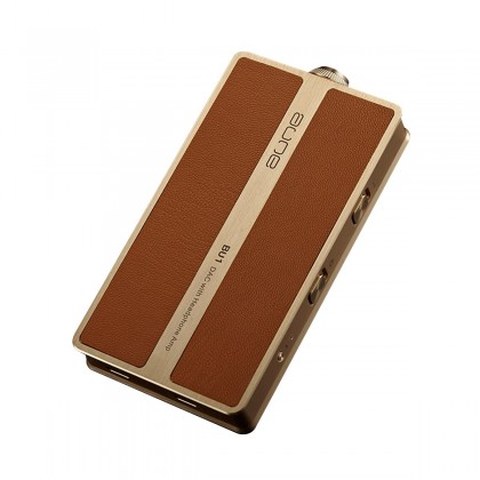
Portable DAC and amp combos have gotten so common that it takes something a little different to stand out, and the Aune BU1 manages it with a leather-wrapped chassis that looks more like a wallet than an audio component. Underneath that unusual finish sits a genuinely capable portable DAC with a fully discrete headphone amplifier, and I spent a few weeks pairing it with a phone and a laptop to see whether the styling was backed up by real performance.
Aune BU1 Quick Specs
| Max resolution | PCM 32-bit/768kHz, native DSD512 |
| THD | As low as 0.00076% |
| Noise floor | Around 1.97 microvolts |
| Battery | 4000mAh, roughly 8 hours at low gain |
| Charging | USB-C |
| Outputs | 3.5mm and balanced, depending on variant |
| Build | Leather-wrapped metal chassis |
What is inside
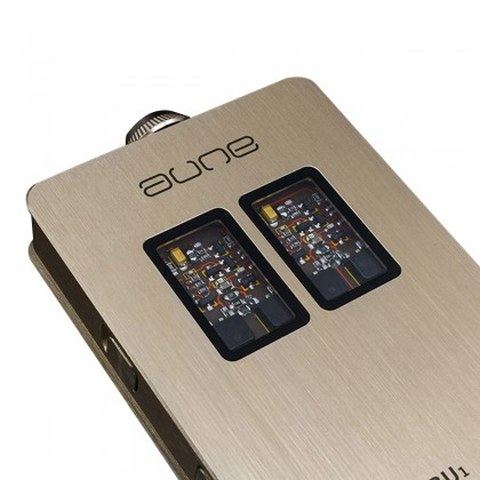
The BU1 supports PCM up to 32-bit/768kHz and native DSD512, decoded through a fully discrete amplifier circuit rather than a single integrated amp chip. Aune quotes distortion as low as 0.00076% and a noise floor around 1.97 microvolts, which are genuinely strong numbers for something this size. The layout follows a philosophy of symmetry across the board, and the design lineage traces back to the same person responsible for Aune’s well-regarded B1 desktop amplifier, which explains why the internals look considerably more serious than the exterior might suggest at a glance.
A 4000mAh battery keeps things running for roughly eight hours at low gain, which is enough for a full workday or a long commute stretch without needing to top it up. It charges over USB-C and works fine alongside both Android and Apple devices, using standard USB audio class drivers so there is nothing unusual to configure.
Build and everyday use
The leather-and-metal finish is not just decoration. It gives the BU1 enough grip that it does not slide around in a bag, and it distinguishes it visually from the sea of plain aluminum bricks that make up most of this category. Full specifications and photos are available on Linsoul’s product page, and a hands-on breakdown of the internals is up on kropka.audio if you want to see the board layout for yourself.
- USB-C input and charging, no separate charging port to juggle
- 3.5mm and balanced output options depending on the variant you buy
- Gain switch for adapting to sensitive IEMs versus harder-to-drive headphones
- Roughly eight hours of battery life at low gain settings
Sound quality impressions
Paired with a set of mid-range IEMs, the BU1 came across as clean and neutral rather than adding its own color to the sound. That is generally what you want from a source component: it should get out of the way and let the headphones or earphones do the coloring. Bass depth was solid without any obvious bloat, and the noise floor was low enough that even sensitive in-ear monitors stayed dead silent at idle, which is not always guaranteed with pocketable DACs at this price.
Where it separates itself from cheaper dongles is in how it handles more demanding headphones. It has enough output to drive full-size cans with moderate impedance to a comfortable volume, though I would not push it as your only amp for genuinely hard-to-drive planar headphones. For IEMs and easy-to-drive portables, though, it is more than sufficient and stays composed even at higher volumes.
Fitting it into your setup
The most natural use case is exactly what I tested: phone or laptop on one side, headphones or IEMs on the other, with the BU1 acting as the bridge. Because it draws its own power from the internal battery rather than pulling current from your phone, it is gentler on battery life for the source device compared with some passive dongle DACs. If you travel a lot or spend long hours at a desk without easy access to a charger, that battery independence is a real practical advantage.
Comparing it to the wider dongle market
The dongle DAC and pocket-amp market has exploded in recent years, with dozens of similarly sized options fighting for attention mostly on spec sheets rather than real-world usability. What sets the BU1 apart is that it does not try to be the thinnest or lightest option on the shelf. It embraces a slightly larger footprint in exchange for a genuine internal battery, a proper discrete amplifier stage, and a build that feels like it was designed to last rather than to be replaced in a year. If your priority is the absolute smallest possible accessory that disappears in a pocket, a thin passive dongle will suit you better. If you want something that behaves more like a small standalone amplifier that just happens to be portable, the BU1’s approach makes more sense.
It is also worth mentioning how the BU1 handles heat and sustained use. Because the amplifier stage is fully discrete rather than running through a single small integrated chip, it manages sustained high-volume listening without the thermal throttling or dynamic compression that some ultra-compact dongles exhibit after twenty or thirty minutes of continuous use. For long train rides or full workdays at a desk, that consistency matters more than most spec sheets let on.
Troubleshooting Common BU1 Issues
A few weeks of daily use surfaced the kinds of small snags most portable DAC owners eventually hit. Here is what I found worked:
- Phone does not recognize the BU1 when plugged in: Try a different USB-C cable first — charge-only cables without data lines are a surprisingly common culprit with dongle and portable DACs. If that does not fix it, restart the phone with the DAC already connected, since some Android devices need the USB audio class driver to initialize on boot rather than mid-session.
- No sound from one channel or intermittent cutouts: Check the 3.5mm or balanced connector for a loose fit or debris in the port before assuming a hardware fault. A dirty or slightly bent plug is the most common cause of one-sided dropout on portable amps.
- Battery drains faster than the advertised 8 hours: Higher gain settings and harder-to-drive headphones both pull more current. If runtime feels short, try the low gain setting with your usual headphones and compare, since gain mismatch is the most common reason real-world battery life falls short of the spec sheet number.
- Audible hiss with sensitive IEMs: Switch to the lowest available gain setting. The BU1’s noise floor is low for its class, but very sensitive IEMs can still reveal hiss on higher gain settings that would be inaudible with less sensitive headphones.
- DSD files will not play or fall back to PCM: Confirm your playback app is set to bitperfect or exclusive mode rather than letting the phone’s OS resample the signal before it reaches the BU1, since OS-level audio processing can silently convert native DSD to PCM before the DAC ever sees it.
FAQ
Does the Aune BU1 work with both Android and iPhone?
Yes, it uses standard USB audio class protocols and works with both platforms, though iPhone users will need the appropriate USB-C to Lightning adapter or cable depending on their phone model.
How long does the battery last?
Around eight hours at low gain settings, less if you run higher gain or drive harder headphones for extended periods.
Can the BU1 drive full-size headphones?
It can drive most moderate-impedance full-size headphones to a comfortable level, though very demanding planar designs will benefit from a proper desktop amplifier instead.
Is the leather finish durable?
It has held up well through daily bag use in my testing, though as with any leather-wrapped product it will show wear characteristics over time rather than staying pristine forever.
What is the maximum resolution it supports?
Up to PCM 32-bit/768kHz and native DSD512 over USB.
Final thoughts
Small accessories like a portable DAC and amp are easy to underrate, since they rarely get the spotlight that headphones and full-size amplifiers do, but they are frequently the piece of a chain that determines whether everything downstream gets a fair chance to shine. The BU1 does that job well, and the styling choice, whether you love it or find it unusual, at least ensures it is not just another anonymous aluminum brick sitting in a drawer of accessories you have forgotten the names of.
Between a computer science background and a habit of tearing down every gadget I review, I always end up more interested in what is under the hood than what the outside looks like, and the BU1 earned its keep on both counts.