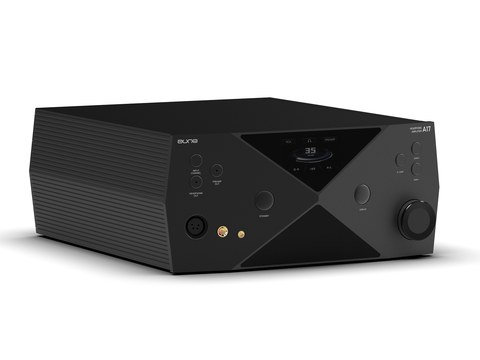
Aune has spent years building a reputation on DAC/amp combo units and portable dongles, so the A17 is a bit of a statement piece: a pure headphone amplifier, no DAC chip inside at all, built around a fully discrete, fully balanced Class-A design. This is aimed at people who already own a DAC they like and want the analog amplification stage to stop being the weak link.
What the A17 Is (and Is Not)
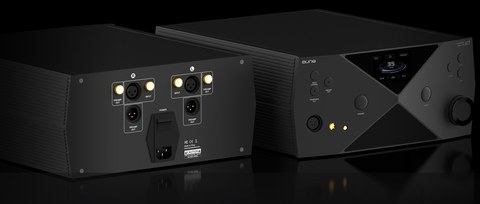
It is worth being direct about this up front: the A17 has no digital-to-analog converter inside it. It takes an analog signal in over RCA or XLR from whatever DAC or preamp is already in your system, and its entire job is amplification, done as cleanly and powerfully as Aune’s engineering team could manage. That makes it a poor match for anyone shopping for an all-in-one desktop solution, and exactly the right tool for someone building a proper two-box (or three-box) stack with a dedicated DAC already in place.
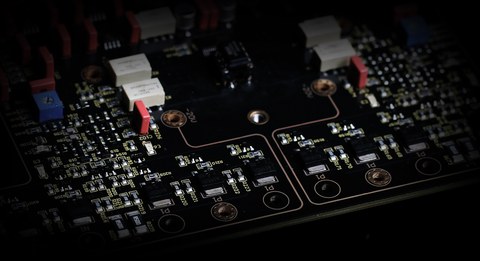
The amplifier stage is fully discrete, meaning no integrated op-amp chips are doing the heavy lifting, and it runs in true Class-A operation, a design choice that trades power efficiency and heat for lower distortion and a more linear response across the volume range.
Key Specifications
| Output power | Up to 11,500mW into 32-ohm balanced load, 1,260mW into 300-ohm, roughly 640mW usable into 600-ohm |
| Noise floor | ≤7 microvolts |
| THD+N | 0.00045% |
| Input stage | Twin-JFET design, two current modes, four gain settings |
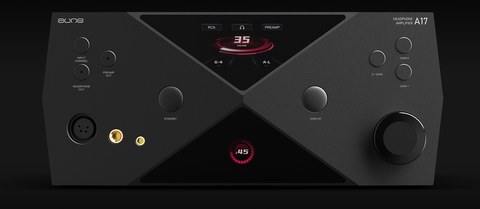
| Volume control | 99-step R2R, built around the JRC MUSES72323 chip |
| Power supply | 100W toroidal transformer for the analog section, separate isolated supply for display/control logic |
| Filter capacitance | Roughly 80,000μF across the bank |
| Voltage rails | ±20V preamp stage, ±15V output stage |
| Outputs | 4-pin XLR, 6.35mm, 4.4mm balanced headphone jacks, plus XLR/RCA preamp outputs |
The Split Power Supply Approach
One of the more interesting engineering choices here is the split voltage-rail architecture. Running the preamp stage at a higher ±20V gives the amplifier plenty of dynamic headroom before clipping, while the output stage runs at a lower ±15V to keep heat under control, since three pairs of output transistors running in parallel per channel in true Class-A already generate a fair amount of warmth on their own. Pairing that with a fully separate power supply for the digital display and control logic, isolated through digital isolators from the analog section, is exactly the kind of detail that shows up as a genuinely quieter noise floor rather than just a spec-sheet bullet point.
Setup and Pairing
- Feed it a clean source. Since there is no DAC inside, the A17 will faithfully amplify whatever character your source DAC or preamp already has, good or bad.
- Start on the lower current mode and lower gain setting with sensitive headphones, then work upward. With over 11W on tap into low-impedance loads, it is trivially easy to overdrive sensitive planar or dynamic headphones on the wrong gain setting.
- Use the balanced 4-pin XLR or 4.4mm output whenever the headphone supports it; the balanced topology is where this amplifier’s low noise floor and output power really show up.
- If also using the XLR/RCA preamp outputs to feed a separate power amp or active speakers, keep the headphone output muted or disconnected to avoid interaction between the two output paths.
Troubleshooting Common A17 Issues
Most problems people run into with the A17 come down to gain staging or cable choice rather than an actual fault, but a few are worth knowing about ahead of time.
- Volume jumps too much between low steps: This usually means the current mode or gain setting is too high for the headphone connected. Drop to the lower current mode and lowest gain setting first, especially with sensitive IEMs, then work upward from there rather than starting on a high setting and fighting for fine control.
- Amplifier runs noticeably hot during use: Expected behavior for a true Class-A design; the three parallel output transistor pairs per channel generate real heat as part of normal operation. Make sure the chassis has open space around it for airflow rather than being enclosed in a rack or cabinet.
- No sound through the headphone output: Confirm the correct input is selected on the front panel (RCA vs XLR) and that the source DAC or preamp is actually outputting a signal, since the A17 has no internal DAC to fall back on if the input signal itself is silent.
- Preamp outputs and headphone output interact or hum: If running both simultaneously to feed a speaker amp and headphones at once, try muting or disconnecting one path; some ground-loop hum can appear when both outputs are active into different downstream equipment at the same time.
- Channel imbalance at very low volume: Rare with the R2R volume stage, but if it happens, check the gain setting first — running IEMs on a high-power gain setting near the bottom of the volume range is more likely to reveal imbalance than a genuine hardware fault.
Sound
What stands out immediately is how effortless the A17 sounds regardless of headphone load. The twin-JFET input stage carries Aune’s characteristic slightly warm, dense tonal signature into the amplification stage rather than the leaner, more clinical sound some Class-AB balanced amps produce, and the huge power reserves mean even genuinely difficult-to-drive planar headphones are handled with real authority rather than sounding strained near the top of the volume range.
Where the R2R volume control and low noise floor pay off most is with sensitive in-ear monitors run through the lower gain and current settings; channel imbalance at low volumes, a common complaint with cheaper analog volume pots, is essentially a non-issue here thanks to the MUSES72323-based stepped control. Bass control is tight and well-damped, the midrange carries good density and texture without becoming syrupy, and the treble stays composed rather than etched, which fits the “musical rather than analytical” house sound Aune has built its reputation on.
Price and Who Should Buy It
Pricing sits in the roughly $2,200 to $2,600 range depending on the retailer, with Headphones.com and the Aune Store both carrying it; the exact figure varies slightly by region and current promotions, so it is worth comparing a couple of listings before buying. That places the A17 firmly against other flagship-tier discrete balanced amplifiers rather than budget desktop stacks, and it earns that positioning through genuinely serious internal engineering rather than just a large chassis and a high price tag.
This is the right amplifier for someone who already has a DAC or streamer they are happy with and wants a dedicated, no-compromise amplification stage capable of driving anything from sensitive IEMs to power-hungry planar flagships, plus the flexibility to double as a preamp for a small speaker setup. It is the wrong choice for anyone wanting a single box that also handles digital conversion.
FAQ
Does the Aune A17 have a built-in DAC?
No. It is a pure analog headphone amplifier and preamp; it needs a separate DAC or preamp feeding it over RCA or XLR.
Can it drive planar magnetic headphones?
Yes, comfortably. With up to 11,500mW into a 32-ohm balanced load and usable power well beyond that into higher-impedance loads, it has enough headroom for demanding planar and dynamic flagships.
Can the A17 be used as a preamp for speakers?
Yes, it includes XLR and RCA preamp outputs specifically for driving a separate power amplifier or active speakers, in addition to its headphone outputs.
Why does it run hot?
It operates in true Class-A, which trades efficiency for linearity and lower distortion. Heat is a normal and expected byproduct of that design choice, and the chassis is engineered with thermal management in mind.
Is the volume control digital or analog?
It uses a 99-step R2R electronic volume control built around the JRC MUSES72323 chip, which combines precise digital control logic with an analog resistor-ladder signal path.
Having spent time comparing discrete balanced amplifiers from several brands for headphone reviews on this site, the A17’s combination of split power-rail design and genuine Class-A operation put it in a different league from the desktop DAC/amp combos most readers are used to seeing here.