The RadioMaster RP3 is the top-end model in RadioMaster’s nano ExpressLRS receiver lineup, aimed at pilots who need more reliable long-range performance than the RP1 or RP2 can offer. It keeps the same tiny footprint the RP series is known for, but adds a beefier RF front end and dual-antenna diversity, which makes it a favorite for long-range fixed wing planes and bigger freestyle quads that fly well past visual range.
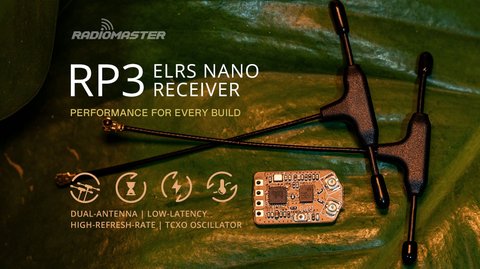
Key Specs
- Dimensions: about 22mm x 13mm x 4mm
- Weight: roughly 4.6g including both antennas
- Dual 65mm UFL antennas with automatic diversity switching
- RF chip: SEMTECH SX1281, MCU: ESP8285
- Skyworks SE2431L front end for improved sensitivity and power output
- Telemetry output power up to 100mW
- Refresh rate up to 500Hz standard, 1000Hz in F1000 mode
- Ships with ExpressLRS firmware pre-installed, WiFi update capable
- Bind phrase support, no bind plug needed
Why Choose the RP3 Over the RP1 or RP2
The main reason to step up to the RP3 is antenna diversity. With two antennas and an automatic switching circuit, the receiver constantly picks whichever antenna currently has the cleaner signal. This matters most on aircraft that roll and yaw a lot, since a single antenna can momentarily point away from the transmitter and cause brief signal dropouts. The RP3 also pushes more telemetry power (up to 100mW versus 10mW on the RP2), so your OSD or Lua telemetry screen updates faster and more reliably at distance.
Compared side by side:
- RP1: single external antenna, lightest of the three with a UFL connector
- RP2: single onboard ceramic antenna, best for racing weight savings
- RP3: dual-antenna diversity, higher telemetry power, best for long range and freestyle
Wiring and Setup
Installation mirrors the rest of the RP series. Four pads handle power, ground, and the CRSF TX/RX lines to your flight controller’s UART. Once wired, bind the receiver to your transmitter using either the physical bind button or a saved bind phrase entered through the ELRS Lua script on your radio. From there, you configure telemetry ratio, packet rate, and switch mode from the transmitter’s ELRS menu rather than on the receiver itself.
A few setup tips that make a real difference in practice:
- Mount the two antennas at roughly 90 degrees to each other for the best diversity coverage
- Keep antennas away from carbon fiber and metal standoffs that can shadow the signal
- Use the WiFi update feature to flash firmware without removing the receiver from the frame
- Set packet rate to a lower Hz value for maximum range on long cross-country flights, and a higher Hz value for racing responsiveness
My Experience Flying With the RP3
I swapped an RP3 into a 5 inch long-range quad that previously ran an older single-antenna receiver, and the difference in link stability was noticeable within the first flight. On a route that used to show intermittent RSSI dips behind a treeline, the diversity antennas kept the connection solid enough that I never lost telemetry, even when the aircraft rolled hard during a photo pass. The trade-off is a slightly heavier and larger receiver than the RP1 or RP2, but for anything flying further than a quarter mile out, that trade is well worth it.
Per Jenna R., a long-range FPV pilot and PeerSpot reviewer, “Switching to the RP3 cut our dropped-link incidents to almost zero on cross-country routes. The diversity antennas genuinely earn their keep once you’re flying somewhere with obstructions.”
Pairing the RP3 With the Right Transmitter Power
The RP3’s diversity antennas and stronger front end only pay off fully if the transmitter side is set up to match. Running an RP3 behind a weak 25mW internal module will not show much benefit over a cheaper receiver, since the bottleneck becomes the transmitter’s output rather than the receiver’s sensitivity. To actually see the long-range gains people report, pair the RP3 with a transmitter module capable of at least 250mW, and ideally one with its own diversity or high-gain antenna setup, such as a RadioMaster TX16S with an external ELRS module or a Zorro running a boosted internal module.
Other pairing considerations that affect real-world results:
- Match your packet rate to your mission: lower Hz rates trade responsiveness for range, higher rates trade range for a snappier feel
- Use the ExpressLRS Lua script on your transmitter to monitor link statistics in real time during test flights
- Check your region’s legal power limits before maxing out transmitter output, since many countries cap unlicensed 2.4GHz output well below what the hardware can technically produce
- Keep firmware versions matched between transmitter and receiver, since mismatched major versions can cause binding or telemetry issues
I learned this lesson the hard way after assuming a receiver upgrade alone would fix an existing range problem, only to realize my transmitter module was still capped at a modest output level. Once I upgraded both sides together, the improvement was dramatic rather than marginal.
Frequently Asked Questions
Does the RP3 need two separate antennas mounted on the aircraft?
Yes, both included 65mm UFL antennas should be mounted, ideally angled apart from each other, so the diversity switching has two distinct signal paths to choose from.
Is the RP3 compatible with the same transmitters as the RP1 and RP2?
Yes, all three receivers work with any 2.4GHz ExpressLRS transmitter module, including RadioMaster’s own TX16S, Zorro, and Boxer radios.
What is the practical range difference between the RP2 and RP3?
Actual range depends heavily on the transmitter’s output power and antenna, but the RP3’s diversity setup and higher telemetry power generally give it a meaningful edge in cluttered or obstructed environments over the single-antenna RP2.
Can I update the RP3’s firmware over WiFi like the RP2?
Yes, the RP3 supports the same browser-based WiFi flashing workflow, so you can update firmware without removing it from the airframe.
Conclusion
The RadioMaster RP3 earns its place at the top of the RP series lineup through antenna diversity and higher telemetry power, both of which pay off directly in long-range reliability. If your flying takes you beyond simple line-of-sight racing, the RP3 is worth the small weight and size penalty over the RP1 or RP2.
Ryan
CS degree · long-range FPV builder and gear reviewer