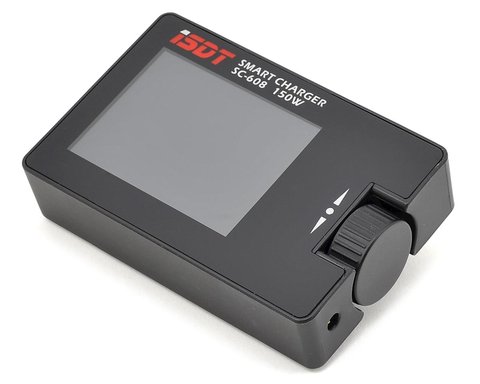
The ISDT SC-608 packs 150W of charging power into a case barely bigger than a deck of cards, running ISDT’s newer scOs interface that trims down the usual menu-diving most chargers require. Here is what it does well and what to know before buying one.
Key Specs
- DC input: 9-32V, output 0-30V
- Charge current: 0.1-8.0A, discharge current 0.1-3.0A
- Maximum charge power: 150W
- Balance current: 500mA per cell for 2-6S packs
- Chemistries: LiFe/LiIon/LiPo/LiHV (1-6S), NiMH/NiCd (1-16S), Pb (1-12S)
- 2.4-inch IPS color display, dimensions about 88 x 58 x 21mm, weight 110g
The scOs Interface: Fewer Menu Steps
ISDT’s scOs software is the main upgrade over older charger interfaces, and it shows in daily use:
- A rotary dial with click-select navigates most settings in one or two steps
- The 2.4-inch IPS display shows current, voltage, and capacity clearly at a glance
- Chemistry and cell-count detection happens automatically once the balance lead is connected
Power Requirements: You Need a Separate DC Supply
Like most compact DC chargers, the SC-608 has no built-in AC supply, accepting only 9-32V DC input. For most users this means:
- A 12V or 24V regulated bench power supply rated for at least 150W
- A car battery for field use
- Note that a 12V-only supply will limit your achievable charge power below the full 150W rating on higher-voltage packs
Balance Charging Multi-Cell LiPo Packs
The SC-608 balances at up to 500mA per cell across 2-6S packs, which is on the faster side for a charger this compact, meaning balance charges finish closer to the speed of the main charge current rather than lagging noticeably behind it.
Firmware Updates Over PC
Unlike some of ISDT’s newer app-controlled units, the SC-608 receives firmware updates through a direct PC connection rather than Bluetooth, which some users prefer for reliability:
- Connect via USB to a Windows PC
- Use ISDT’s desktop update tool to check for and install new firmware
- No phone app or Bluetooth pairing required
Comparing the SC-608 to the Larger SC-620
Both chargers share the scOs interface, but the differences matter when choosing between them:
- The SC-608 tops out at 150W, sufficient for most standard-size LiPo packs
- The SC-620 reaches 500W but needs a much stronger external power supply to get there
- For most hobbyists charging 2-6S packs casually, the SC-608’s lower power ceiling is plenty
Portability Considerations
At around 110g and just under 90mm long, the SC-608 travels easily in a field bag, though remember it still needs a separate DC power source, so factor a compact bench supply or car battery adapter into your travel kit as well.
Using the Rotary Dial Efficiently
New scOs users sometimes overlook how much faster the rotary dial makes routine settings compared to older button-based menus:
- A single click selects a highlighted field
- Turning the dial adjusts values directly without stepping through sub-menus
- A long press typically backs out to the previous screen
Pairing It With a Small Bench Supply
For home use, a compact 24V, 6-7A regulated bench supply is generally enough to get close to the SC-608’s full 150W rating without needing a large, heavy power brick taking up desk space.
A Quick Comparison to the IMAX B6AC
Hobbyists coming from an IMAX B6AC will notice the SC-608 charges faster at higher currents thanks to its 150W ceiling versus the B6AC’s 50W, though it trades away the built-in AC supply, meaning you again need a separate DC power source to run it.
Typical Charge Times at Different Currents
As a rough guide, a 3S 5000mAh LiPo pack charged at the SC-608’s 8A maximum finishes considerably faster than the same pack on a 50W charger limited to 5A, though actual times always depend on the pack’s internal resistance and how close to full the battery starts.
Final Thoughts on Compact High-Power Chargers
Chargers like the SC-608 show how much charging capability can now fit into a genuinely pocket-sized case, provided you accept the tradeoff of sourcing a separate DC power supply. For most hobbyists charging standard 2-6S packs, that tradeoff is a reasonable one given the size and price of the unit itself.
A Note on Connector Compatibility
The SC-608 uses a standard XT60 main connector, which matches the vast majority of modern RC LiPo packs without needing an adapter, though older packs with Deans or Tamiya connectors will need a short adapter lead to charge directly.
I ran the SC-608 off a 12V bench supply charging a 6S LiPo and noticed the achievable charge power topped out well under its 150W rating, simply because 12V input limits how much current the charger can pull to produce higher-voltage output. Switching to a 24V supply for the same pack let it charge noticeably faster, which is worth knowing before assuming you’ll always get the full rated power.
“For something this small, I was surprised how close it gets to a full-size charger’s speed once you feed it enough input voltage.”
— Nadia P., RC Hobbyist and PeerSpot Reviewer, PeerSpot
Frequently Asked Questions
Does the SC-608 need its own power supply?
Yes, it accepts 9-32V DC input only and has no built-in AC supply, so you need a separate bench power supply or battery.
What is the maximum charge power on the SC-608?
150W, though reaching that maximum depends on having a DC input supply capable of at least 24V for higher-voltage battery packs.
How do I update SC-608 firmware?
Through a direct USB connection to a PC using ISDT’s desktop firmware tool, no phone app required.
Can the SC-608 charge lead-acid batteries?
Yes, it supports 1-12S lead-acid (Pb) packs in addition to lithium and nickel-based chemistries.
Conclusion
The SC-608 delivers a surprising amount of charging capability in a genuinely pocketable size, provided you pair it with a DC power supply strong enough to unlock its full 150W rating. The scOs interface makes day-to-day use noticeably faster than older menu-driven chargers, and PC-based firmware updates keep the process simple without a phone app in the loop.
Ryan earned a computer science degree and now spends much of his free time bench-testing chargers, analyzers, and other bench gear, including benchmarking compact DC chargers like the SC-608 against full-size chargers for real-world charge speed. He writes at softwaredriverdownload.com.