The ISDT D2 Mark II is an AC-only dual channel charger built for hobbyists who want to charge two packs at once with independent settings on each channel. This manual walkthrough covers the important settings, wiring, and modes so you are not stuck guessing at the menu.
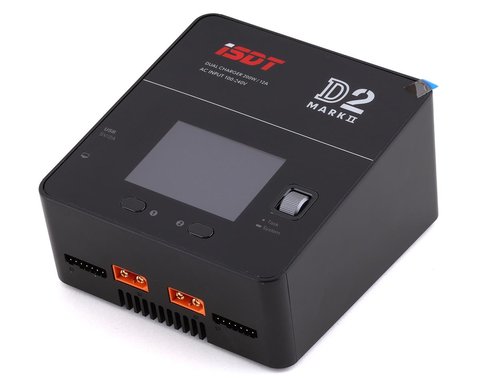
Key Specs
- AC-only input: 100-240V, no DC input option on this model
- 200W total power shared across 2 independent channels
- Up to 12A per channel
- Supports LiPo, LiHV, LiFe, and NiMH chemistries
- Dimensions approximately 108 x 120 x 70mm
- LCD display shows voltage, current, and capacity per channel
Wiring Two Batteries at Once
The D2’s headline feature is running two completely independent charge profiles simultaneously. The manual workflow for this is:
- Connect channel 1’s main and balance leads to your first battery
- Connect channel 2’s main and balance leads to your second battery
- Set chemistry, cell count, and current independently on each channel
- Start each channel separately – they do not need to run the same profile
Splitting the 200W Power Budget
Because the D2 shares a single 200W AC supply across both channels, running two demanding charges at full current simultaneously will cause the unit to automatically reduce output to stay within its power budget:
- A single channel can use up to 12A / 200W on its own
- Two channels running together split that 200W total, not double it
- Plan larger, faster charges on one channel and smaller top-ups on the other for the best overall speed
Chemistry and Mode Settings
Each channel independently supports the following:
- LiPo, LiHV, and LiFe balance charging with automatic cell-count detection through the balance port
- NiMH charging with peak-detection cutoff
- Storage mode to bring lithium packs to a safe resting voltage for long-term storage
- Discharge mode for capacity testing or bringing overcharged packs down safely
No DC Input: Planning Around AC-Only Operation
Unlike some ISDT chargers, the D2 Mark II has no DC input option, meaning it needs mains power to operate at all. This makes it well suited to a home workbench setup but less convenient at a field or track where only a car battery or portable power station is available.
Comparing Single vs Dual Channel Workflows
Whether the D2’s dual-channel design is worth it depends on how you actually charge batteries:
- If you regularly charge one pack while flying or driving another, dual channels save real time
- If you only ever charge one pack at a time, a single-channel charger of similar power may be simpler
- Mixed chemistry sessions, like LiPo on one channel and NiMH on the other, are where the D2 shines most
Long-Term Care for an AC-Only Charger
Since the D2 relies entirely on its internal AC supply, a few habits help keep it reliable:
- Use a surge-protected outlet, since there is no external DC brick to swap if the internal supply is damaged
- Keep both channels’ connectors clean and free of corrosion
- Avoid running both channels at maximum current simultaneously for extended periods to manage internal heat
Reading the Dual Channel Display
The D2’s LCD splits information clearly between both channels, and getting comfortable reading it quickly speeds up multi-battery sessions:
- Each channel shows its own voltage, current, and elapsed capacity independently
- A shared status row indicates which channel, if any, is being power-limited by the 200W total budget
- Error or warning icons appear per-channel rather than as a single ambiguous alert
Storage Charging Both Channels at Once
One underused feature is running storage mode on both channels simultaneously at the end of a flying or driving day, letting you bring two packs to safe resting voltage in one sitting rather than running the process twice sequentially, which is a meaningful time saver if you regularly cycle through several packs.
When a Single-Channel Charger Might Still Make Sense
Despite the dual-channel convenience, some hobbyists are better served by a single, more powerful channel:
- If you only ever charge one large pack at a time, a single 200W channel charges faster than two 100W channels
- If your packs are all similar chemistry and cell count, running them sequentially on a high-power single-channel unit may be simpler
I ran two different LiPo packs on the D2 at once, a 3S pack on channel 1 at 6A and a 6S pack on channel 2 at a lower 3A, and watched the display step down channel 1’s actual current slightly when channel 2 ramped up, exactly as the power-sharing behavior in the manual describes. Once I understood that the 200W is a shared pool rather than 200W per channel, planning charge sessions became much easier.
“Charging two packs at once cut my prep time in half compared to running a single-channel charger twice.”
— Sofia L., Multirotor Builder, RCGroups Forum
Frequently Asked Questions
Can the ISDT D2 run on a car battery?
No, this model is AC-only with a 100-240V input and has no DC input option, so it requires mains power.
Does each channel get its own 200W?
No, the 200W is a shared power budget across both channels. Running two demanding charges at once will split that total rather than doubling it.
What chemistries does the D2 support?
LiPo, LiHV, LiFe, and NiMH, with independent chemistry and cell-count settings per channel.
Can I discharge a battery on the D2 while charging another?
Yes, each channel operates independently, so one can run a discharge or storage cycle while the other charges.
Conclusion
The D2 Mark II earns its keep by letting you run two independent charge profiles from a single AC-powered unit, which is a real time-saver for anyone juggling multiple packs before a session. The main thing to keep in mind from the manual is that 200W is a shared budget, not a per-channel figure, so plan your simultaneous charges accordingly.
Ryan is a CS degree holder who has built a career around troubleshooting drivers, firmware updates, and gadget quirks, including running multi-channel AC chargers like the ISDT D2 side by side to compare real-world charge times. He writes at softwaredriverdownload.com.