The IMAX B6AC fixes the one complaint most people have about the plain B6: it plugs straight into a wall outlet. This tutorial covers unboxing, first charge, and the settings that trip up new users most often, so you can get a battery on charge within a few minutes of opening the box.
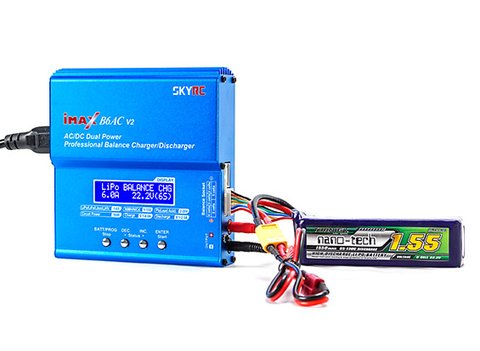
Key Specs
- Built-in universal AC-DC power supply: 100-240VAC, plus an alternate 11-18VDC input
- Charge current: 0.1-5.0A, maximum charge power 50W
- Discharge current: 0.1-1.0A, maximum discharge power 5W
- Chemistries: NiCd/NiMH 1-15 cells, LiPo/LiIon/LiFe 1-6S, Pb 2-20V
- V2 revision adds refined firmware and a cleaner menu interface
- No separate power adapter needed for normal indoor use
Step 1: Plug It In – No Adapter Hunting Required
The single biggest difference from the plain B6 is right here. The B6AC has a universal AC-DC power supply built into the case, accepting anywhere from 100 to 240 volts. That means:
- You can plug it into a standard wall outlet immediately after unboxing
- It also works internationally without a voltage converter, only a plug adapter if needed
- The alternate 11-18VDC input is still there if you prefer running it from a car battery at the field
Step 2: Connect the Battery and Balance Lead
Plug the main charge leads into the battery’s main connector (often XT60 or similar depending on your pack), then connect the balance lead into the matching balance port on the charger. For a LiPo pack:
- Select LiPo chemistry using BATT/PROG
- Confirm the cell count shown matches your pack (2S, 3S, 4S, etc.)
- Set your charge current, typically 1C or lower for longevity
- Press ENTER/START and hold to begin, then double-check the current draw on the display
Common Menu Settings Worth Knowing
A few settings inside the menu are easy to miss but matter for day-to-day use:
- Cut-off voltage: adjustable per chemistry, useful for storage charging
- Safety timer: stops a charge automatically if something looks wrong, worth leaving enabled
- Capacity limit: caps charge input, handy if you suspect a pack has a fault
- Buzzer: can be toggled if you charge batteries overnight in a shared space
Discharge and Storage Mode
The B6AC can also discharge packs down to a storage-safe voltage, which extends LiPo lifespan when batteries sit unused for weeks at a time. Storage mode automatically charges or discharges to roughly 3.8V per cell depending on the current state of the pack, removing the guesswork from long-term storage.
Troubleshooting Common First-Time Issues
A handful of problems account for most of the support questions new B6AC owners run into:
- No balance detected: usually a balance lead plugged in loosely or into the wrong port
- Charge stops early: often triggered by the safety timer or a capacity limit set too low
- Display shows an error code: check that cell count matches the actual pack before assuming a fault
- Charger runs hot: normal at higher currents, but make sure vents are not blocked
Getting the Most Out of the V2 Firmware
The V2 revision of the B6AC refined several small but meaningful details compared to the original release:
- Smoother menu transitions with fewer accidental double-presses
- More consistent balance detection across different battery brands
- Slightly improved thermal management under sustained higher-current charging
Field Use vs Home Bench Use
The B6AC’s dual power input options mean it adapts well to two very different environments:
- At home, plug straight into a wall outlet and rely on the universal 100-240VAC input
- At the field or track, switch to the 11-18VDC input and run from a car battery or portable jump-starter pack
- Carrying both connection options in your bag means one charger covers both scenarios without buying a second unit
Cleaning Up After a Charge Session
A short end-of-session routine keeps the B6AC and your batteries in good shape over time:
- Unplug the balance lead before the main lead to avoid arcing at the connector
- Let the unit cool for a minute before stacking it back into a storage case
- Wipe down connectors if you charge in a dusty garage or field environment
I tested the B6AC right out of the box on a 4S LiPo that had been sitting half-charged for a few months, and storage mode brought it to a safe resting voltage without me having to calculate anything by hand. Compared to the plain B6 I had used previously, not needing a separate DC brick on the bench made the whole process noticeably faster to set up.
“The AC version is the one I recommend to anyone starting out, since there’s nothing extra to buy before you can charge your first pack.”
— Priya S., Drone Racing Enthusiast, PeerSpot
Frequently Asked Questions
Does the IMAX B6AC work on both 110V and 220V mains power?
Yes, its built-in supply accepts 100-240VAC, so it works worldwide with only a plug shape adapter if traveling.
What is the difference between the B6 and B6AC?
The B6AC includes a built-in universal AC-DC power supply, while the plain B6 requires an external 11-18VDC source such as a car battery or bench supply.
How do I use storage mode on the B6AC?
Select your battery chemistry, then choose the storage option from the menu instead of charge or discharge. The unit automatically brings the pack to a safe resting voltage.
Can the B6AC charge more than 6S LiPo packs?
No, it is limited to 1-6S for LiPo/LiIon/LiFe chemistries. Higher cell-count packs need a charger rated for more series cells.
Conclusion
The IMAX B6AC earns its popularity by removing the one real annoyance of the original B6 design: you plug it in and start charging, no separate DC supply required. Once you understand the menu logic and get comfortable with storage mode, it becomes one of the simplest chargers to keep on a workbench for mixed LiPo, NiMH, and lead-acid duty.
Ryan has a computer science degree and has spent years pulling drivers, firmware, and hardware manuals apart to see how they actually work, including running side-by-side comparisons between DC-only and AC-DC balance chargers for hobby battery packs. He writes at softwaredriverdownload.com.