The WOLFBOX MegaFlow 50 (sold as the MF50) is a cordless electric air duster reaching 110,000 RPM, built as a rechargeable, chemical-free replacement for canned compressed air. Here’s what it’s actually good for, and how it compares to the canned air most people already have sitting in a drawer.
| Spec | Detail |
|---|---|
| Max Speed | Up to 110,000 RPM, 3 adjustable settings |
| Weight | 0.45 lb |
| Nozzles | 4 interchangeable nozzles |
| Charging | USB-C, full charge in about 3.5 hours |
| Runtime | Up to 240 minutes on lowest speed |
| Recognition | iF Design Award for compact form factor |
Key Specs
- Up to 110,000 RPM with 3 adjustable speed settings
- Weighs just 0.45 lb, small enough for one-handed use
- 4 interchangeable nozzles for different cleaning tasks
- USB-C charging, full charge in about 3.5 hours
- Up to 240 minutes of runtime on the lowest speed setting
- iF Design Award recognition for its compact form factor
What It’s Actually Good For
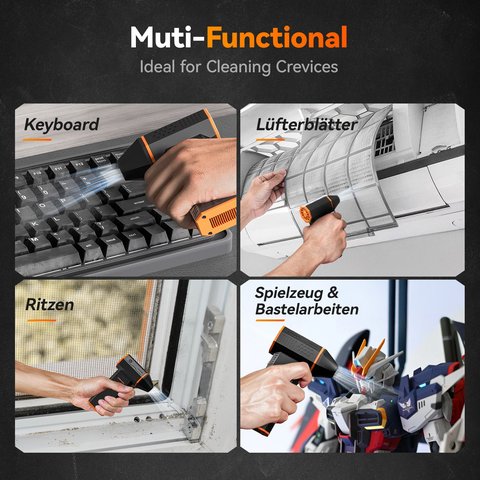
- Clearing dust and crumbs from between keyboard keys
- Blowing debris out of laptop vents and PC case fans
- Cleaning camera lenses, drone bodies, and other delicate electronics
- Quick interior car cleaning around vents and console crevices
- Clearing sawdust from small woodworking projects and craft supplies
The real advantage over canned air isn’t just avoiding the recurring cost — canned air also gets noticeably weaker as the can empties and can spit out propellant residue if tilted, while an electric duster like the MegaFlow 50 delivers consistent airflow at full power until the battery itself runs low.
Electric Duster vs Canned Air: The Real Comparison
Canned air relies on a compressed propellant that gradually loses pressure as the can empties, meaning the last third of a can is noticeably weaker than the first. It also carries a real risk of expelling liquid propellant if the can is tilted too far, which can leave residue on sensitive electronics. The MegaFlow 50 avoids both problems since it moves ambient air mechanically rather than releasing a pressurized gas, so output stays consistent from full charge to nearly empty.
The tradeoff is upfront cost — an electric duster costs more than a single can of air, but pays for itself after a handful of refills, especially if you clean electronics regularly rather than as a rare one-off task.
Choosing the Right Nozzle for the Job
The MegaFlow 50 ships with 4 interchangeable nozzles, generally split between narrow concentrated tips for tight gaps like keyboard switches and USB ports, and wider flared nozzles for open surfaces like laptop lids or camera bodies. Using the wrong nozzle for the job isn’t harmful, but matching the nozzle to the surface makes cleaning noticeably faster and more effective.
For full specs and current pricing, see the WOLFBOX official MF50 product page.
Charging Habits That Extend Battery Life
Like most rechargeable lithium-powered tools, the MF50’s battery lasts longer over its lifetime if you avoid letting it sit fully depleted for extended periods, and avoid leaving it on a charger indefinitely once full. Charging via USB-C means it’s compatible with the same charger and cable you likely already use for a phone or laptop, so there’s no need to keep track of a separate proprietary charging brick.
Environmental Impact Compared to Disposable Cans
Beyond the cost savings, switching from canned air to a rechargeable duster also cuts down on the aerosol can waste that accumulates from repeated purchases. Each empty can eventually needs proper disposal, and depending on your local regulations, aerosol cans sometimes require special recycling handling rather than standard curbside pickup. A single rechargeable unit avoids that recurring waste stream entirely over its usable lifespan.
Common MegaFlow 50 Problems and Fixes
- Airflow feels weaker than expected: Confirm the correct nozzle is attached for the task; a wide nozzle spreads airflow over a larger area and will feel less forceful than a narrow concentrated tip on the same setting.
- Unit won’t turn on: Check the USB-C charging cable and port for debris, and try a different cable, since a partially seated connection can prevent a full charge from registering.
- Runtime seems shorter than advertised: Higher speed settings drain the battery considerably faster than the lowest setting used for the 240-minute rating, so runtime naturally shortens on higher power modes.
- Nozzle won’t stay attached: Make sure it’s pressed in fully until it clicks or seats flush; a loose nozzle is usually a seating issue rather than a defect.
- Battery life degrades over time: This is normal lithium battery wear. Avoiding full depletion and not leaving it on the charger indefinitely once full helps slow the degradation.
Frequently Asked Questions
Is the MegaFlow 50 the same as the MF50?
Yes, “MegaFlow 50” and “MF50” refer to the same WOLFBOX air duster model.
Does it come with a travel pouch or case?
This varies by seller and bundle, so check the specific listing if a carrying case matters to you.
Is it safe to use directly on a laptop’s internal fan?
Generally yes for external vents, but avoid opening the laptop chassis unless you’re comfortable doing so, since internal components are more sensitive to static and misdirected airflow.
How long does a full charge actually last?
Up to 240 minutes on the lowest setting, though higher speeds will drain the battery faster.
Does it produce any moisture like canned air can?
No, since it moves ambient air rather than releasing compressed propellant, it avoids the condensation risk associated with canned air.
Can it also inflate small items like pool floats?
It’s designed for dust removal rather than inflation, so it’s not the right tool for filling air-tight items even though it produces airflow.
Is it safe for camera sensors specifically?
On the lowest speed setting with the narrow nozzle it’s generally fine for exterior lens elements, though sensor cleaning inside the camera body should be done carefully and at low power.
Can it clean vinyl records or turntable equipment safely?
On the lowest setting with a wide nozzle, many users report success clearing dust from vinyl and turntables, though extra caution around the needle is warranted.
Is it TSA-friendly for carry-on travel?
As a small lithium battery device, it generally travels fine in carry-on luggage, though checking your airline’s specific battery device policy beforehand is a good idea.
Does it lose suction or power output as the battery drains?
Airflow stays relatively consistent through most of the charge, with a noticeable drop-off only near full depletion, unlike canned air’s steady weakening from the start.
Can multiple family members share one unit?
Yes, since it’s rechargeable and cordless, it’s easy to share across a household for various cleaning tasks without needing to buy separate units.
Does it come with any kind of case for storage?
This depends on the specific bundle; check your listing to confirm whether a storage pouch or case is included.
Conclusion
The MegaFlow 50 is a practical, reusable alternative to canned air for anyone who cleans electronics regularly. Its compact size and long runtime make it easy to keep on a desk rather than digging through a drawer for a half-empty can, and the consistent airflow avoids the weakening and residue issues that come with pressurized cans, making it a worthwhile upgrade for anyone who cleans electronics more than occasionally.
Ryan
CS graduate · tests every camera and driver he writes about firsthand