The Moondrop Block caught me off guard. Moondrop built its reputation on wired in-ear monitors with serious driver engineering behind them, so a pair of true wireless flathead earbuds felt like an unusual detour. After a couple weeks of daily use around the house and on short walks, I think it makes more sense than it looks like on paper.
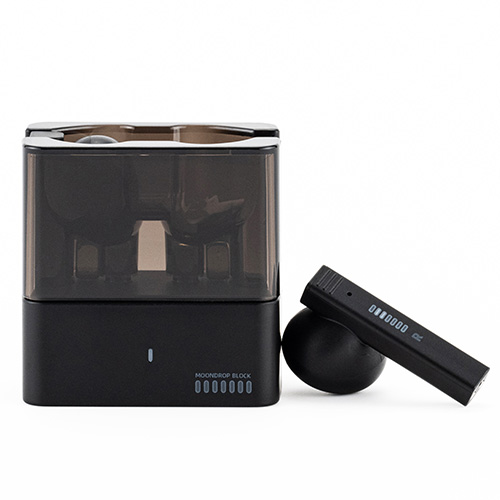
| Quick Facts: Moondrop Block | |
|---|---|
| Brand | Moondrop |
| Model | Block (MD-TWS-030) |
| Form factor | Semi-in-ear, flathead-style true wireless |
| Driver | 13mm dynamic, N52 magnet, CCAW voice coil |
| Bluetooth | 5.4, ~55ms low-latency mode |
| Battery life | ~6 hours earbuds, ~15 more from the case |
| Typical price | Around $20 |
What the Block actually is
This is important to get straight before anything else: the Block is not an in-ear monitor. It is a semi-in-ear, flathead-style true wireless earbud, model number MD-TWS-030, closer in form factor to classic Apple EarPods than to Moondrop’s usual canal-sealing IEMs. If you came looking for a wired Moondrop IEM called Block, you’re thinking of a different product — this one sits in the ear rather than sealing into the canal.
- 13mm dynamic driver with an N52 magnet and CCAW voice coil
- Bluetooth 5.4 connectivity with a claimed 55ms low-latency mode
- Dual-microphone beam-forming ENC for calls
- Roughly 6 hours of earbud battery, about 15 more hours from the case
Sound signature
Moondrop tuned the Block following its familiar VDSF-adjacent house curve, and the bass-enhanced 13mm driver gives it more low-end presence than most flathead-style earbuds manage. Because it doesn’t seal into the ear canal, you won’t get the sub-bass slam of a proper IEM, but for a design that sits loosely against the outer ear, the bass response is more satisfying than I expected going in.
Mids are clean and vocals sound natural, which tracks with Moondrop’s tuning philosophy carrying over even into a completely different form factor and driver type. Treble stays smooth rather than sparkly, avoiding the sometimes harsh top end that cheaper flathead earbuds can suffer from.
Comfort: the actual selling point
Flathead earbuds exist because some people simply cannot tolerate anything sealing into the ear canal for extended periods. If that’s you, the Block solves a real problem — there is no canal pressure buildup, no seal to fuss with, and it’s genuinely comfortable to wear for hours at a stretch, including during phone calls where an in-ear seal can feel isolating in an unpleasant way.
Getting the most out of it
Where it falls short
Isolation is minimal by design, so it is not the right choice for noisy commutes or open offices where you need to block out surroundings. Bass extension, while better than expected, still can’t match a proper sealed IEM. And at $20, build materials are appropriately budget, though nothing felt flimsy during my testing period.
How it compares to other flathead earbuds
The flathead earbud category has a small but dedicated following, and most entries fall into one of two camps: cheap wired designs with minimal driver engineering, or true wireless versions that treat sound quality as an afterthought behind the Bluetooth feature list. The Block sits in a rarer middle ground — a properly tuned dynamic driver behind a true wireless flathead form factor, backed by an actual audio company’s tuning philosophy rather than a generic OEM design with a logo slapped on.
That distinction matters more than it might seem. A lot of budget flathead TWS earbuds sound thin and bright because manufacturers assume buyers in this category don’t care much about tonal balance. Moondrop applying its VDSF-adjacent house curve here, even on a completely different driver type and form factor, results in a noticeably more balanced and pleasant listen than most alternatives at a similar price.
Battery and charging case in daily use
Over about two weeks of regular use, I found the claimed 6-hour earbud battery life to be roughly accurate for moderate volume listening, dropping somewhat faster at higher volumes as expected. The charging case’s extra 15 hours meant I only needed to plug the case itself into power every four or five days under my typical daily usage pattern, which is convenient for anyone who doesn’t want to think about charging cases constantly.
Charging the case from empty took close to the claimed 1.5 hours in my testing, and a quick 10-minute top-up was enough to get a couple hours of playback in a pinch, which is handy before a commute if you forgot to charge overnight.
Common Problems and How to Fix Them
The Block is a simple product, but a handful of issues come up often enough with flathead-style true wireless earbuds that they’re worth addressing directly:
- Problem: One earbud won’t pair or keeps dropping connection. Fix: place both earbuds back in the case for about ten seconds, then take them out together; this resyncs the left-right connection, which is a more common hiccup on flathead designs since the earbuds sit looser than a canal-sealing IEM and can shift slightly during handling.
- Problem: Bass sounds thin or the fit feels unstable. Fix: because the Block doesn’t seal into the canal, small rotation and angle changes make a real difference — try adjusting the angle against your outer ear rather than assuming the driver itself is underpowered.
- Problem: Low-latency mode doesn’t seem to engage during gaming. Fix: confirm your phone actually supports the matching low-latency Bluetooth codec, since the 55ms mode depends on codec support on both ends, not just the earbuds.
- Problem: Case battery drains faster than expected. Fix: check that the earbuds are seated fully in the case with the charging contacts aligned; a loose seat can leave them trickle-charging inefficiently or not charging at all.
- Problem: Call quality sounds muffled to the other person. Fix: make sure nothing is covering the outer earbud housing where the microphones sit, since the beam-forming ENC setup relies on a clear line to both mics to isolate your voice properly.
Frequently asked questions
Is the Moondrop Block an in-ear monitor or true wireless earbuds?
It is a true wireless flathead-style earbud (model MD-TWS-030), not a canal-sealing in-ear monitor. It sits against the outer ear rather than inserting into the ear canal.
How is the battery life on the Moondrop Block?
Roughly 6 hours per charge from the earbuds themselves, with the charging case providing about 15 additional hours, for around 21 hours of total playback between full case charges.
Does the Moondrop Block support low-latency gaming?
Yes, it advertises a 55ms low-latency connectivity mode over Bluetooth 5.4, which is noticeably better than typical Bluetooth earbuds for gaming and video sync.
Is the Moondrop Block good for calls?
The dual-microphone beam-forming ENC setup does a reasonable job isolating your voice from background noise during calls, and the flathead design is comfortable for long conversations.
Final thoughts
The Moondrop Block is a smart, low-cost answer to a specific problem: comfortable, casual listening without canal insertion. It won’t replace a proper IEM for critical listening, but for background music, calls, and casual use where comfort matters more than isolation, it delivers more than its price suggests.
About the author: I write about consumer audio and PC gear as a hobby, usually after spending entirely too long reading spec sheets before actually buying anything myself.