Matrix Audio spent years building streamers and DACs before releasing a dedicated preamplifier, and when the MP-1 finally arrived it came as the brand’s first Class A design. That’s a notable departure for a company best known for digital source components, so it’s worth walking through what the MP-1 actually does differently and where it fits alongside the rest of Matrix Audio’s M-series system.
| Spec | Detail |
|---|---|
| Amplifier class | Pure Class A output stage, fully differential transistor input stage |
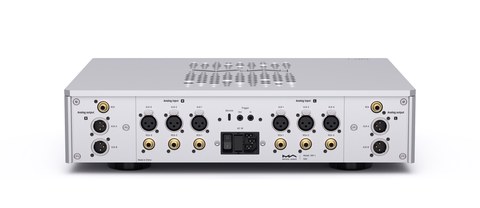
| Inputs | 3x RCA pairs, 3x XLR pairs, independent per-input gain trim |
| Outputs | 1x RCA pair, 2x XLR pairs, plus trigger in/out |
| Price tier | Higher-tier standalone preamplifier segment |
| Compatibility | Any source/power amp with compatible gain staging; part of the M-series stack with MS-1 and MA-1 |
Circuit design
The MP-1 is built around a fully differential transistor input stage, chosen for low noise and strong linearity ahead of the gain stage. The output section runs in pure Class A with a high bias current, which avoids the crossover distortion that shows up in Class AB designs right at the zero-crossing point of the waveform. In practice, this is the same tradeoff every Class A design makes: more heat and higher standby power draw in exchange for a cleaner, more linear output stage.
Internally, the main amplification section is built from four independent, fully balanced amplification units, with two units per channel handling the in-phase and inverted halves of the balanced signal separately before they’re combined. Matrix Audio’s own documentation on the MP-1 product page goes into more detail on this topology if you want the full schematic-level breakdown.
Inputs, outputs, and routing
- Three pairs of RCA inputs and three pairs of XLR inputs
- One pair of RCA outputs plus two pairs of XLR outputs for flexible routing to multiple amplifiers
- Independent level attenuation and gain compensation per input, so mismatched source levels don’t force you to ride the volume knob every time you switch sources
- Trigger in/out ports for automated power-up sequencing with matching amplifiers
The ability to set independent attenuation per input is a small feature that matters more than it looks on a spec sheet. Anyone who has jumped from a phono stage to a hot-running DAC output knows the frustration of a preamp that treats every input identically.
Power supply
Two 60W square copper wire toroidal transformers handle power duty, with each transformer dedicated independently to one channel’s volume control circuit and main amplification unit. Splitting the power supply this way is a deliberate move to keep channel separation high and to prevent one channel’s current draw from modulating the other’s supply rail, which is a common source of subtle crosstalk in shared-supply designs.
Industrial design
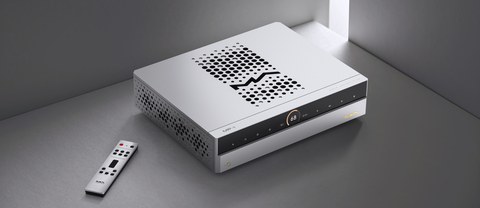
The top panel is covered in an array of hundreds of circular perforations of varying sizes and depths, arranged to spell out Matrix Audio’s stylized “M” logo when viewed from the right angle, described by the company as evoking the rhythm of dancing beats. It’s a distinctive look compared to the plain brushed panels most preamps ship with, and it doubles as passive ventilation for the Class A output stage, which runs warmer than a typical Class AB preamp at idle.
- Front-panel touch controls with a circular volume readout
- Included remote control matching the unit’s finish
- Compact footprint relative to full Class A power amplifiers, since the MP-1 only has to bias a preamp-level output stage rather than drive speakers directly
Building a system around it
Matrix Audio’s M-series is designed as a three-piece stack: the MS-1 handles streaming and digital-to-analog conversion, the MP-1 handles volume control and input switching, and a matching MA-1 power amplifier does the actual speaker-driving. Used together, they form what the company positions as its most complete home system. That said, the MP-1 is a standard analog preamplifier at heart, so nothing stops you from pairing it with a different source or a third-party power amplifier, as long as your gain staging works out.
If you already own a DAC or streamer you like and just need a clean, low-noise volume control and input switcher between that source and your power amp, the MP-1 slots in without requiring you to replace the rest of your chain.
What to check before buying
A few things are worth confirming before you commit to a Class A preamp like this one:
- Ventilation – Class A circuits idle warm, so give the unit open space above and around it rather than stacking gear directly on top
- Standby power draw – if you’re sensitive to always-on power consumption, know that Class A designs draw meaningfully more at idle than Class AB or D alternatives
- Gain matching with your specific power amp – too much preamp gain paired with a very sensitive power amp can leave you with almost no usable range on the volume dial
Long-term ownership notes
Class A preamps are simple enough mechanically that there isn’t much to maintain, but a few habits help keep one running well for years. Give it a dedicated outlet or a good power conditioner if your home wiring is noisy, since a Class A input stage will reveal power supply noise more readily than a Class D design masks it. Keep the perforated top panel free of dust buildup, since the holes are functioning as passive ventilation rather than pure decoration. And if you’re not using the unit for an extended stretch, a full power-down rather than leaving it on standby indefinitely will extend the life of the output transistors, which spend their entire on-time biased at a relatively high current even with no signal passing through.
Troubleshooting Common Setup Issues
- No sound from one or all inputs: check the per-input level trim setting first, since an input accidentally set near minimum gain can look like a dead channel when it is actually just attenuated far down.
- Connected power amp will not turn on with the preamp: check the trigger cable is fully seated at both ends, and confirm the amp’s trigger input is set to respond to a 12V trigger signal rather than manual power-on only.
- Audible hum or noise: try a different outlet or a dedicated power conditioner, since a Class A input stage reveals upstream power supply noise more readily than Class D designs mask it.
- Alternate path: if trigger-based automatic power sequencing is not working reliably, power the connected amplifier on manually instead. It is a minor inconvenience but avoids relying on the trigger link entirely.
FAQ
Is the MP-1 a power amplifier or a preamplifier?
It’s a line-level preamplifier only. It handles volume control, input switching, and gain staging, but does not drive speakers directly.
What class of amplification does it use?
Pure Class A, which was a first for Matrix Audio at the time of release.
How many inputs does it have?
Three pairs of RCA inputs and three pairs of XLR inputs, each with independent level trim.
Does it need to be paired with other Matrix Audio components?
No. It’s part of a matching M-series system with the MS-1 streamer and MA-1 amplifier, but it functions as a standard analog preamp with any compatible source and power amp.
Does Class A design mean it runs hot?
It runs warmer at idle than a typical Class AB preamp, though nowhere near as hot as a full Class A power amplifier, since it only has to bias a line-level output stage.
I’ve swapped through more preamps over the years than I can count, and the ones with per-input gain trim always end up staying in the rack the longest — it’s a small feature until you don’t have it anymore.