The Foxeer Lollipop Micro is a compact 5.8GHz circular-polarised FPV antenna available with several connector and cable options. Match RHCP or LHCP to the receiving antenna, verify SMA versus RP-SMA, and keep the active element clear of carbon and the battery.
I mounted a Lollipop Micro antenna at an awkward angle to save space and video range dropped noticeably compared to a cleaner vertical mount. Repositioning it for a clear vertical orientation restored the expected range.
This guide covers the tiny aircraft version and the longer angled-SMA goggle version. It explains connector identification, UFL handling, mounting, range faults and why a correct antenna can still perform poorly when its cable or active element is hidden by the frame.
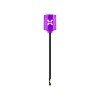
Key specifications
| Item | Details |
|---|---|
| Frequency band | 5.5GHz to 6GHz |
| Centre frequency | About 5.7GHz |
| Gain | About 2.5dBi |
| Polarisation | RHCP or LHCP, depending on version |
| Connector options | SMA, RP-SMA, MMCX and UFL variants |
| Small UFL weight | About 1.6g |
| Long goggle version | Angled SMA RHCP, approximately 150mm overall |
Choose the correct Lollipop Micro version
Foxeer sells more than one product under the Micro Lollipop name. The small aircraft antenna is available with several connector types and both circular polarisations. The longer goggle version uses an angled SMA connector and RHCP.
Check all three details before ordering: connector family, connector gender and polarisation. A plug can screw on while still being the wrong SMA family, and RHCP mixed with LHCP causes major signal loss.
SMA and RP-SMA are not the same
Standard SMA and reverse-polarity SMA use similar threaded shells but swap the centre pin and socket arrangement. Identify the centre contact on both the VTX and antenna.
Do not force a connector that stops early. A mismatched centre contact can bend or leave the VTX effectively running without an antenna.
UFL and MMCX handling
UFL is very light but is not designed for repeated rough removal. Lift it straight up with a suitable tool and press it straight down when reconnecting. Pulling the coax cable can tear the connector from the board.
MMCX is stronger for repeated connection, but it is heavier. Support the cable so crash force is not transferred directly into the VTX socket.
Match RHCP and LHCP
Circular polarisation describes the direction of rotation of the radio wave. The transmitting and receiving antennas should use the same direction for best range and multipath rejection.
| Aircraft antenna | Goggle antenna | Expected result |
|---|---|---|
| RHCP | RHCP | Correct match |
| LHCP | LHCP | Correct match |
| RHCP | LHCP | Severe cross-polarisation loss |
| Circular | Linear | Works at short range but with a performance penalty |
Mounting on a small FPV drone
Place the active element where it can see the goggles during most flight attitudes. Keep it above or behind carbon plates, batteries and high-current wiring. The coax can bend gently, but a sharp kink changes its impedance and weakens the cable.
- Secure the feeder, not only the antenna head.
- Leave a small flexible section for crash movement.
- Keep the active element out of the propeller arc.
- Do not clamp the coax with a hard zip tie edge.
- Check that a top-mounted battery cannot crush the antenna.
Using the long goggle version
The longer angled-SMA version is designed to move the active element away from the goggle body. Pointing an omnidirectional circular antenna straight up usually gives broad coverage around the pilot.
For longer-range use, pair one omni antenna with a directional patch when the goggles support diversity. The patch covers the main flight direction while the omni helps when the aircraft is beside or behind the pilot.
VTX safety and bench testing
Never power a VTX without a correctly fitted antenna. Even a low-power transmitter can heat quickly when energy is reflected back into the output stage.
Start range testing at low power and short distance. If the link is poor, inspect the antenna and connector before increasing VTX power. Extra power cannot repair a broken feeder or cross-polarised setup.
Common Lollipop Micro problems
| Problem | Likely cause | What to do |
|---|---|---|
| Very short range | Wrong polarization or damaged feeder | Match RHCP/LHCP and inspect the cable near the connector |
| Signal drops when turning | Antenna shadowed by battery or carbon | Move the active element above and away from the frame |
| High VTX temperature | Antenna missing, loose or wrong connector | Power down and verify the connector before testing again |
| Good close range, poor distance | Connector loss or bent coax | Test with a known-good antenna of the same polarization |
| Intermittent video after crashes | Cracked solder joint inside the antenna | Replace the antenna rather than increasing VTX power |
A hidden crack often appears where the coax enters the antenna head or connector. The outside jacket can look normal while the centre conductor is intermittent.
If the signal changes when the cable is touched, replace the antenna. Do not continue flying on a feeder that works only at one angle.
When to replace the antenna
Replace it after a hard strike that cracks the case, bends the connector, cuts the coax or produces a clear range reduction. Antennas are consumable crash parts, and visual damage is not the only sign of failure.
Keep a known-good spare with the same connector and polarisation. Swapping one antenna is a faster diagnostic than changing VTX firmware or receiver settings.
Sources and further reading
Conclusion
Match the connector and circular polarisation, mount the active element in clear space and replace damaged feeders after a crash. More VTX power cannot compensate for a loose or mismatched antenna.
Frequently Asked Questions
Is the Lollipop Micro RHCP or LHCP?
The small aircraft version is sold in both options. Check the label or order selection. The longer angled-SMA goggle version is commonly RHCP.
Can SMA and RP-SMA connect together?
The shells may thread, but the centre contacts differ. Use the correct connector family or an appropriate adapter.
Can I fly with one RHCP and one LHCP antenna?
The link may work at very short range, but cross-polarisation causes large signal loss and is not recommended.
Why is range poor after a crash?
The coax or internal antenna joint may be cracked even when the outer case looks normal. Test with a known-good antenna.
How should the antenna be mounted?
Keep the active element clear of carbon, battery and propellers, while supporting the feeder so the VTX connector does not take crash force.
Ryan is a longtime PC and gadget enthusiast who tests gear before recommending it, sharing setup notes and troubleshooting steps at softwaredriverdownload.com.