RadioMaster’s TX15 and GX12 both target pilots who want a dual-band ExpressLRS transmitter with real gimbals rather than a stick-only handheld. They sit close together in price and capability, but the design philosophy behind each is genuinely different: the TX15 chases gimbal feel and screen size, while the GX12 chases portability and link redundancy through Gemini-X. Here is how the two actually compare once you get past the marketing copy.
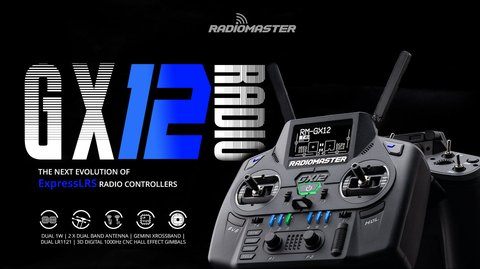
Key Specs
- TX15: 3.5-inch color IPS touchscreen, full-size AG02 or Hall gimbals, dual-band ExpressLRS up to 1000mW
- GX12: monochrome display, foldable compact gimbals, dual-band Gemini-X ExpressLRS with antenna diversity across both bands
- Both run EdgeTX firmware and support standard model memory and mixing
- Both charge via USB-C and use rechargeable Li-ion packs
Spec Comparison Table
| Feature | RadioMaster TX15 | RadioMaster GX12 |
|---|---|---|
| Display | 3.5″ color IPS touchscreen, 480×320 | Monochrome LCD |
| Gimbals | Full-size AG02 CNC or Hall V5.0 | Compact foldable gimbal sticks |
| Frequency bands | 2.4GHz and 900MHz, up to 1000mW | 2.4GHz and 900MHz with Gemini-X dual-band diversity |
| Antenna diversity | Not supported | Dual antenna, Gemini-X crossband diversity |
| Portability | Larger, fixed gimbal sticks | Foldable sticks and antennas, travel friendly |
| Firmware | EdgeTX | EdgeTX |
| Best for | Pilots who prioritize gimbal precision and a large touchscreen | Long-range and travel pilots who value link redundancy and portability |
Where the TX15 Wins
If gimbal feel is your top priority, the TX15’s full-size AG02 or Hall sensor sticks simply feel more precise under the thumbs than the GX12’s smaller, foldable units. The larger color touchscreen also makes navigating model setup and mixes noticeably faster, especially if you manage a large number of aircraft profiles. For pilots who fly mostly from a fixed location, like a local field, and rarely need to pack the radio into a small bag, the TX15’s larger footprint is not really a downside.
Where the GX12 Wins
The GX12’s headline feature is Gemini-X, which lets the radio transmit across both 2.4GHz and 900MHz simultaneously with antenna diversity, giving you a redundant link if one band experiences interference. That is a genuinely useful safety net for long-range flights over unfamiliar terrain. On top of that, the GX12’s foldable gimbal sticks and antennas make it dramatically easier to toss in a backpack without needing a hard case or gimbal protectors, which matters if you travel to fly.
Quick summary of when to pick which:
- Choose the TX15 if you want the best stick feel and a color touchscreen, and portability is not a priority
- Choose the GX12 if you fly long range, want link redundancy, or need a radio that folds down for travel
My Take After Flying Both
I flew a long-range fixed wing on the GX12 during a weekend trip where checked baggage space was tight, and being able to fold the whole radio down into a padded pouch instead of a hard case made a real difference. Back at home, though, I still reach for the TX15 for everyday quad flying, mostly because the bigger touchscreen makes swapping between a dozen saved models much less fiddly than scrolling through the GX12’s monochrome menus.
Per Owen K., an RC Hobbyist and PeerSpot reviewer, “I bought the GX12 specifically for a trip where I couldn’t bring a case, and the Gemini-X diversity gave me confidence flying routes I wouldn’t have attempted with a single-band radio.”
Price and Value Considerations
Both radios tend to land in a similar price bracket, which makes the decision less about budget and more about which trade-offs actually matter for how you fly. The TX15’s larger touchscreen and gimbal quality justify its price for pilots who spend a lot of time in the menus managing dozens of aircraft profiles, since the time saved navigating a color touchscreen adds up over months of use. The GX12’s Gemini-X hardware, on the other hand, represents a genuine engineering investment in link reliability that is hard to put a price on if you have ever lost a long-range aircraft to a dropped link.
A few extra factors worth weighing before you buy either radio:
- Check current bundle deals, since both radios are sometimes sold with a matched nano receiver at a discount
- Consider resale value, since the TX15’s broader popularity can make it easier to sell later if your needs change
- Factor in accessory costs like cases and neck straps, which differ in price depending on the radio’s shape
- Look at your local retailer’s return policy, since gimbal feel is subjective and worth testing in person if at all possible
Frequently Asked Questions
Is the GX12 as powerful as the TX15 in terms of RF output?
Both support similar output power ranges, though the GX12’s advantage comes from Gemini-X diversity rather than raw transmit power.
Can I use the same receivers with both the TX15 and GX12?
Yes, since both are ExpressLRS dual-band transmitters, they work with the same range of ELRS receivers, including the RP1, RP2, and RP3 nano receivers.
Which radio is better for a first-time buyer?
The TX15 is generally a friendlier starting point thanks to its touchscreen menus, while the GX12 suits pilots who already know they want Gemini-X diversity and portability.
Do both radios run the same firmware?
Yes, both ship with EdgeTX and receive updates through the same open-source firmware project.
Which Receivers Pair Best With Each Radio
Since both radios use the ExpressLRS ecosystem, receiver choice matters as much as the transmitter itself. If you plan to use the GX12’s Gemini-X feature, you will specifically want a Gemini-capable receiver rather than a standard single-antenna unit like the RP1 or RP2, since a single-band receiver simply cannot take advantage of the dual-band diversity transmission. For the TX15, any standard ELRS nano receiver works fine, with the RP3 being a strong match if you want diversity reception on the aircraft side even without Gemini-X on the transmitter.
A quick pairing guide:
- TX15 plus RP1 or RP2 for lightweight racing and freestyle builds
- TX15 plus RP3 for longer range flights where you still want diversity on the receiver end
- GX12 plus a Gemini-capable receiver to make full use of dual-band redundancy
Conclusion
Neither radio is strictly better than the other; they are built for different priorities. Pick the TX15 for gimbal feel and screen real estate, and pick the GX12 for Gemini-X link redundancy and travel portability. Whichever you land on, both give you a solid dual-band ExpressLRS platform running EdgeTX.
Ryan compares RC transmitters side by side on the bench before recommending them. He writes at softwaredriverdownload.com.