If you have narrowed your next radio purchase down to two RadioMaster sticks, you have probably landed on the Boxer and the GX12. Both are gimbal-style ELRS handheld transmitters built for FPV and mini quad pilots, both run EdgeTX out of the box, and both sit in a similar price bracket. But they are not interchangeable choices — the gimbal hardware, portability, and control feel are different enough that picking the wrong one can leave you wishing you had bought the other. I have flown with both radios over several packs and travel trips, and this comparison breaks down where each one actually wins.
Key Specs
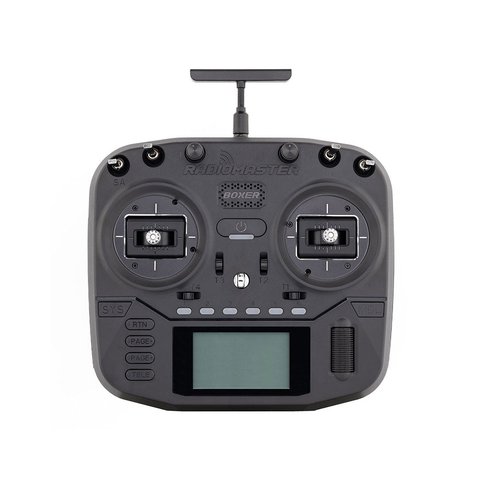
- RadioMaster Boxer: High-precision 4.0 Hall gimbals as standard, 16 channels max, 532.5g
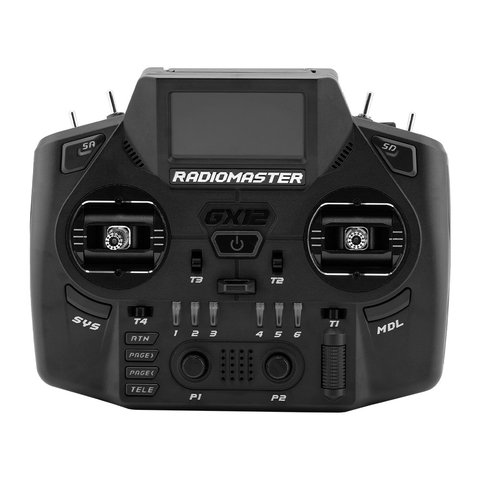
- RadioMaster GX12: GX01 CNC aluminum Hall gimbals with folding sticks, 16 channels max, 573g
- Boxer storage: STM32F407 processor, 1MB flash, expandable via microSD
- GX12 storage: 512MB integrated flash, no SD card needed
- Boxer protocol options: CC2500 multi-protocol, 4-in-1 module, or ELRS 2.4GHz
- GX12 protocol: ExpressLRS and mLRS compatible, dual-band antenna setup
- Both: 128×64 monochrome display, EdgeTX firmware, USB-C charging
Full Spec Comparison
| Spec | RadioMaster Boxer | RadioMaster GX12 |
|---|---|---|
| Gimbals | Full-size 4.0 Hall effect, standard | GX01 CNC Hall effect, folding, slightly shorter throw |
| Weight | 532.5g | 573g |
| Channels | Max 16 (receiver dependent) | Max 16 (receiver dependent) |
| Protocol options | CC2500, 4-in-1, or ELRS | ExpressLRS and mLRS |
| Storage | 1MB flash + microSD expansion | 512MB built-in flash, no SD required |
| Display | 128×64 monochrome LCD | 128×64 monochrome OLED |
| Antenna | Single external antenna | Dual-band folding antennas |
| Refresh rate | Standard gimbal response | 1000Hz gimbal refresh |
| Portability | Fixed sticks, larger footprint | Foldable sticks and antennas, more travel-friendly |
| Price | $153.99 (ELRS), $109.99 (CC2500) | $169.99 |
Gimbal Feel: Where Most Buyers Actually Decide
The gimbals are the single biggest difference between these two radios. The Boxer uses RadioMaster’s full-size 4.0 Hall gimbals, the same family found in the flagship TX16S, and they have a longer stick throw with a heavier, more mechanical feel that a lot of freestyle and racing pilots prefer for fine throttle control. The GX12 debuts the newer GX01 gimbals, which are also CNC aluminum and Hall effect, but built into a smaller housing with folding stick ends for travel. That folding design is genuinely useful in a backpack, but the shorter throw means less resolution per millimeter of stick movement, which some pilots notice on tight proximity flying.
Neither gimbal is bad. It comes down to whether you prioritize the familiar full-size throw of the Boxer or the compact folding convenience of the GX12 when the radio is not in your hands.
Storage and Protocol Setup
This is where the two radios diverge in philosophy. The Boxer is sold in CC2500, 4-in-1, and ELRS variants, so you choose your protocol at purchase and can later expand storage with a microSD card for extra model memory, Lua scripts, and sound packs. The GX12 skips the SD card entirely in favor of 512MB of integrated flash, which is fast and eliminates a common failure point (corrupted or poorly formatted cards), but it also means you cannot simply swap a card to move your model list to another radio.
- If you already own other RadioMaster gear on CC2500 or 4-in-1, the Boxer’s protocol flexibility matters more.
- If you fly exclusively ELRS and want one less thing to format or troubleshoot, the GX12’s built-in storage is simpler.
- Both radios back up their model data over USB-C, so migrating between radios of the same family is straightforward either way.
Portability and Travel
On paper the GX12 is heavier, but it packs down smaller thanks to the folding gimbal sticks and dual folding antennas. The Boxer’s fixed sticks mean you need a padded case with more depth, or you risk bending a stick end in a backpack. For pilots who fly at multiple fields or travel with their gear regularly, the GX12’s folding design is a real advantage even though the raw weight number favors the Boxer.
My Own Time With Both Radios
I flew the Boxer for about eight months before picking up a GX12 to compare side by side at the same field with the same quad and the same ELRS receiver. The first thing I noticed switching to the GX12 was how much smaller it felt in my flight bag once folded, which mattered on a weekend trip where space was tight. But on the stick itself, my throttle control felt slightly less precise for the first few packs, purely because my thumb was used to the Boxer’s longer throw. After a week of flying, the difference mostly disappeared, though I still reach for the Boxer when I know I am doing technical gap flying and want the most granular stick feel I can get.
Which One Should You Buy
- Choose the Boxer if you want the longest gimbal throw for precision flying, need protocol flexibility beyond ELRS, or already have a microSD-based backup workflow.
- Choose the GX12 if portability and travel packing matter most, you fly exclusively ExpressLRS or mLRS, and you like the idea of skipping SD card management entirely.
- Budget-conscious buyers who do not need ELRS should look at the Boxer’s CC2500 variant, which is noticeably cheaper than either ELRS option.
Both radios are backed by the same EdgeTX ecosystem, so whichever you pick, you are getting access to the same open-source firmware, mixing options, and community support. You can check current pricing and full specs directly on the RadioMaster Boxer product page and the RadioMaster GX12 product page.
Frequently Asked Questions
Can I put an ELRS module into the CC2500 Boxer later?
The Boxer’s internal RF module is fixed at purchase, so a CC2500 unit cannot be converted to internal ELRS. You can, however, add an external ELRS module if the radio has an external bay, without replacing the internal hardware.
Does the GX12’s smaller gimbal throw actually hurt flight performance?
Most pilots adjust within a few packs. It is more noticeable in technical proximity or racing flying than in general freestyle, where the difference becomes hard to feel after some practice.
Is the GX12’s 512MB flash enough model storage for a large fleet?
Yes, for the vast majority of pilots. EdgeTX model files are small, so 512MB comfortably holds hundreds of model profiles along with Lua scripts and telemetry logs.
Are the Boxer and GX12 both compatible with the same receivers?
Any ELRS variant of either radio binds to standard ExpressLRS receivers the same way. The GX12 additionally supports mLRS, which requires a compatible mLRS receiver rather than a standard ELRS one.
Conclusion
The Boxer and GX12 both do a solid job as a primary FPV transmitter, and neither is a bad purchase. The real decision point is gimbal feel versus portability: the Boxer’s longer stick throw suits pilots chasing precision, while the GX12’s folding design and built-in storage suit pilots who travel often and want fewer moving parts to manage. If you can, try to feel both gimbals in person before deciding, since that single factor tends to matter more to long-term satisfaction than any spec on a sheet.
Ryan has spent years testing FPV radios and RC gear hands-on before writing about them. He writes at softwaredriverdownload.com.