The SkyRC e680 sits in a sweet spot a lot of chargers miss: it is compact enough to travel with, but flexible enough with AC/DC input and a built-in power supply mode that it can genuinely replace two or three separate pieces of pit-box gear.
Key Specs
- Power input: AC 100-240V or DC 11-18V
- Max charge power: 80W
- Max charge current: 8A
- Adjustable output voltage: 13.8V, 10-80W adjustable power supply mode
- Chemistries: LiPo/LiFe/Li-ion/LiHV (1-6S), NiMH, NiCd, Pb
- Balancing: up to 300mA per cell
- Dimensions: 135 x 110 x 60mm
- Weight: 390g
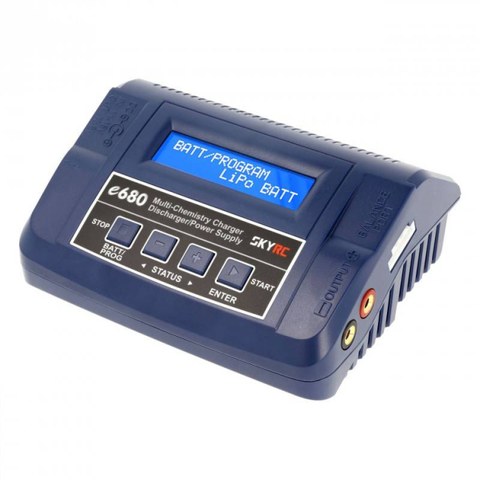
Charging Drone Batteries Directly
One of the most practical, specific use cases for the e680 is charging DJI Mavic-series drone batteries directly, at up to 4A. If you fly both RC cars or planes and a Mavic drone, that means one charger on the bench instead of the drone’s proprietary charging hub plus a separate LiPo charger for everything else.
- Set the appropriate charge current (up to 4A) for Mavic-compatible battery charging
- Balance ports keep individual cell voltages even across the pack during charge
- No need for the drone manufacturer’s dedicated charging hub for routine top-offs
Built-In Power Supply Mode
Beyond charging batteries, the e680 doubles as an adjustable DC power supply, outputting 13.8V at anywhere from 10W to 80W. That is genuinely useful in a pit or workshop setting for powering tire warmers, pit lights, or other small 12V-class accessories without dragging out a separate bench supply.
- Switch the e680 into power supply mode from the main menu
- Adjust output wattage to match the connected accessory’s needs
- Use the output leads to power tire warmers, LED pit lights, or similar gear directly
Cold-Weather and AGM Support
The e680 can also charge AGM (sealed lead-acid) batteries, and SkyRC specifically notes it can be used for Pb battery charging at low temperatures, which is a small but meaningful detail if you fly or race in colder conditions where standard chargers sometimes refuse to cooperate with cold packs.
I run mine mostly for a mixed fleet: a couple of 4S plane packs, a 6S car pack, and a Mavic battery that used to require its own separate charging hub. Consolidating all of that onto one 80W charger cut down meaningfully on what I have to pack for a weekend at the field.
Cycling NiMH/NiCd Packs
For hobbyists still running older NiMH or NiCd receiver packs, the e680 supports automatic cycling — discharging and recharging a pack repeatedly in one programmed sequence to help maintain capacity on batteries that have been sitting unused for a while.
“The power supply mode is what sold me — I use the e680 to run my tire warmers at the track now instead of hauling a separate supply, and it still handles all my LiPo charging duties fine.” — Wesley A., on-road racer, posting on a regional RC forum
Setting Up the e680 for Mixed-Fleet Charging
- Select the correct chemistry for the connected pack (LiPo/LiFe/Li-ion/LiHV, NiMH, NiCd, or Pb)
- For drone batteries, cap charge current at or below 4A regardless of the pack’s rated maximum, matching SkyRC’s documented safe rate for Mavic-compatible cells
- Connect balance leads whenever available, even on packs that technically could be charged without one
- Switch input source between AC and DC depending on whether you are charging at home or in the field
Because the e680 handles such a wide spread of chemistries and use cases, it rewards spending a few minutes actually learning the menu structure rather than blindly pressing through defaults — the difference between using it well and using it adequately mostly comes down to matching charge current to what each specific pack or accessory actually needs.
Comparing It to Single-Purpose Chargers
- Dedicated drone charging hubs: often simpler for that one battery type, but useless for anything else in your fleet
- Dedicated LiPo-only chargers: sometimes cheaper if you truly never touch NiMH, Pb, or drone batteries
- e680: broader chemistry coverage plus a genuinely useful power-supply mode, at a modest size and weight penalty compared to single-purpose units
Frequently Asked Questions
Can the SkyRC e680 charge DJI Mavic drone batteries?
Yes, it can charge DJI Mavic-compatible batteries directly at up to 4A, without needing the drone’s proprietary charging hub.
Does it need an AC outlet to work?
No, it accepts either a standard AC wall outlet (100-240V) or a 12V-class DC input (11-18V), so it works both at home and in the field.
Can it power accessories other than batteries?
Yes, its built-in power supply mode outputs 13.8V at 10-80W adjustable, suitable for tire warmers, pit lights, and similar 12V-class accessories.
Does it support lead-acid batteries?
Yes, AGM and Pb battery charging is supported, including use in low-temperature conditions.
Care and Longevity Tips
- Keep the case’s cooling vents clear, particularly when running the power supply mode at higher wattages for extended periods
- Inspect AC and DC input cables periodically if the unit travels between home charging and field/track use
- Avoid running drone battery charge current above the documented 4A safe rate even if the pack’s own rating suggests it could handle more
- Store lithium packs at a safe storage voltage between sessions rather than leaving them fully charged for weeks at a time
None of this is unique to the e680, but its multi-role nature — battery charger, drone charger, and bench power supply all in one — means it tends to see more total runtime hours than a single-purpose charger might, so a bit of routine care goes a long way toward keeping it reliable across all three roles.
Conclusion
The SkyRC e680 earns its spot on a crowded workbench by doing more than one job well — lithium and NiMH charging, drone battery support, and a genuinely useful adjustable power supply mode all packed into one 80W unit. For hobbyists juggling multiple types of RC gear, that consolidation is worth more than any single spec on the sheet.
Ryan tests multi-chemistry RC chargers across mixed fleets of planes, cars, and drones to see how well a single unit can replace several dedicated ones. He writes at softwaredriverdownload.com.