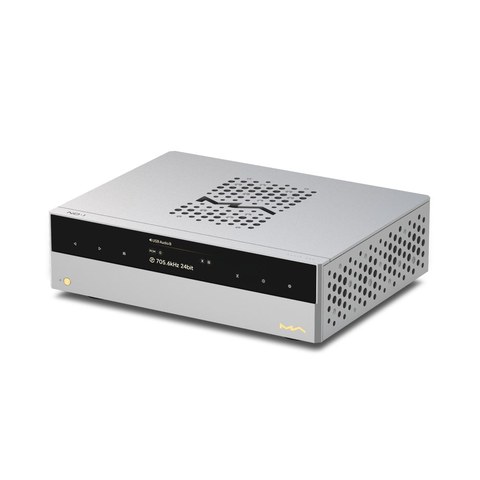
Matrix Audio’s ND-1 lands in an interesting spot in the DAC market: a standalone converter with no streaming platform, no headphone jack, and no built-in preamp, aimed at listeners who want a dedicated DAC that does one job extremely well and lets the rest of the system handle everything else. Paired with a matching NA-1 headphone amplifier, it also forms a two-box source-and-amp system for anyone who wants separates without going fully modular. Here’s a closer look at what’s inside and how it behaves.
| Quick Facts | Matrix Audio ND-1 |
|---|---|
| Type | Standalone DAC, no streamer or headphone amp |
| DAC chips | AK4191EQ modulator with dual AK4499EX |
| Max PCM / DSD | 32-bit/768kHz PCM, native DSD512 |
| Digital inputs | AES/EBU, RCA coaxial, optical, IIS-LVDS, USB |
| Output stage | Switchable direct or Lundahl transformer-coupled |
| Companion amp | Matrix Audio NA-1 headphone amplifier |
Chipset and conversion
The ND-1 uses AKM’s flagship chipset pairing: an AK4191EQ delta-sigma modulator combined with dual AK4499EX DAC chips, one dedicated to each channel’s conversion rather than splitting a single chip’s resources across both channels. That per-channel dedication is the same basic philosophy Matrix Audio applies across its higher-tier DACs, and it shows up in the measured numbers.
- Signal-to-noise ratio rated above 127dB A-weighted on the XLR outputs
- THD+N below 0.0002 percent at 1kHz
- PCM support up to 32-bit/768kHz and native DSD up to DSD512
- Custom femtosecond clock with DPLL synthesis, keeping jitter as low as 45 femtoseconds
Digital inputs and external clocking
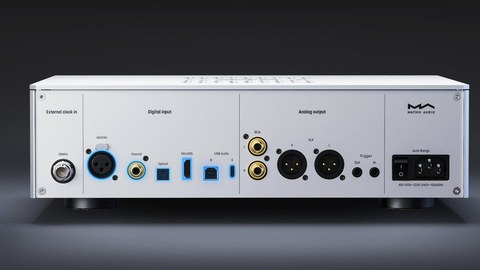
Inputs cover AES/EBU, RCA coaxial, optical Toslink, IIS-LVDS, and USB Audio, which is a comprehensive spread for a standalone DAC at this level. There is also an external clock input, letting the ND-1 sync to an outboard master clock such as Matrix Audio’s own SC-1 reference clock for listeners chasing the lowest possible jitter figures. This is very much an optional, advanced-tier upgrade path rather than something most owners will need – the internal clock is already precise enough that most systems won’t reveal an audible difference – but it’s a nice option to have available for anyone building a no-compromise digital front end.
Coupled versus direct output
One of the more distinctive features carried over from Matrix Audio’s higher-end designs is the switchable output stage: users can choose between conventional directly-coupled analog outputs or transformer-coupled output through Lundahl transformers. Direct coupling favors transparency and speed; the transformer path adds a small amount of harmonic warmth and can also provide galvanic isolation benefits in systems with grounding issues. Being able to A/B this on the fly, without needing two separate DACs, is a genuinely useful feature rather than a spec-sheet checkbox.
Build quality details
- Fully linear power supply rather than a switch-mode design, which tends to keep the noise floor lower at the cost of a bulkier, heavier chassis
- Dual-PCB internal layout separating digital and analog sections
- MA-DAMPER PRO isolation feet designed to reduce the transmission of mechanical vibration into the chassis
None of these are unique to Matrix Audio, but the combination of a linear supply, physically separated digital/analog boards, and dedicated isolation feet at this price point is a reasonable value proposition compared to some competing standalone DACs that cut corners on one of the three.
Pairing with the NA-1
Matrix Audio designed the ND-1 alongside a companion NA-1 headphone amplifier, described in the company’s own materials as a 20W Class A design. Since the ND-1 itself has no headphone output or volume control, the NA-1 (or a third-party headphone amp with its own volume stage) is a necessary companion if headphones are part of your listening plan. For speaker-based systems, the ND-1’s fixed-level output needs a preamp or an integrated amp with its own input gain control downstream.
Setup considerations
Because the ND-1 has no streaming functionality built in, you’ll need a separate transport – a computer, a network streamer, or a CD transport – feeding it over one of its digital inputs. This is by design: Matrix Audio sells dedicated streamers and streamer/DAC combos elsewhere in its lineup, and the ND-1 exists specifically for buyers who already have a transport solution and want best-in-class conversion without paying for streaming features they won’t use.
- USB input is the simplest path for most computer-based setups
- IIS-LVDS offers the lowest jitter path when paired with a compatible transport, though pinout compatibility needs to be checked between brands
- The external clock input is worth using only if you already own or plan to buy a compatible master clock – it adds no benefit on its own
Comparing it to an all-in-one alternative
It’s worth being honest about the tradeoff a DAC-only design like the ND-1 asks you to make. An all-in-one unit such as Matrix Audio’s own mini-i Pro series bundles a streamer, DAC, headphone amp, and preamp into one box for a lower total cost and a single remote to keep track of. The ND-1 asks you to already own, or plan to buy, a transport and an amplification stage separately. What you get in exchange is a DAC section that isn’t sharing board space, power supply budget, or engineering priority with three other subsystems – every design choice in the ND-1 was made purely in service of conversion quality.
Whether that tradeoff is worth it depends entirely on whether you’re the kind of listener who wants to upgrade pieces of a system independently over time, or whether you’d rather have everything bundled and simply replace the whole unit when you’re ready for the next tier.
Common Setup Problems and Fixes
- Problem: No audio output after connecting a new digital source. Fix: Confirm the ND-1 is switched to the correct input on its front panel; unlike an all-in-one unit, it won’t auto-detect which of its five digital inputs is active.
- Problem: Volume is far too loud or can’t be controlled at all. Fix: Remember the ND-1 has no volume control of its own; you need a preamp, an integrated amp with input gain control, or the companion NA-1 downstream to manage volume.
- Problem: No improvement noticed after adding an external clock. Fix: This is expected in most systems; the ND-1’s internal clock is already precise enough that an external master clock is a marginal, advanced-tier upgrade rather than a night-and-day change.
- Problem: Switching between direct and transformer-coupled output doesn’t seem to do anything audible. Fix: The difference is subtle by design; try A/B testing on a revealing track with a quiet section, since the transformer path’s added warmth and isolation benefits are easiest to hear on a system with an existing ground-loop hum.
- Problem: IIS-LVDS input doesn’t work with a transport from a different brand. Fix: Check pinout compatibility before assuming a fault; IIS-LVDS pin assignments aren’t fully standardized across manufacturers, so cross-brand pairing sometimes requires a specific adapter or cable.
FAQ
Does the ND-1 have a headphone output?
No. It’s a line-level DAC only; Matrix Audio’s companion NA-1 headphone amplifier fills that role if needed.
What DAC chips does it use?
An AK4191EQ modulator with dual AK4499EX converters, one dedicated per channel.
Can it accept an external clock?
Yes, there’s a dedicated external clock input for pairing with a reference clock such as Matrix Audio’s SC-1.
What’s the difference between direct and transformer-coupled output?
Direct coupling favors transparency and immediacy; the Lundahl transformer-coupled path adds mild warmth and can help with ground-loop isolation. Both are selectable on the same unit.
Does it include a volume control?
No, the ND-1 outputs at a fixed line level and requires a preamp or integrated amp downstream to control volume.
Coming from someone who has owned more all-in-one streamer/DAC combos than dedicated separates, the ND-1 was a useful reminder of why some people still build modular systems on purpose.